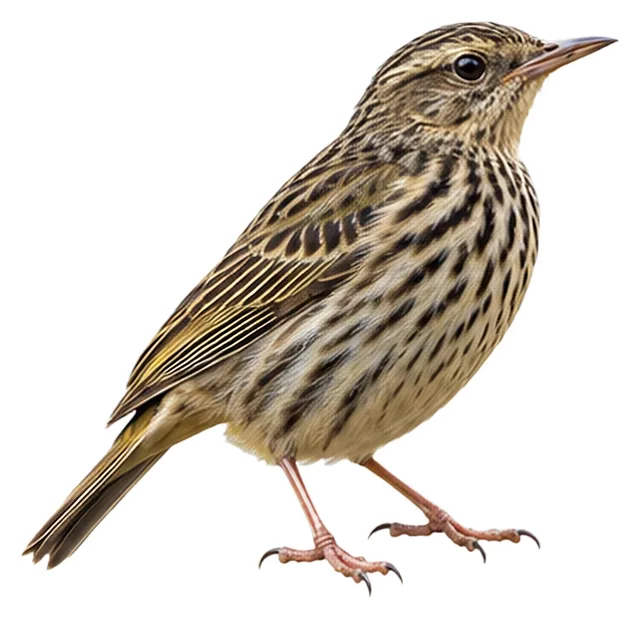
Striped Pipit
Anthus lineiventris Sundevall, 1850
17–18 cmLength35 gWeight
The striped pipit (Anthus lineiventris) is a species of bird in the family Motacillidae, which is native to Africa southwards of the equator.
Busiest months: August–September · Most records: South Africa, Zimbabwe, Malawi
Where and when it's recorded
Busiest months: August–September · Most records: South Africa, Zimbabwe, Malawi

Striped Pipit has been recorded at 58 of the 8,276 birding hotspots we track, in 9 countries and regions.
Records by month Southern Hemisphere
Where it's recorded most
- Walter Sisulu National Botanical GardenSouth Africa63 records
- Gosho ParkZimbabwe44 records
- Mutinondo WildernessZambia33 records
More places
- Phinda GR – AirfieldSouth Africa28 records
- TundavalaAngola27 records
- Dzalanyama Forest ReserveMalawi27 records
- Dzalanyama Forest Lodge areaMalawi22 records
- Manyoni GR – Zebra Hills LodgeSouth Africa22 records
- Rwakobo Rock LodgeUganda21 records
- Aberfoyle LodgeZimbabwe18 records
Countries and regions with the most records
eBird records via GBIF up to 2024-12-31. A record means someone listed it; more records partly mean more birders, not more birds.
About
The striped pipit (Anthus lineiventris) is a species of bird in the family Motacillidae, which is native to Africa southwards of the equator.
Excerpt from Wikipedia, CC BY-SA 4.0 · authors · Read more on Wikipedia
Questions
How big is the Striped Pipit?
The Striped Pipit is about 17–18 cm long and weighs around 35 g.
Where does the Striped Pipit live?
Its breeding range: Africa: Rwanda and southern Kenya to eastern South Africa; western Angola. It is most often recorded in South Africa, Zimbabwe and Malawi.
When is the best time to see the Striped Pipit?
At the hotspots we track, it is recorded most in August and September (Southern Hemisphere).
Is the Striped Pipit endangered?
The IUCN Red List classifies the Striped Pipit as Least Concern.
What does the Striped Pipit eat?
Main food: Insects & other invertebrates.
What family is the Striped Pipit in?
It belongs to the family Wagtails, Pipits (Motacillidae), order Passerines (Passeriformes).
At a glance
- Length
- 17–18 cm
- Weight
- 35 g
- Habitat
- Grassland
- Diet
- Insects & other invertebrates
- Lifestyle
- Active on the ground
- Migration
- Resident (barely migrates)
- Conservation
- Least Concern
More measurements
- Wing
- 84 mm
- Tail
- 74 mm
- Bill
- 18 mm
- Tarsus
- 28 mm
Averages from the AVONET dataset; length from field guides where available.
Range
Africa: Rwanda and southern Kenya to eastern South Africa; western Angola
Breeding range, IOC World Bird List 15.2
Classification
- Order
- Passerines Passeriformes
- Family
- Wagtails, Pipits Motacillidae
- Genus
- Anthus
Other birds in the genus Anthus
 Richard's PipitAnthus richardi
 Paddyfield PipitAnthus rufulus
 Australian PipitAnthus australis
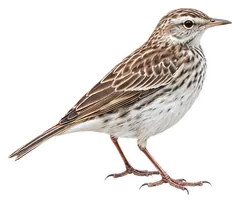 New Zealand PipitAnthus novaeseelandiae
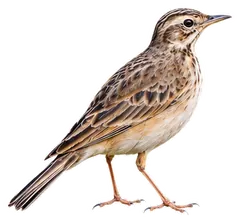 African PipitAnthus cinnamomeus
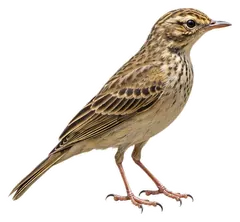 Mountain PipitAnthus hoeschi
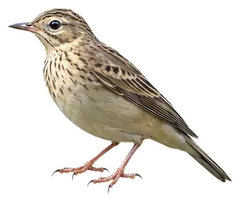 Blyth's PipitAnthus godlewskii
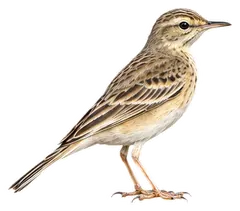 Tawny PipitAnthus campestris
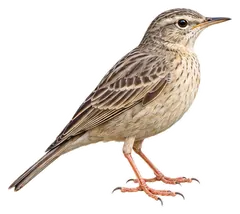 Long-billed PipitAnthus similis
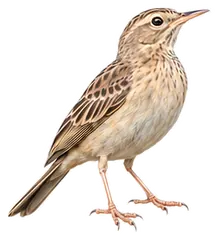 Nicholson's PipitAnthus nicholsoni
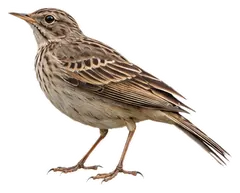 Wood PipitAnthus nyassae
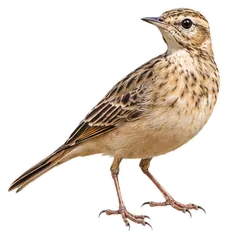 Buffy PipitAnthus vaalensis
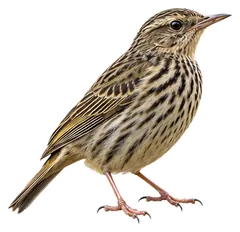
Download illustration
Free to use with credit: “Illustration: Bird Album (birdalbum.com)”. Drawn by AI from a reference photo by Kate Braun. ↗
Heard it but can't see it? Mingji identifies birds by sound and photo, on your phone.