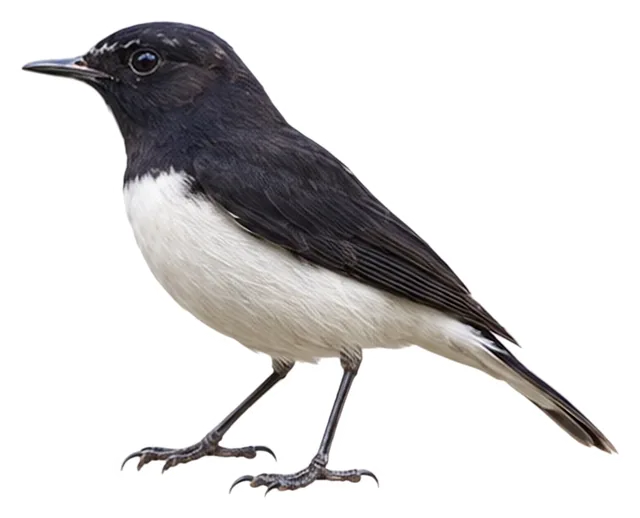
Variable Wheatear
Oenanthe picata (Blyth, 1847)
≈16 cmLength22 gWeight
This single species has three different plumage color morphs.
Busiest months: October–November · Most records: India, United Arab Emirates, Pakistan
How to identify
Field marks
- Black-bellied morph male with a white rump
- Black-bellied morph male with a black tail tip
- White-bellied morph male with a white belly
- White-crowned morph male with a white crown and nape
Male, female and young
In the female of the white-bellied morph, the black areas are replaced by gray-brown, and the belly has more of a pale yellowish-brown tinge.
Where and when it's recorded
Busiest months: October–November · Most records: India, United Arab Emirates, Pakistan

Variable Wheatear has been recorded at 44 of the 8,276 birding hotspots we track, in 10 countries and regions.
Records by month Northern Hemisphere
Where it's recorded most
- Wamm FarmsUnited Arab Emirates708 records
- Tal Chhapar SanctuaryIndia605 records
- Nalsarovar OutskirtsIndia120 records
More places
- Green MubazzarahUnited Arab Emirates101 records
- Ranthambore NPIndia61 records
- Nalsarovar Bird SanctuaryIndia57 records
- Sultanpur National ParkIndia42 records
- Kirthar National Park - Khar CenterPakistan39 records
- Manohara River - KageshwariNepal28 records
- Bharatpur – Keoladeo Ghana NPIndia28 records
Countries and regions with the most records
eBird records via GBIF up to 2024-12-31. A record means someone listed it; more records partly mean more birders, not more birds.
About
The variable wheatear (Oenanthe picata) is a species of bird in the family Muscicapidae. It is found in Afghanistan, Egypt, India, Iran, Kazakhstan, Lebanon, Nepal, Oman, Pakistan, Russia, Tajikistan, Turkmenistan, the United Arab Emirates, and Uzbekistan.
Excerpt from Wikipedia, CC BY-SA 4.0 · authors · Read more on Wikipedia
Questions
How big is the Variable Wheatear?
The Variable Wheatear is about ≈16 cm long and weighs around 22 g.
Where does the Variable Wheatear live?
Its breeding range: Palearctic: Turkmenistan, Uzbekistan and Kyrgyzstan to southern Iran and southern Pakistan. It is most often recorded in India, United Arab Emirates and Pakistan.
When is the best time to see the Variable Wheatear?
At the hotspots we track, it is recorded most in October and November (Northern Hemisphere).
Is the Variable Wheatear endangered?
The IUCN Red List classifies the Variable Wheatear as Least Concern.
What does the Variable Wheatear eat?
Main food: Insects & other invertebrates.
What family is the Variable Wheatear in?
It belongs to the family Chats, Old World Flycatchers (Muscicapidae), order Passerines (Passeriformes).
At a glance
- Length
- ≈16 cm
- Weight
- 22 g
- Habitat
- Desert
- Diet
- Insects & other invertebrates
- Lifestyle
- Perches in trees
- Migration
- Migratory
- Conservation
- Least Concern
More measurements
- Wing
- 90 mm
- Tail
- 65 mm
- Bill
- 17 mm
- Tarsus
- 24 mm
Averages from the AVONET dataset; length from field guides where available.
Range
Palearctic: Turkmenistan, Uzbekistan and Kyrgyzstan to southern Iran and southern Pakistan
Breeding range, IOC World Bird List 15.2
Classification
- Order
- Passerines Passeriformes
- Family
- Chats, Old World Flycatchers Muscicapidae
- Genus
- Oenanthe
Other birds in the genus Oenanthe
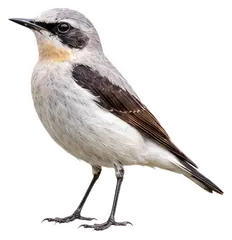 Northern WheatearOenanthe oenanthe
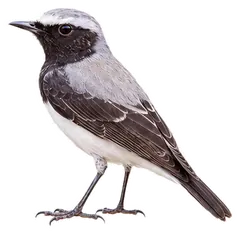 Atlas WheatearOenanthe seebohmi
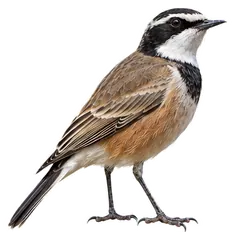 Capped WheatearOenanthe pileata
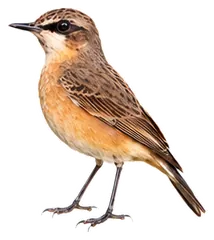 Buff-breasted WheatearOenanthe bottae
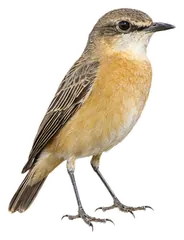 Rusty-breasted WheatearOenanthe frenata
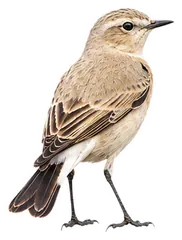 Isabelline WheatearOenanthe isabellina
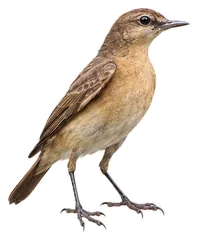 Heuglin's WheatearOenanthe heuglinii
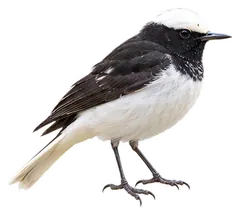 Hooded WheatearOenanthe monacha
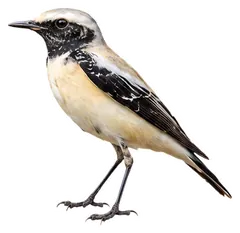 Desert WheatearOenanthe deserti
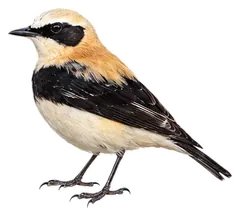 Western Black-eared WheatearOenanthe hispanica
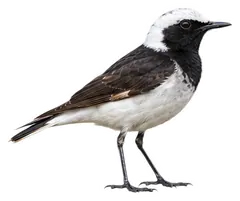 Pied WheatearOenanthe pleschanka
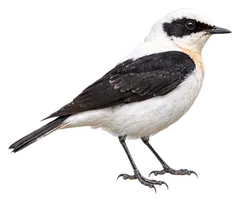 Eastern Black-eared WheatearOenanthe melanoleuca
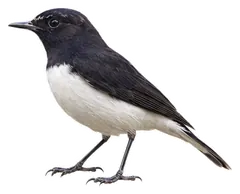
Download illustration
Free to use with credit: “Illustration: Bird Album (birdalbum.com)”. Drawn by AI from a reference photo by Avinash Bhagat. ↗
Heard it but can't see it? Mingji identifies birds by sound and photo, on your phone.