 Bird Album
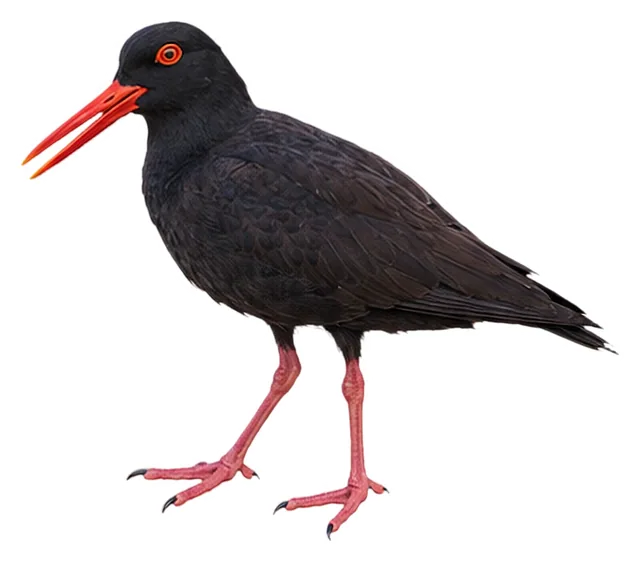
African Oystercatcher
Haematopus moquini Bonaparte, 1856
42–45 cmLength692 gWeight
The African oystercatcher or African black oystercatcher (Haematopus moquini) is a large charismatic wader resident to the mainland coasts and offshore islands of southern Africa.
Busiest months: September–November · Most records: South Africa, Namibia, Mozambique
Where and when it's recorded
Busiest months: September–November · Most records: South Africa, Namibia, Mozambique

African Oystercatcher has been recorded at 29 of the 8,276 birding hotspots we track, in 3 countries and regions.
Records by month Southern Hemisphere
Where it's recorded most
- Boulders BeachSouth Africa919 records
- Stony Point – Penguin ColonySouth Africa905 records
- Strandfontein WTPSouth Africa733 records
More places
- West Coast NPSouth Africa663 records
- West Coast NP – Seeberg hideSouth Africa503 records
- West Coast NP – Geelbek hides vicinitySouth Africa364 records
- Table Mt. NP – Cape of Good HopeSouth Africa328 records
- Table Mt. NP – Cape Point SectionSouth Africa319 records
- Rooi-ElsSouth Africa206 records
- De Hoop Nature ReserveSouth Africa189 records
Countries and regions with the most records
eBird records via GBIF up to 2024-12-31. A record means someone listed it; more records partly mean more birders, not more birds.
About
The African oystercatcher or African black oystercatcher (Haematopus moquini) is a large charismatic wader resident to the mainland coasts and offshore islands of southern Africa. This oystercatcher has a population of over 6,000 adults, which breed between November and April. The scientific name moquini commemorates the French naturalist Alfred Moquin-Tandon who discovered and named this species before Bonaparte.
Excerpt from Wikipedia, CC BY-SA 4.0 · authors · Read more on Wikipedia
Questions
How big is the African Oystercatcher?
The African Oystercatcher is about 42–45 cm long and weighs around 692 g.
Where does the African Oystercatcher live?
Its breeding range: Africa: coastal northern Namibia to Kwa-Zulu Natal (southern Africa). It is most often recorded in South Africa, Namibia and Mozambique.
When is the best time to see the African Oystercatcher?
At the hotspots we track, it is recorded most in September, October and November (Southern Hemisphere).
Is the African Oystercatcher endangered?
The IUCN Red List classifies the African Oystercatcher as Least Concern.
What does the African Oystercatcher eat?
Main food: Fish, shrimp & shellfish.
What family is the African Oystercatcher in?
It belongs to the family Oystercatchers (Haematopodidae), order Charadriiformes.
At a glance
- Length
- 42–45 cm
- Weight
- 692 g
- Habitat
- Coast & tidal flats
- Diet
- Fish, shrimp & shellfish
- Lifestyle
- Active on the ground
- Migration
- Resident (barely migrates)
- Conservation
- Least Concern
More measurements
- Wing
- 267 mm
- Tail
- 107 mm
- Bill
- 77 mm
- Tarsus
- 50 mm
Averages from the AVONET dataset; length from field guides where available.
Range
Africa: coastal northern Namibia to Kwa-Zulu Natal (southern Africa)
Breeding range, IOC World Bird List 15.2
Classification
- Order
- Charadriiformes
- Family
- Oystercatchers Haematopodidae
- Genus
- Haematopus
Other birds in the genus Haematopus
 Magellanic OystercatcherHaematopus leucopodus
 Blackish OystercatcherHaematopus ater
 Black OystercatcherHaematopus bachmani
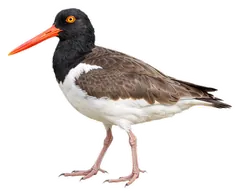 American OystercatcherHaematopus palliatus
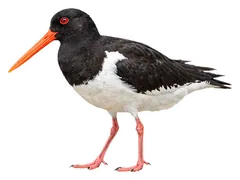 Eurasian OystercatcherHaematopus ostralegus
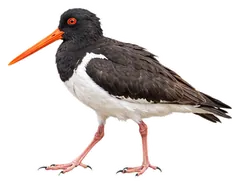 South Island OystercatcherHaematopus finschi
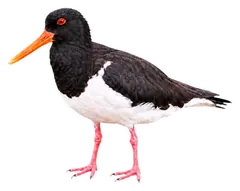 Pied OystercatcherHaematopus longirostris
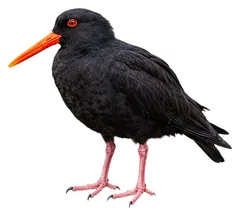 Variable OystercatcherHaematopus unicolor
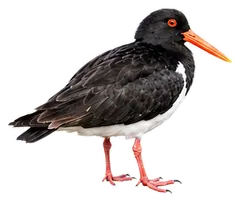 Chatham Islands OystercatcherHaematopus chathamensis
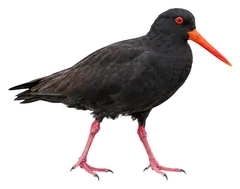 Sooty OystercatcherHaematopus fuliginosus
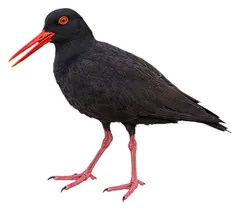
Download illustration
Free to use with credit: “Illustration: Bird Album (birdalbum.com)”. Drawn by AI from a reference photo by mary-hunter. ↗
Heard it but can't see it? Mingji identifies birds by sound and photo, on your phone.
In other languages
- EnglishAfrican Oystercatcher
- 简体中文非洲黑蛎鹬
- 繁體中文非洲蠣鴴
- 日本語アフリカクロミヤコドリ
- DeutschKapausternfischer
- FrançaisHuîtrier de Moquin
- EspañolOstrero negro africano
- Portuguêsostraceiro-preto-africano
- ItalianoBeccaccia di mare africana
- NederlandsAfrikaanse Zwarte Scholekster
- РусскийАфриканский кулик-сорока
- Svenskakapstrandskata
- DanskAfrikansk Strandskade
- Polskiostrygojad afrykański