 Bird Album
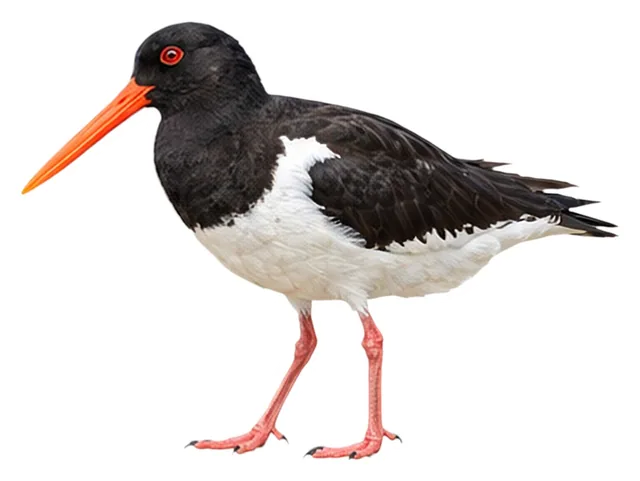
Eurasian Oystercatcher
Haematopus ostralegus Linnaeus, 1758
40–45 cmLength82 cmWingspan526 gWeight
It is a noisy, boldly black-and-white wader with a long, straight orange-red bill and red eyes.
Busiest months: April–May · Most records: United Kingdom, Spain, Ireland
How to identify
Field marks
- Black-and-white feathers
- Bill long, straight and orange-red
- Eyes red; legs dark pink and rather short
- White patches on wings and tail in flight; back black, belly white
Male, female and young
Sexes similar in plumage; female has a slightly longer bill. Juvenile is rufous-tinged, with a white collar and a darker bill.
Voice
A loud, distinctive, thin, high-pitched piping call.
Where and when it's recorded

Eurasian Oystercatcher has been recorded at 1,112 of the 8,171 birding hotspots we track, in 87 countries and regions.
Records by month Northern Hemisphere
Where it's recorded most
- Titchwell Marsh RSPB ReserveUnited Kingdom7,452 records
- Minsmere RSPB ReserveUnited Kingdom3,705 records
- Spurn Bird Observatory Recording AreaUnited Kingdom3,342 records
More places
- Teesside South GareUnited Kingdom2,982 records
- Cley & Salthouse Marshes NWT NR – Cley Marshes including Hides and Visitor CentreUnited Kingdom2,425 records
- North ForelandUnited Kingdom2,296 records
- Seaforth LWT NRUnited Kingdom2,074 records
- Frampton Marsh RSPB ReserveUnited Kingdom2,058 records
- GirdlenessUnited Kingdom2,041 records
- Snettisham RSPB ReserveUnited Kingdom1,906 records
Countries and regions with the most records
eBird records via GBIF up to 2024-12-31. A record means someone listed it; more records partly mean more birders, not more birds.
About
The Eurasian oystercatcher or European oystercatcher (Haematopus ostralegus), also known as the common pied oystercatcher, or (in Europe) just oystercatcher, is a wader in the oystercatcher bird family Haematopodidae. The sexes are similar in appearance but the bill of the female is longer than that of the male.
Excerpt from Wikipedia, CC BY-SA 4.0 · authors · Read more on Wikipedia
Questions
How big is the Eurasian Oystercatcher?
The Eurasian Oystercatcher is about 40–45 cm long, with a wingspan of 82 cm and weighs around 526 g.
Where does the Eurasian Oystercatcher live?
Its breeding range: Palearctic: northwestern, southwestern, central Palearctic; far northeastern Palearctic. It is most often recorded in United Kingdom, Spain and Ireland.
When is the best time to see the Eurasian Oystercatcher?
At the hotspots we track, it is recorded most in April and May (Northern Hemisphere).
Is the Eurasian Oystercatcher endangered?
The IUCN Red List classifies the Eurasian Oystercatcher as Near Threatened.
What does the Eurasian Oystercatcher eat?
Main food: Fish, shrimp & shellfish.
What family is the Eurasian Oystercatcher in?
It belongs to the family Oystercatchers (Haematopodidae), order Charadriiformes.
At a glance
- Length
- 40–45 cm
- Wingspan
- 82 cm
- Weight
- 526 g
- Habitat
- Coast & tidal flats
- Diet
- Fish, shrimp & shellfish
- Lifestyle
- Active on the ground
- Migration
- Resident (barely migrates)
- Conservation
- Near Threatened
More measurements
- Wing
- 250 mm
- Tail
- 106 mm
- Bill
- 76 mm
- Tarsus
- 50 mm
Averages from the AVONET dataset; length from field guides where available.
Range
Palearctic: northwestern, southwestern, central Palearctic; far northeastern Palearctic
Breeding range, IOC World Bird List 15.2
Subspecies · 2
- Haematopus ostralegus buturlini w Kazakhstan to nw Xinjiang (nw China) | non-breeding: to sw Asia and India
- Haematopus ostralegus osculans coastal Kamchatka, Sea of Okhotsk (se Russia), coastal and inland n Korean Pen., ne China and Kinmen I. (off Fujian Province, e China) | non-breeding: to e China
Classification
- Order
- Charadriiformes
- Family
- Oystercatchers Haematopodidae
- Genus
- Haematopus
Other birds in the genus Haematopus
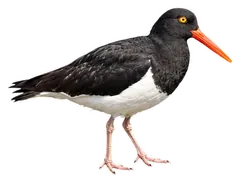 Magellanic OystercatcherHaematopus leucopodus
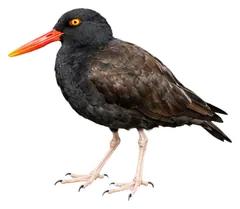 Blackish OystercatcherHaematopus ater
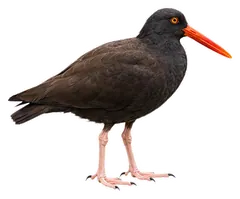 Black OystercatcherHaematopus bachmani
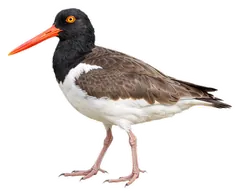 American OystercatcherHaematopus palliatus
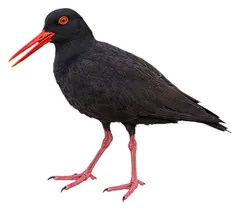 African OystercatcherHaematopus moquini
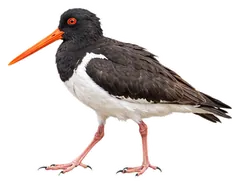 South Island OystercatcherHaematopus finschi
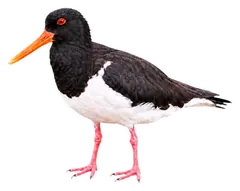 Pied OystercatcherHaematopus longirostris
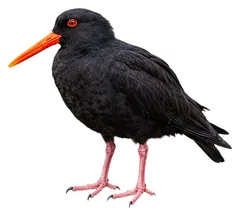 Variable OystercatcherHaematopus unicolor
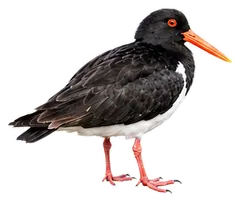 Chatham Islands OystercatcherHaematopus chathamensis
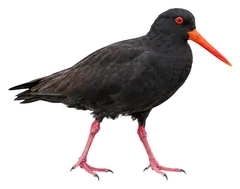 Sooty OystercatcherHaematopus fuliginosus
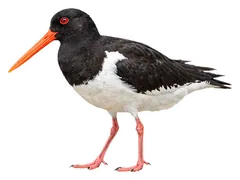
Download illustration
Free to use with credit: “Illustration: Bird Album (birdalbum.com)”. Drawn by AI from a reference photo by Andreas Trepte. ↗

Heard it but can't see it? Mingji identifies birds by sound and photo, on your phone.