 Bird Album
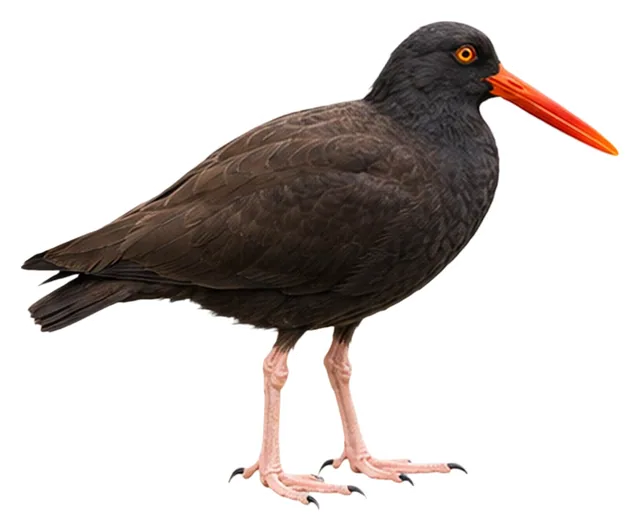
Black Oystercatcher
Haematopus bachmani Audubon, 1838
582 gWeight
The black oystercatcher (Haematopus bachmani) is a conspicuous black bird found on the shoreline of western North America, ranging from the Aleutian Islands of Alaska to the coast of the Baja California peninsula.
Busiest months: September and November · Most records: United States, Canada, Mexico
Where and when it's recorded
Busiest months: September and November · Most records: United States, Canada, Mexico

Black Oystercatcher has been recorded at 68 of the 8,276 birding hotspots we track, in 3 countries and regions.
Records by month Northern Hemisphere
Where it's recorded most
- Southeast Farallon IslandUnited States16,412 records
- Pt. Pinos – seawatch onlyUnited States11,901 records
- Pillar Point HarborUnited States5,917 records
More places
- Heron's Head ParkUnited States5,676 records
- Tsawwassen Ferry Terminal JettyCanada5,449 records
- Clover PointCanada4,794 records
- Rocky Point Bird ObservatoryCanada4,747 records
- Pt. PinosUnited States4,495 records
- Esquimalt LagoonCanada4,036 records
- Oak Bay – Cattle PointCanada3,249 records
Countries and regions with the most records
eBird records via GBIF up to 2024-12-31. A record means someone listed it; more records partly mean more birders, not more birds.
About
The black oystercatcher (Haematopus bachmani) is a conspicuous black bird found on the shoreline of western North America, ranging from the Aleutian Islands of Alaska to the coast of the Baja California peninsula.
Excerpt from Wikipedia, CC BY-SA 4.0 · authors · Read more on Wikipedia
Questions
How big is the Black Oystercatcher?
The Black Oystercatcher weighs around 582 g.
Where does the Black Oystercatcher live?
Its breeding range: North America, Middle America: coastal eastern North Pacific from western Aleutian Islands to west-central Baja California (northwestern Mexico). It is most often recorded in United States, Canada and Mexico.
When is the best time to see the Black Oystercatcher?
At the hotspots we track, it is recorded most in September and November (Northern Hemisphere).
What does the Black Oystercatcher eat?
Main food: Fish, shrimp & shellfish.
What family is the Black Oystercatcher in?
It belongs to the family Oystercatchers (Haematopodidae), order Charadriiformes.
At a glance
- Weight
- 582 g
- Habitat
- Coast & tidal flats
- Diet
- Fish, shrimp & shellfish
- Lifestyle
- Active on the ground
- Migration
- Resident (barely migrates)
More measurements
- Wing
- 247 mm
- Tail
- 99 mm
- Bill
- 78 mm
- Tarsus
- 50 mm
Averages from the AVONET dataset; length from field guides where available.
Range
North America, Middle America: coastal eastern North Pacific from western Aleutian Islands to west-central Baja California (northwestern Mexico)
Breeding range, IOC World Bird List 15.2
Classification
- Order
- Charadriiformes
- Family
- Oystercatchers Haematopodidae
- Genus
- Haematopus
Other birds in the genus Haematopus
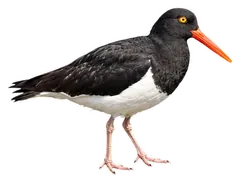 Magellanic OystercatcherHaematopus leucopodus
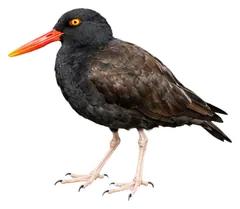 Blackish OystercatcherHaematopus ater
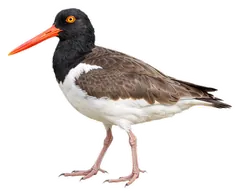 American OystercatcherHaematopus palliatus
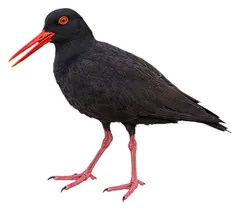 African OystercatcherHaematopus moquini
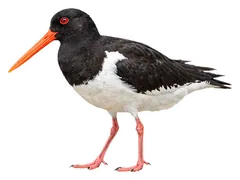 Eurasian OystercatcherHaematopus ostralegus
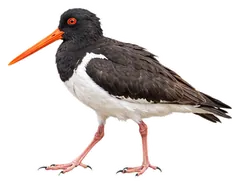 South Island OystercatcherHaematopus finschi
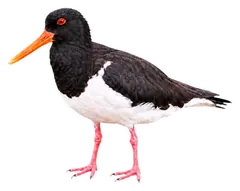 Pied OystercatcherHaematopus longirostris
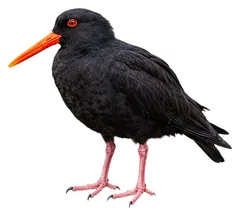 Variable OystercatcherHaematopus unicolor
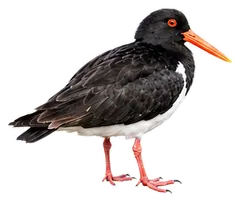 Chatham Islands OystercatcherHaematopus chathamensis
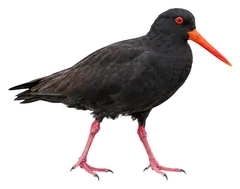 Sooty OystercatcherHaematopus fuliginosus
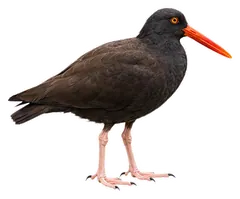
Download illustration
Free to use with credit: “Illustration: Bird Album (birdalbum.com)”. Drawn by AI from a reference photo by Mike Baird. ↗
Heard it but can't see it? Mingji identifies birds by sound and photo, on your phone.
In other languages
- EnglishBlack Oystercatcher
- 简体中文北美黑蛎鹬
- 繁體中文黑蠣鴴
- 日本語クロミヤコドリ
- DeutschKlippenausternfischer
- FrançaisHuîtrier de Bachman
- EspañolOstrero Negro Norteamericano
- Portuguêspirupiru-preto-norte-americano
- ItalianoBeccaccia di mare nera
- NederlandsNoord-Amerikaanse Zwarte Scholekster
- РусскийЧёрный кулик-сорока
- Svenskaklippstrandskata
- DanskAmerikansk Sort Strandskade
- Polskiostrygojad czarny