 Bird Album
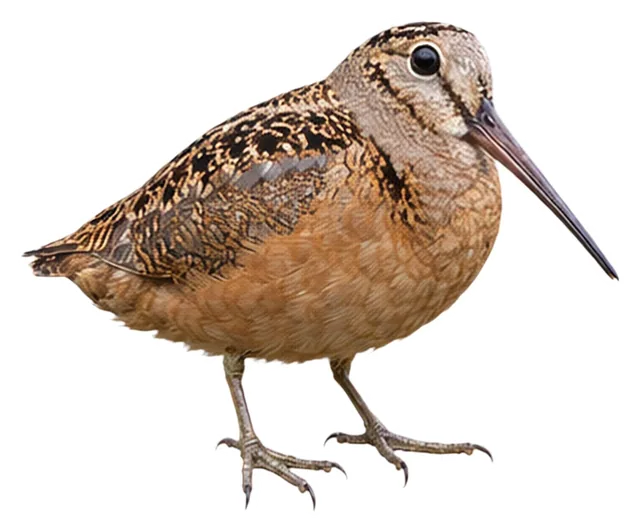
American Woodcock
Scolopax minor Gmelin, JF, 1789
196 gWeight
The American woodcock (Scolopax minor), sometimes colloquially referred to as the timberdoodle, mudbat, becasse, bogsucker, brush snipe, night partridge, or Labrador twister is a small shorebird species found primarily in the eastern half of North America.
Busiest months: May · Most records: United States, Canada, Bermuda
Where and when it's recorded

American Woodcock has been recorded at 452 of the 8,171 birding hotspots we track, in 3 countries and regions.
Records by month Northern Hemisphere
Where it's recorded most
- Magee Marsh – BoardwalkUnited States9,534 records
- Point Pelee National ParkCanada2,632 records
- Long Point – LPBO Old Cut Field StationCanada1,607 records
More places
- Magee MarshUnited States1,405 records
- Rondeau Provincial ParkCanada1,268 records
- Parker River NWRUnited States1,237 records
- Tommy Thompson ParkCanada1,175 records
- Green-Wood Cemetery, BrooklynUnited States1,157 records
- Cape Island – South Cape May MeadowsUnited States799 records
- Schlitz Audubon Nature CenterUnited States708 records
Countries and regions with the most records
eBird records via GBIF up to 2024-12-31. A record means someone listed it; more records partly mean more birders, not more birds.
About
The American woodcock (Scolopax minor), sometimes colloquially referred to as the timberdoodle, mudbat, becasse, bogsucker, brush snipe, night partridge, or Labrador twister is a small shorebird species found primarily in the eastern half of North America. Woodcocks spend most of their time on the ground in brushy, young-forest habitats, where the birds' brown, black, and gray plumage provides excellent camouflage.
Excerpt from Wikipedia, CC BY-SA 4.0 · authors · Read more on Wikipedia
Questions
How big is the American Woodcock?
The American Woodcock weighs around 196 g.
Where does the American Woodcock live?
Its breeding range: North America: temperate eastern Nearctic forest and edge: southwestern Alberta east to Maritime Provinces (south-central to southeastern Canada) and south to southeastern Texas and northern Florida (eastern USA). It is most often recorded in United States, Canada and Bermuda.
When is the best time to see the American Woodcock?
At the hotspots we track, it is recorded most in May (Northern Hemisphere).
Is the American Woodcock endangered?
The IUCN Red List classifies the American Woodcock as Least Concern.
What does the American Woodcock eat?
Main food: Insects & other invertebrates.
What family is the American Woodcock in?
It belongs to the family Sandpipers, Snipes (Scolopacidae), order Charadriiformes.
At a glance
- Weight
- 196 g
- Habitat
- Forest
- Diet
- Insects & other invertebrates
- Lifestyle
- Active on the ground
- Migration
- Migratory
- Conservation
- Least Concern
More measurements
- Wing
- 130 mm
- Tail
- 63 mm
- Bill
- 72 mm
- Tarsus
- 31 mm
Averages from the AVONET dataset; length from field guides where available.
Range
North America: temperate eastern Nearctic forest and edge: southwestern Alberta east to Maritime Provinces (south-central to southeastern Canada) and south to southeastern Texas and northern Florida (eastern USA)
Breeding range, IOC World Bird List 15.2
Classification
- Order
- Charadriiformes
- Family
- Sandpipers, Snipes Scolopacidae
- Genus
- Scolopax
Other birds in the genus Scolopax
 Eurasian WoodcockScolopax rusticola
 Amami WoodcockScolopax mira
 Bukidnon WoodcockScolopax bukidnonensis
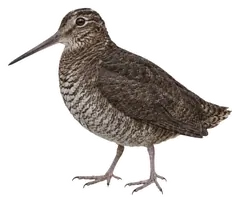 Javan WoodcockScolopax saturata
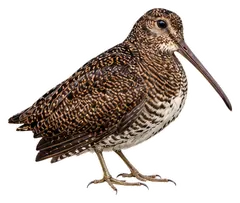 New Guinea WoodcockScolopax rosenbergii
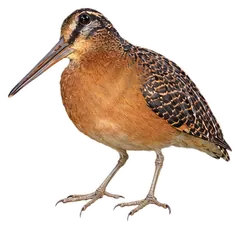 Sulawesi WoodcockScolopax celebensis
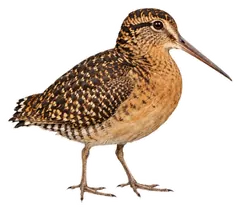 Moluccan WoodcockScolopax rochussenii
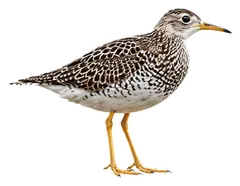 Upland SandpiperBartramia longicauda
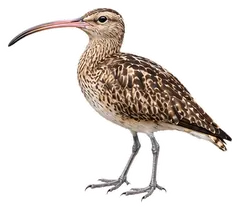 Bristle-thighed CurlewNumenius tahitiensis
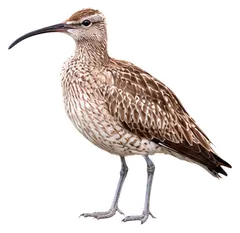 Eurasian WhimbrelNumenius phaeopus
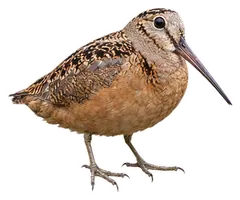
Download illustration
Free to use with credit: “Illustration: Bird Album (birdalbum.com)”. Drawn by AI from a reference photo by Matt Brady. ↗
Heard it but can't see it? Mingji identifies birds by sound and photo, on your phone.
In other languages
- EnglishAmerican Woodcock
- 简体中文小丘鹬
- 繁體中文小丘鷸
- 日本語アメリカヤマシギ
- DeutschKanadaschnepfe
- FrançaisBécasse d’Amérique
- EspañolChocha americana
- Portuguêsgalinhola-americana
- ItalianoBeccaccia americana
- NederlandsAmerikaanse Houtsnip
- РусскийАмериканский вальдшнеп
- Svenskaamerikansk morkulla
- DanskAmerikansk Skovsneppe
- Polskisłonka amerykańska