 Bird Album
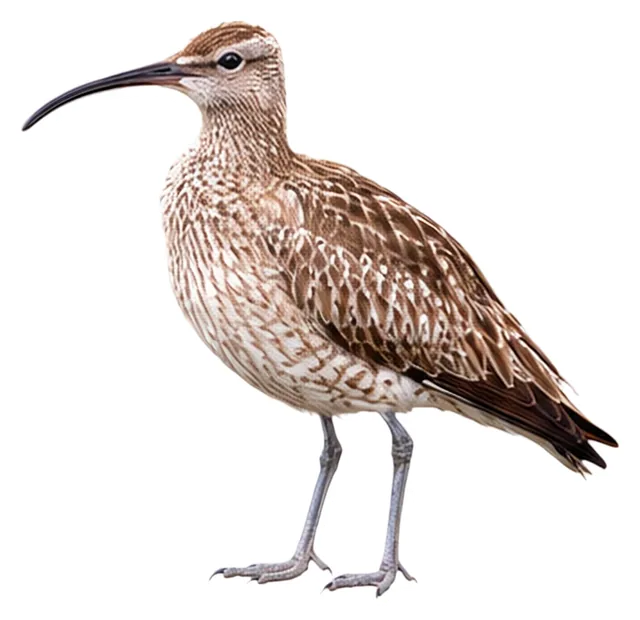
Eurasian Whimbrel
Numenius phaeopus (Linnaeus, 1758)
37–47 cmLength107 cmWingspan365 gWeight
This gray-rufous wader has a long, decurved bill and a stripe down the center of its crown.
Busiest months: April–May and August–September · Most records: United States, Chile, Spain
How to identify
Field marks
- Bill long and decurved, with a kink
- Central crown stripe; distinct supercilium
- Body feathers mainly gray-rufous
- Only some subspecies have a white back and rump
Voice
Usual call is an undulating whistle, drawn out into a trill in song.
Where and when it's recorded
Busiest months: April–May and August–September · Most records: United States, Chile, Spain

Eurasian Whimbrel has been recorded at 2,809 of the 8,276 birding hotspots we track, in 196 countries and regions.
Records by month Northern Hemisphere
Where it's recorded most
- Southeast Farallon IslandUnited States14,264 records
- San Diego River mudflatsUnited States8,299 records
- Malibu Lagoon – State Beach including LagoonUnited States6,468 records
More places
- Pt. Pinos – seawatch onlyUnited States5,782 records
- Heron's Head ParkUnited States5,706 records
- Bolsa Chica Ecological ReserveUnited States5,704 records
- Edwin B. Forsythe NWRUnited States5,686 records
- Cairns EsplanadeAustralia5,490 records
- Txingudi – PlaiaundiSpain5,083 records
- Tárcoles – Tour en BoteCosta Rica4,119 records
Countries and regions with the most records
eBird records via GBIF up to 2024-12-31. A record means someone listed it; more records partly mean more birders, not more birds.
About
The Eurasian whimbrel (Numenius phaeopus), historically known as the white-rumped whimbrel in North America, is a wader in the large family Scolopacidae. It is one of the most widespread of the curlews, breeding across much of subarctic Palearctic region and Europe as far south as Scotland. This species and the Hudsonian whimbrel were split in 2019, although some taxonomic authorities still consider them to be conspecific.
Excerpt from Wikipedia, CC BY-SA 4.0 · authors · Read more on Wikipedia
Questions
How big is the Eurasian Whimbrel?
The Eurasian Whimbrel is about 37–47 cm long, with a wingspan of 107 cm and weighs around 365 g.
Where does the Eurasian Whimbrel live?
Its breeding range: Palearctic: patchily in subarctic tundra of Palearctic: northeastern Greenland and northern Scotland through subarctic Russia to Chukotskiy Peninsula (northeastern Russia). It is most often recorded in United States, Chile and Spain.
When is the best time to see the Eurasian Whimbrel?
At the hotspots we track, it is recorded most in April, May, August and September (Northern Hemisphere).
Is the Eurasian Whimbrel endangered?
The IUCN Red List classifies the Eurasian Whimbrel as Least Concern.
What does the Eurasian Whimbrel eat?
Main food: Omnivore.
What family is the Eurasian Whimbrel in?
It belongs to the family Sandpipers, Snipes (Scolopacidae), order Charadriiformes.
At a glance
- Length
- 37–47 cm
- Wingspan
- 107 cm
- Weight
- 365 g
- Habitat
- Grassland
- Diet
- Omnivore
- Lifestyle
- Active on the ground
- Migration
- Migratory
- Conservation
- Least Concern
More measurements
- Wing
- 233 mm
- Tail
- 100 mm
- Bill
- 92 mm
- Tarsus
- 60 mm
Averages from the AVONET dataset; length from field guides where available.
Range
Palearctic: patchily in subarctic tundra of Palearctic: northeastern Greenland and northern Scotland through subarctic Russia to Chukotskiy Peninsula (northeastern Russia)
Breeding range, IOC World Bird List 15.2
Classification
- Order
- Charadriiformes
- Family
- Sandpipers, Snipes Scolopacidae
- Genus
- Numenius
Other birds in the genus Numenius
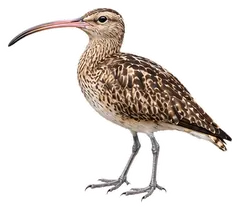 Bristle-thighed CurlewNumenius tahitiensis
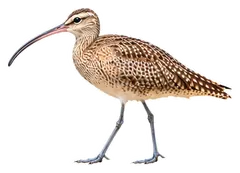 Hudsonian WhimbrelNumenius hudsonicus
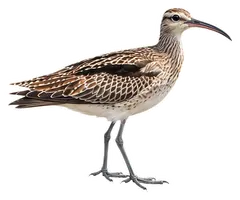 Little CurlewNumenius minutus
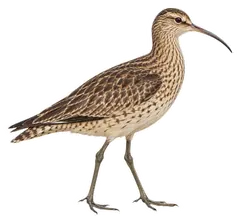 Eskimo CurlewNumenius borealis
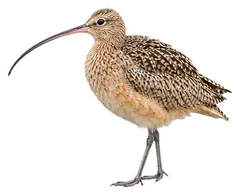 Long-billed CurlewNumenius americanus
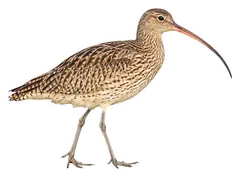 Far Eastern CurlewNumenius madagascariensis
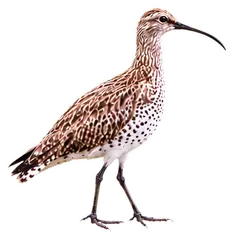 Slender-billed CurlewNumenius tenuirostris
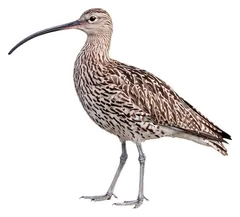 Eurasian CurlewNumenius arquata
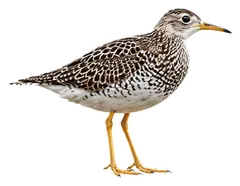 Upland SandpiperBartramia longicauda
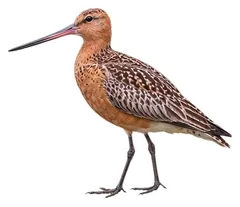 Bar-tailed GodwitLimosa lapponica
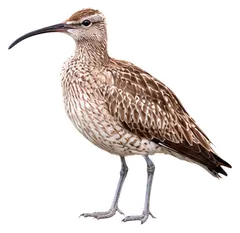
Download illustration
Free to use with credit: “Illustration: Bird Album (birdalbum.com)”. Drawn by AI from a reference photo by Andreas Trepte. ↗

Heard it but can't see it? Mingji identifies birds by sound and photo, on your phone.