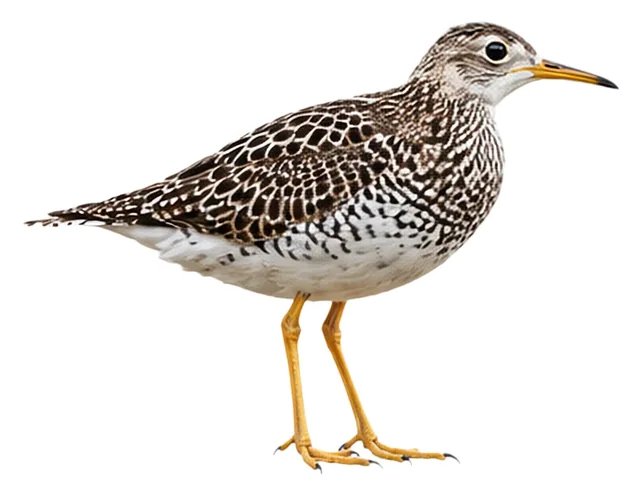
Upland Sandpiper
Bartramia longicauda (Bechstein, 1812)
159 gWeight
The upland sandpiper (Bartramia longicauda) is a large sandpiper, closely related to the curlews.
Busiest months: April · Most records: United States, Canada, Argentina
Where and when it's recorded
Busiest months: April · Most records: United States, Canada, Argentina

Upland Sandpiper has been recorded at 597 of the 8,276 birding hotspots we track, in 44 countries and regions.
Records by month Northern Hemisphere
Where it's recorded most
- Muskegon Wastewater SystemUnited States1,827 records
- Hagerman NWRUnited States1,503 records
- Carden Alvar – Wylie RoadCanada1,437 records
More places
- Hornsby BendUnited States1,106 records
- Carden AlvarCanada1,097 records
- King Ranch – Norias DivisionUnited States576 records
- Dallas Southside WTPUnited States477 records
- Cheyenne Bottoms WAUnited States450 records
- Village Creek Drying Beds (PPW-W 083) – ACCESS CLOSED July 2025United States404 records
- Jocelyn Nungaray NWR (Anahuac)United States306 records
Countries and regions with the most records
eBird records via GBIF up to 2024-12-31. A record means someone listed it; more records partly mean more birders, not more birds.
About
The upland sandpiper (Bartramia longicauda) is a large sandpiper, closely related to the curlews. Older names are the upland plover and Bartram's sandpiper. In Louisiana, it is also colloquially known as the papabotte.
Excerpt from Wikipedia, CC BY-SA 4.0 · authors · Read more on Wikipedia
Questions
How big is the Upland Sandpiper?
The Upland Sandpiper weighs around 159 g.
Where does the Upland Sandpiper live?
Its breeding range: North America: inland grassland of subarctic to northern temperate Neotropics: north to southeastern Alaska and northwestern Canada, east to southeastern Canada and New England, in south to eastern Oregon, northeastern Oklahoma and in southeast to Pennsylvania (east-central USA). It is most often recorded in United States, Canada and Argentina.
When is the best time to see the Upland Sandpiper?
At the hotspots we track, it is recorded most in April (Northern Hemisphere).
Is the Upland Sandpiper endangered?
The IUCN Red List classifies the Upland Sandpiper as Least Concern.
What does the Upland Sandpiper eat?
Main food: Insects & other invertebrates.
What family is the Upland Sandpiper in?
It belongs to the family Sandpipers, Snipes (Scolopacidae), order Charadriiformes.
At a glance
- Weight
- 159 g
- Habitat
- Grassland
- Diet
- Insects & other invertebrates
- Lifestyle
- Active on the ground
- Migration
- Migratory
- Conservation
- Least Concern
More measurements
- Wing
- 159 mm
- Tail
- 79 mm
- Bill
- 33 mm
- Tarsus
- 49 mm
Averages from the AVONET dataset; length from field guides where available.
Range
North America: inland grassland of subarctic to northern temperate Neotropics: north to southeastern Alaska and northwestern Canada, east to southeastern Canada and New England, in south to eastern Oregon, northeastern Oklahoma and in southeast to Pennsylvania (east-central USA)
Breeding range, IOC World Bird List 15.2
Classification
- Order
- Charadriiformes
- Family
- Sandpipers, Snipes Scolopacidae
- Genus
- Bartramia
More from the family Sandpipers, Snipes
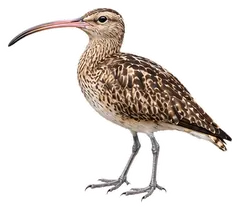 Bristle-thighed CurlewNumenius tahitiensis
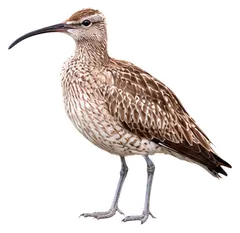 Eurasian WhimbrelNumenius phaeopus
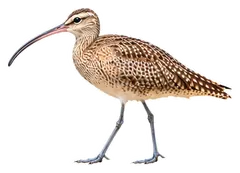 Hudsonian WhimbrelNumenius hudsonicus
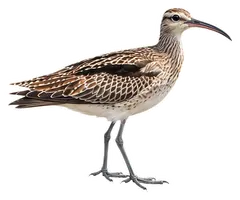 Little CurlewNumenius minutus
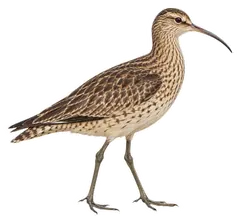 Eskimo CurlewNumenius borealis
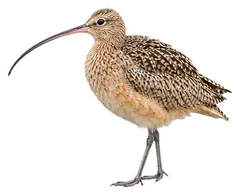 Long-billed CurlewNumenius americanus
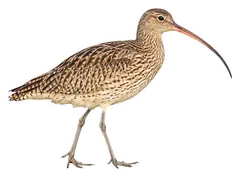 Far Eastern CurlewNumenius madagascariensis
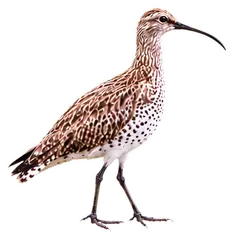 Slender-billed CurlewNumenius tenuirostris
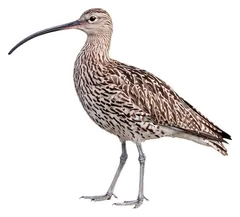 Eurasian CurlewNumenius arquata
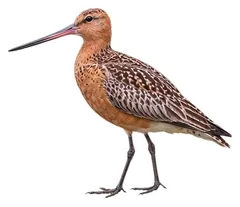 Bar-tailed GodwitLimosa lapponica
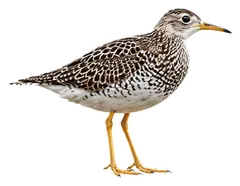
Download illustration
Free to use with credit: “Illustration: Bird Album (birdalbum.com)”. Drawn by AI from a reference photo by Markus Lilje. ↗
Heard it but can't see it? Mingji identifies birds by sound and photo, on your phone.