 Bird Album
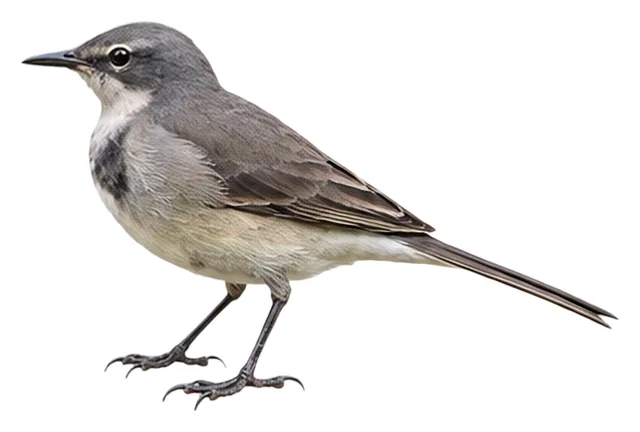
Cape Wagtail
Motacilla capensis Linnaeus, 1766
21 gWeight
The Cape wagtail (Motacilla capensis), also known as Wells's wagtail, is a small insectivorous bird which is widespread in southern Africa.
Busiest months: September–November · Most records: South Africa, Namibia, Uganda
Where and when it's recorded

Cape Wagtail has been recorded at 257 of the 8,171 birding hotspots we track, in 14 countries and regions.
Records by month Southern Hemisphere
Where it's recorded most
- Strandfontein WTPSouth Africa2,250 records
- Stony Point – Penguin ColonySouth Africa1,088 records
- Boulders BeachSouth Africa1,017 records
More places
- Marievale Bird SanctuarySouth Africa919 records
- West Coast NPSouth Africa781 records
- West Coast NP – Geelbek hides vicinitySouth Africa716 records
- Rietvlei NRSouth Africa691 records
- Avis DamNamibia642 records
- Harold Porter Botanical GardensSouth Africa614 records
- Rondevlei NRSouth Africa613 records
Countries and regions with the most records
eBird records via GBIF up to 2024-12-31. A record means someone listed it; more records partly mean more birders, not more birds.
About
The Cape wagtail (Motacilla capensis), also known as Wells's wagtail, is a small insectivorous bird which is widespread in southern Africa. It frequents water's edge, lawns and gardens. It is a mostly resident, territorial species, but has been known to undertake limited altitudinal migration or form flocks outside of the breeding season.
Excerpt from Wikipedia, CC BY-SA 4.0 · authors · Read more on Wikipedia
Questions
How big is the Cape Wagtail?
The Cape Wagtail weighs around 21 g.
Where does the Cape Wagtail live?
Its breeding range: Africa: south-central, southern. It is most often recorded in South Africa, Namibia and Uganda.
When is the best time to see the Cape Wagtail?
At the hotspots we track, it is recorded most in September, October and November (Southern Hemisphere).
Is the Cape Wagtail endangered?
The IUCN Red List classifies the Cape Wagtail as Least Concern.
What does the Cape Wagtail eat?
Main food: Insects & other invertebrates.
What family is the Cape Wagtail in?
It belongs to the family Wagtails, Pipits (Motacillidae), order Passerines (Passeriformes).
At a glance
- Weight
- 21 g
- Habitat
- Wetland
- Diet
- Insects & other invertebrates
- Lifestyle
- Active on the ground
- Migration
- Partial migrant
- Conservation
- Least Concern
More measurements
- Wing
- 82 mm
- Tail
- 86 mm
- Bill
- 17 mm
- Tarsus
- 23 mm
Averages from the AVONET dataset; length from field guides where available.
Range
Africa: south-central, southern
Breeding range, IOC World Bird List 15.2
Classification
- Order
- Passerines Passeriformes
- Family
- Wagtails, Pipits Motacillidae
- Genus
- Motacilla
Other birds in the genus Motacilla
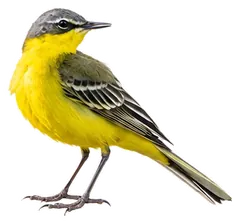 Western Yellow WagtailMotacilla flava
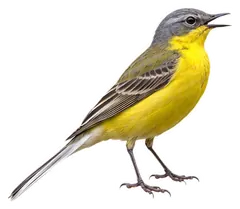 Eastern Yellow WagtailMotacilla tschutschensis
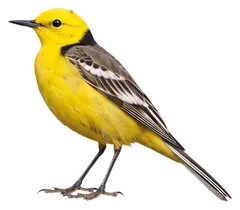 Citrine WagtailMotacilla citreola
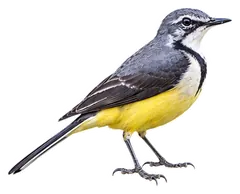 Madagascar WagtailMotacilla flaviventris
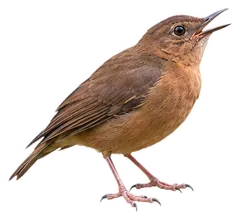 Sao Tome ShorttailMotacilla bocagii
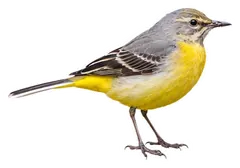 Grey WagtailMotacilla cinerea
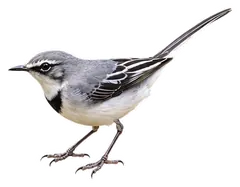 Mountain WagtailMotacilla clara
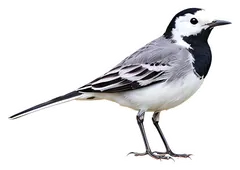 White WagtailMotacilla alba
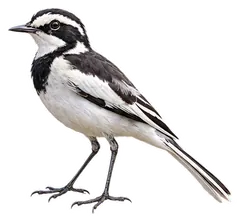 African Pied WagtailMotacilla aguimp
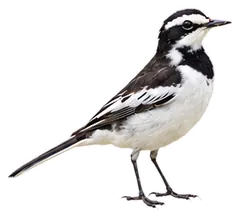 Mekong WagtailMotacilla samveasnae
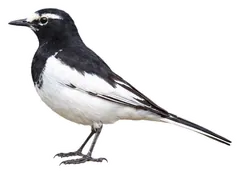 Japanese WagtailMotacilla grandis
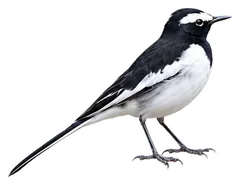 White-browed WagtailMotacilla maderaspatensis
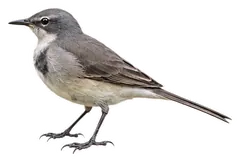
Download illustration
Free to use with credit: “Illustration: Bird Album (birdalbum.com)”. Drawn by AI from a reference photo by Ray Turnbull. ↗
Heard it but can't see it? Mingji identifies birds by sound and photo, on your phone.