 Bird Album
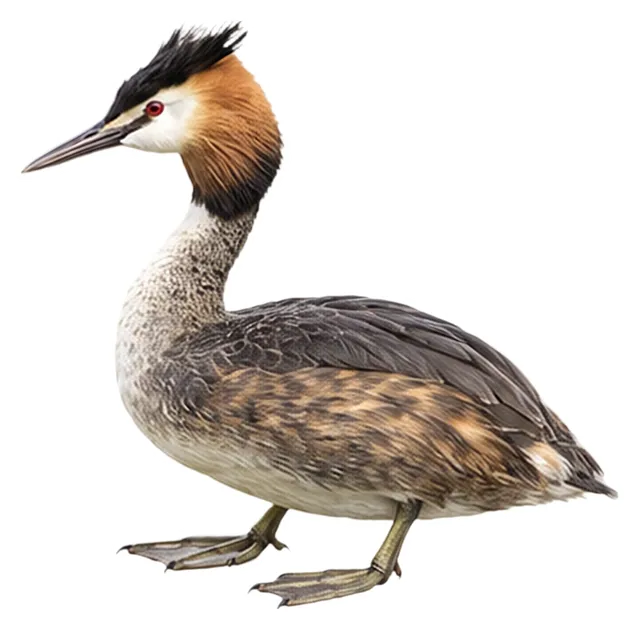
Great Crested Grebe
Podiceps cristatus (Linnaeus, 1758)
50 cmLength88 cmWingspan731 gWeight
The largest grebe in the Old World, it swims and dives well and has ornamental feathers on the head and neck in summer.
Busiest months: April–May · Most records: United Kingdom, Spain, Australia
How to identify
Field marks
- Ornamental feathers on head and neck in summer
- Plumage patterned in black, orange-brown and white
- White above eye and pink bill in winter plumage
- Underparts whitish, upperparts gray-brown
Male, female and young
Sexes differ little; chicks have black-and-white stripes on the head, which disappear in their first winter.
Voice
Loud barking “rah-rah-rah”, also clicking “kek” notes and low growls.
Where and when it's recorded

Great Crested Grebe has been recorded at 2,142 of the 8,171 birding hotspots we track, in 85 countries and regions.
Records by month Northern Hemisphere
Where it's recorded most
- Amwell HMWT NRUnited Kingdom8,182 records
- Walthamstow WetlandsUnited Kingdom3,964 records
- Rutland WaterUnited Kingdom3,563 records
More places
- Attenborough Nature Centre and NWT NRUnited Kingdom3,371 records
- Titchwell Marsh RSPB ReserveUnited Kingdom3,274 records
- Western Treatment PlantAustralia3,082 records
- Elton ReservoirUnited Kingdom2,979 records
- Herdsman LakeAustralia2,952 records
- WWT London Wetland CentreUnited Kingdom2,872 records
- Brent ReservoirUnited Kingdom2,557 records
Countries and regions with the most records
eBird records via GBIF up to 2024-12-31. A record means someone listed it; more records partly mean more birders, not more birds.
Questions
How big is the Great Crested Grebe?
The Great Crested Grebe is about 50 cm long, with a wingspan of 88 cm and weighs around 731 g.
Where does the Great Crested Grebe live?
Its breeding range: Palearctic, Africa, Oriental, Australasia: temperate Eurasia, locally northwestern India, to northeastern Russia, northeastern China and north-central Japan; northeastern, eastern, southern Africa; Australia and South Island (New Zealand). It is most often recorded in United Kingdom, Spain and Australia.
When is the best time to see the Great Crested Grebe?
At the hotspots we track, it is recorded most in April and May (Northern Hemisphere).
Is the Great Crested Grebe endangered?
The IUCN Red List classifies the Great Crested Grebe as Least Concern.
What does the Great Crested Grebe eat?
Main food: Fish, shrimp & shellfish.
What family is the Great Crested Grebe in?
It belongs to the family Grebes (Podicipedidae), order Podicipediformes.
At a glance
- Length
- 50 cm
- Wingspan
- 88 cm
- Weight
- 731 g
- Habitat
- Wetland
- Diet
- Fish, shrimp & shellfish
- Lifestyle
- On the water surface
- Migration
- Resident (barely migrates)
- Conservation
- Least Concern
More measurements
- Wing
- 184 mm
- Tail
- 41 mm
- Bill
- 58 mm
- Tarsus
- 61 mm
Averages from the AVONET dataset; length from field guides where available.
Range
Palearctic, Africa, Oriental, Australasia: temperate Eurasia, locally northwestern India, to northeastern Russia, northeastern China and north-central Japan; northeastern, eastern, southern Africa; Australia and South Island (New Zealand)
Breeding range, IOC World Bird List 15.2
Subspecies · 1
- Podiceps cristatus cristatus Eurasia from nw Europe, s Scandinavia to s Spain through s Russia and n, wc Mongolia, and n Afghanistan, locally in nw India, to ne Russia, n Honshu (nc Japan) and ne China | non-breeding: to coasts of Baltic, Black, and Mediterranean seas, Persian Gulf, n Indian subcontinent to e China and s Japan
Classification
- Order
- Podicipediformes
- Family
- Grebes Podicipedidae
- Genus
- Podiceps
Other birds in the genus Podiceps
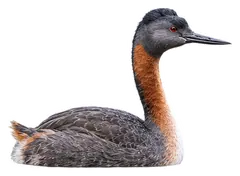 Great GrebePodiceps major
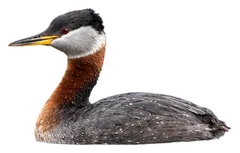 Red-necked GrebePodiceps grisegena
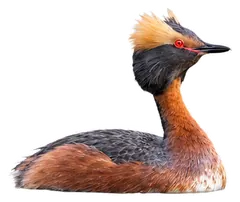 Horned GrebePodiceps auritus
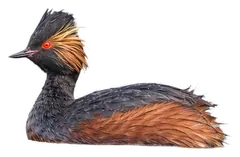 Black-necked GrebePodiceps nigricollis
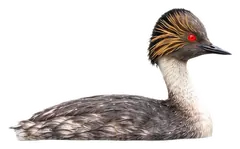 Silvery GrebePodiceps occipitalis
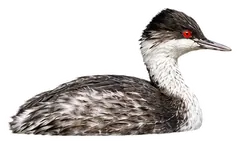 Junin GrebePodiceps taczanowskii
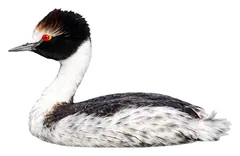 Hooded GrebePodiceps gallardoi
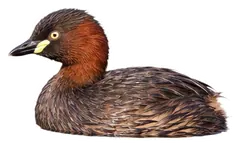 Little GrebeTachybaptus ruficollis
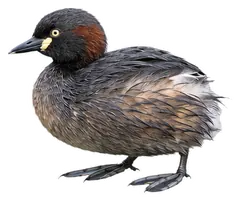 Australasian GrebeTachybaptus novaehollandiae
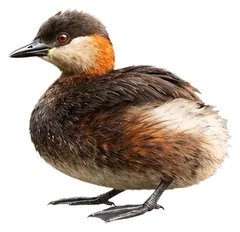 Madagascar GrebeTachybaptus pelzelnii
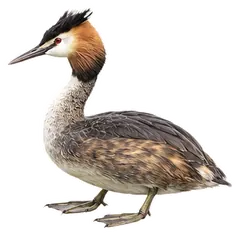
Download illustration
Free to use with credit: “Illustration: Bird Album (birdalbum.com)”. Drawn by AI from a reference photo by caroline legg. ↗
Heard it but can't see it? Mingji identifies birds by sound and photo, on your phone.