 Bird Album
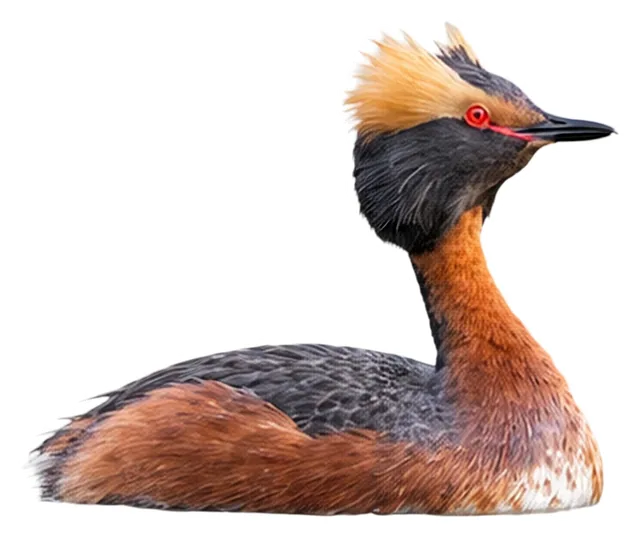
Horned Grebe
Podiceps auritus (Linnaeus, 1758)
31–38 cmLength62 cmWingspan453 gWeight
In the breeding season this grebe develops yellow “horn” feathers behind the eyes that can be raised and lowered.
Busiest months: April · Most records: United States, Canada, Iceland
Looks like Black-necked Grebe
How to identify
Field marks
- In breeding plumage, has “horns” behind the eyes that can be raised
- In breeding plumage, has a chestnut-rufous neck and upper breast, with a black crown and back
- Winter plumage sharply black-and-white, without “horns”
- Straight, pointed bill with a white tip
Male, female and young
The male is slightly larger and brighter, but the sexes are usually indistinguishable; juveniles resemble adults in winter plumage, with slightly duller white and a brown tinge to the back.
Voice
A loud, nasal “aaarrh”, descending in pitch and ending in a trill.
Similar species
Where and when it's recorded

Horned Grebe has been recorded at 1,221 of the 8,171 birding hotspots we track, in 58 countries and regions.
Records by month Northern Hemisphere
To protect this bird from disturbance, we don't list exact sites.
Countries and regions with the most records
eBird records via GBIF up to 2024-12-31. A record means someone listed it; more records partly mean more birders, not more birds.
About
The horned grebe or Slavonian grebe (Podiceps auritus) is a relatively small and threatened species of waterbird in the family Podicipedidae. There are two subspecies, P. a. auritus (Slavonian grebe), which breeds in Eurasia, and P. a. cornutus (horned grebe), which breeds in North America. The Eurasian subspecies is distributed over most of northern Europe and northern Asia, breeding from Iceland east to the Russian Far East.
Excerpt from Wikipedia, CC BY-SA 4.0 · authors · Read more on Wikipedia
Questions
How big is the Horned Grebe?
The Horned Grebe is about 31–38 cm long, with a wingspan of 62 cm and weighs around 453 g.
Where does the Horned Grebe live?
Its breeding range: North America, Palearctic: Iceland, Scandinavia to eastern Russia; southern, central Alaska, western, central Canada and northern tier of western, central contiguous USA states. It is most often recorded in United States, Canada and Iceland.
When is the best time to see the Horned Grebe?
At the hotspots we track, it is recorded most in April (Northern Hemisphere).
Is the Horned Grebe endangered?
The IUCN Red List classifies the Horned Grebe as Vulnerable.
What does the Horned Grebe eat?
Main food: Fish, shrimp & shellfish.
What family is the Horned Grebe in?
It belongs to the family Grebes (Podicipedidae), order Podicipediformes.
At a glance
- Length
- 31–38 cm
- Wingspan
- 62 cm
- Weight
- 453 g
- Habitat
- Wetland
- Diet
- Fish, shrimp & shellfish
- Lifestyle
- On the water surface
- Migration
- Migratory
- Conservation
- Vulnerable
More measurements
- Wing
- 138 mm
- Tail
- 33 mm
- Bill
- 30 mm
- Tarsus
- 43 mm
Averages from the AVONET dataset; length from field guides where available.
Range
North America, Palearctic: Iceland, Scandinavia to eastern Russia; southern, central Alaska, western, central Canada and northern tier of western, central contiguous USA states
Breeding range, IOC World Bird List 15.2
Classification
- Order
- Podicipediformes
- Family
- Grebes Podicipedidae
- Genus
- Podiceps
Other birds in the genus Podiceps
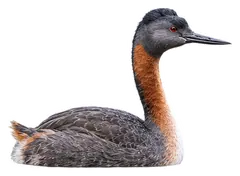 Great GrebePodiceps major
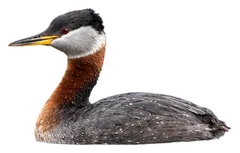 Red-necked GrebePodiceps grisegena
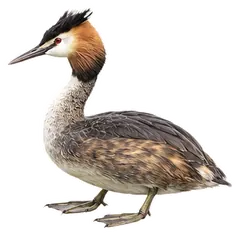 Great Crested GrebePodiceps cristatus
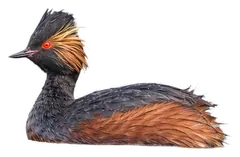 Black-necked GrebePodiceps nigricollis
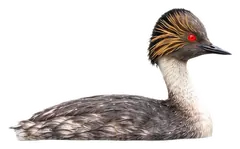 Silvery GrebePodiceps occipitalis
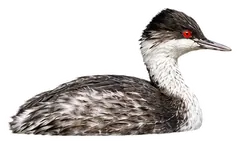 Junin GrebePodiceps taczanowskii
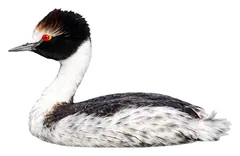 Hooded GrebePodiceps gallardoi
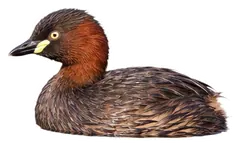 Little GrebeTachybaptus ruficollis
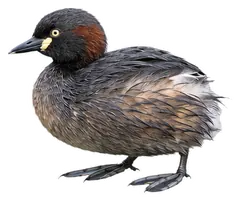 Australasian GrebeTachybaptus novaehollandiae
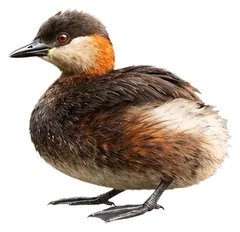 Madagascar GrebeTachybaptus pelzelnii
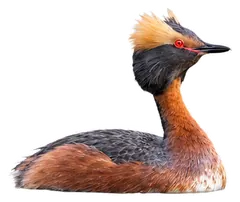
Download illustration
Free to use with credit: “Illustration: Bird Album (birdalbum.com)”. Drawn by AI from a reference photo by egorbirder. ↗
Heard it but can't see it? Mingji identifies birds by sound and photo, on your phone.