 Bird Album
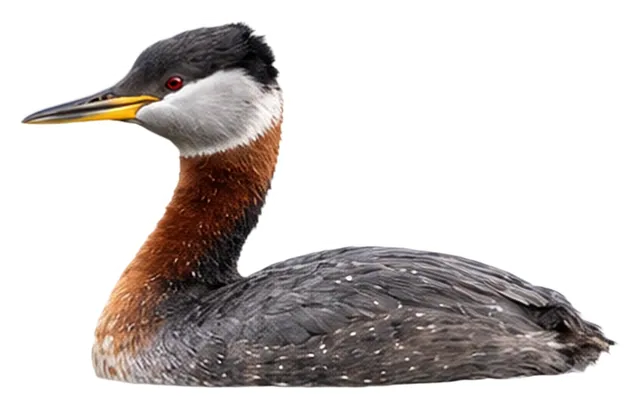
Red-necked Grebe
Podiceps grisegena (Boddaert, 1783)
40–50 cmLength72 cmWingspan1 kgWeight
It has a rusty neck and black cap in the breeding season, becoming dull gray in winter.
Busiest months: April and October · Most records: Canada, United States, United Kingdom
Looks like Horned Grebe, Great Crested Grebe
How to identify
Field marks
- Black cap extends below eye in breeding plumage
- Neck rusty in breeding plumage
- Cheeks and throat very pale gray in breeding plumage
- Bill black, long and pointed, with yellow base
Male, female and young
Sexes similar, but males are heavier on average; juveniles have a striped face, a pale black cap, a pale red neck and more yellow on the bill.
Voice
In the breeding season, it gives a drawn-out wailing “uooooh”, either alone or in a male–female duet.
Similar species
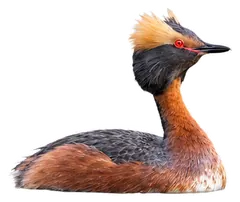
In winter plumage, Horned Grebe is smaller, with a proportionately smaller bill and a white face; this species has a gray face.
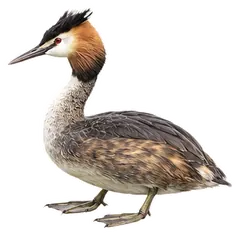
In winter plumage, Great Crested Grebe is similar in size, but has a longer neck, a more contrasting head pattern and always has white above the eye.
Where and when it's recorded
Busiest months: April and October · Most records: Canada, United States, United Kingdom

Red-necked Grebe has been recorded at 967 of the 8,276 birding hotspots we track, in 59 countries and regions.
Records by month Northern Hemisphere
Where it's recorded most
- Toronto – Colonel Samuel Smith ParkCanada16,814 records
- Whitefish PointUnited States5,373 records
- Edmonds WaterfrontUnited States4,647 records
More places
- Tommy Thompson ParkCanada4,120 records
- Discovery ParkUnited States3,505 records
- Point No PointUnited States3,401 records
- Toronto – Humber Bay ParkCanada2,642 records
- Parker River NWRUnited States2,516 records
- Teslin Lake – Teslin Lake Bird ObservatoryCanada2,416 records
- Gardiner BeachUnited States2,298 records
Countries and regions with the most records
eBird records via GBIF up to 2024-12-31. A record means someone listed it; more records partly mean more birders, not more birds.
About
The red-necked grebe (Podiceps grisegena) is an aquatic bird found in the temperate regions of the northern hemisphere. A migratory bird, its wintering habitat is largely restricted to calm waters just beyond the waves around ocean coasts, although some birds may winter on large lakes. Grebes prefer shallow bodies of fresh water such as lakes, marshes or fish-ponds as breeding sites.
Excerpt from Wikipedia, CC BY-SA 4.0 · authors · Read more on Wikipedia
Questions
How big is the Red-necked Grebe?
The Red-necked Grebe is about 40–50 cm long, with a wingspan of 72 cm and weighs around 1 kg.
Where does the Red-necked Grebe live?
Its breeding range: North America, Palearctic: central, eastern Europe and Turkey to temperate west-central Russia and Kazakhstan; subarctic central, eastern Siberia to Kamchatka, Alaska and Canada to southwestern Quebec. It is most often recorded in Canada, United States and United Kingdom.
When is the best time to see the Red-necked Grebe?
At the hotspots we track, it is recorded most in April and October (Northern Hemisphere).
Is the Red-necked Grebe endangered?
The IUCN Red List classifies the Red-necked Grebe as Least Concern.
What does the Red-necked Grebe eat?
Main food: Fish, shrimp & shellfish.
What family is the Red-necked Grebe in?
It belongs to the family Grebes (Podicipedidae), order Podicipediformes.
At a glance
- Length
- 40–50 cm
- Wingspan
- 72 cm
- Weight
- 1 kg
- Habitat
- Wetland
- Diet
- Fish, shrimp & shellfish
- Lifestyle
- On the water surface
- Migration
- Migratory
- Conservation
- Least Concern
More measurements
- Wing
- 167 mm
- Tail
- 32 mm
- Bill
- 48 mm
- Tarsus
- 54 mm
Averages from the AVONET dataset; length from field guides where available.
Range
North America, Palearctic: central, eastern Europe and Turkey to temperate west-central Russia and Kazakhstan; subarctic central, eastern Siberia to Kamchatka, Alaska and Canada to southwestern Quebec
Breeding range, IOC World Bird List 15.2
Subspecies · 1
- Podiceps grisegena holbollii subarctic c, e Siberia to Kamchatka, Hokkaido (rare) and subarctic Alaska and Canada to sw Quebec | non-breeding: to coasts of Sakhalin, Kuril and Commander is. (se Russia), Japan, Korean Pen., and e China; Aleutian Is. to c California; se Canada to New England
Classification
- Order
- Podicipediformes
- Family
- Grebes Podicipedidae
- Genus
- Podiceps
Other birds in the genus Podiceps
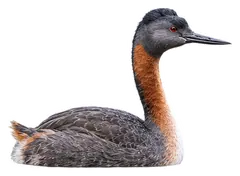 Great GrebePodiceps majorGreat Crested GrebePodiceps cristatusHorned GrebePodiceps auritus
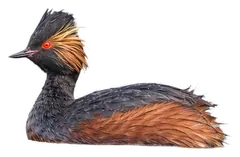 Black-necked GrebePodiceps nigricollis
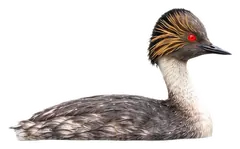 Silvery GrebePodiceps occipitalis
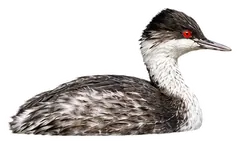 Junin GrebePodiceps taczanowskii
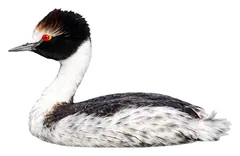 Hooded GrebePodiceps gallardoi
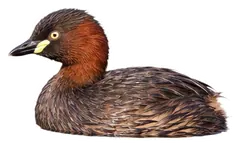 Little GrebeTachybaptus ruficollis
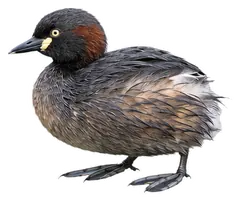 Australasian GrebeTachybaptus novaehollandiae
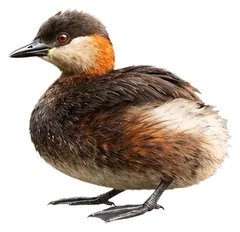 Madagascar GrebeTachybaptus pelzelnii
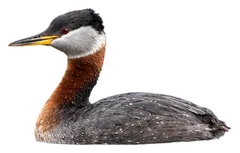
Download illustration
Free to use with credit: “Illustration: Bird Album (birdalbum.com)”. Drawn by AI from a reference photo by mbrookem. ↗
Heard it but can't see it? Mingji identifies birds by sound and photo, on your phone.
In other languages
- EnglishRed-necked Grebe
- 简体中文赤颈䴙䴘
- 繁體中文赤頸鸊鷈
- 日本語アカエリカイツブリ
- 한국어큰논병아리
- DeutschRothalstaucher
- FrançaisGrèbe jougris
- EspañolSomormujo cuellirrojo
- Portuguêsmergulhão-de-faces-brancas
- ItalianoSvasso collorosso
- NederlandsRoodhalsfuut
- РусскийСерощёкая поганка
- Svenskagråhakedopping
- DanskGråstrubet Lappedykker
- Polskiperkoz rdzawoszyi