 Bird Album
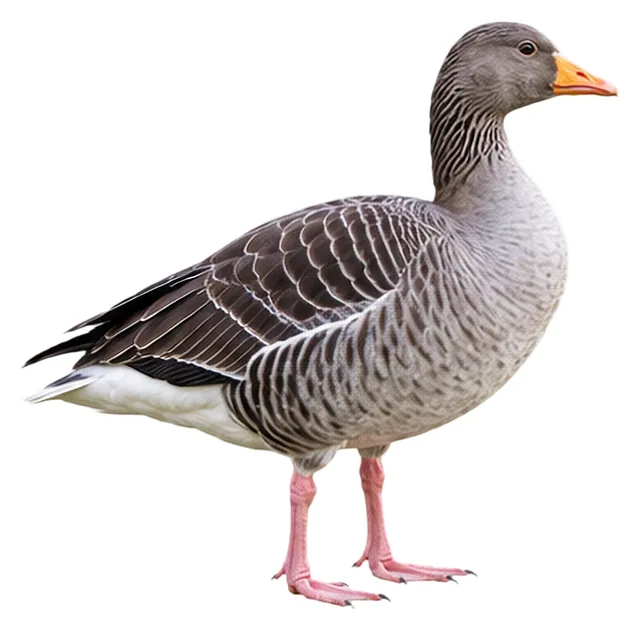
Greylag Goose
Anser anser (Linnaeus, 1758)
77–80 cmLength155 cmWingspan3.3 kgWeight
This large gray-brown goose stands out for its lack of distinctive features and is identified by its pink bill, legs and feet.
Busiest months: April–May · Most records: United Kingdom, Spain, Germany
Looks like Taiga Bean Goose, Swan Goose, Greater White-fronted Goose
How to identify
Field marks
- Large gray-brown goose with no outstanding features
- Bill orange-yellow or pink, legs and feet pink
- Forewing and rump pale gray, conspicuous in flight
Male, female and young
Both sexes gray-brown throughout the year; juvenile lacks black spots on the breast and belly and has grayish legs and feet.
Voice
Loud call, like a domestic goose’s “aahng-ung-ung”, given both on the ground and in flight.
Similar species
Where and when it's recorded

Greylag Goose has been recorded at 1,906 of the 8,171 birding hotspots we track, in 100 countries and regions.
Records by month Northern Hemisphere
Where it's recorded most
- Titchwell Marsh RSPB ReserveUnited Kingdom6,751 records
- Amwell HMWT NRUnited Kingdom6,505 records
- Minsmere RSPB ReserveUnited Kingdom4,902 records
More places
- Cley & Salthouse Marshes NWT NR – Cley Marshes including Hides and Visitor CentreUnited Kingdom3,699 records
- KaldbakstjarnirIceland3,668 records
- Walthamstow WetlandsUnited Kingdom3,597 records
- WWT Slimbridge Wetland CentreUnited Kingdom3,561 records
- Frampton Marsh RSPB ReserveUnited Kingdom3,558 records
- Rutland WaterUnited Kingdom3,339 records
- El Oso – Laguna y entornoSpain3,200 records
Countries and regions with the most records
eBird records via GBIF up to 2024-12-31. A record means someone listed it; more records partly mean more birders, not more birds.
About
The greylag goose (Anser anser) is a species of large goose in the waterfowl family Anatidae and the type species of the genus Anser. Its distribution is widespread, with birds from the north of its range in Europe and Asia often migrating southwards to spend the winter in warmer places, although many populations are resident, even in the north.
Excerpt from Wikipedia, CC BY-SA 4.0 · authors · Read more on Wikipedia
Questions
How big is the Greylag Goose?
The Greylag Goose is about 77–80 cm long, with a wingspan of 155 cm and weighs around 3.3 kg.
Where does the Greylag Goose live?
Its breeding range: Palearctic: central, western. It is most often recorded in United Kingdom, Spain and Germany.
When is the best time to see the Greylag Goose?
At the hotspots we track, it is recorded most in April and May (Northern Hemisphere).
Is the Greylag Goose endangered?
The IUCN Red List classifies the Greylag Goose as Least Concern.
What does the Greylag Goose eat?
Main food: Land plants.
What family is the Greylag Goose in?
It belongs to the family Ducks, Geese, Swans (Anatidae), order Anseriformes.
At a glance
- Length
- 77–80 cm
- Wingspan
- 155 cm
- Weight
- 3.3 kg
- Habitat
- Wetland
- Diet
- Land plants
- Lifestyle
- Active on the ground
- Migration
- Migratory
- Conservation
- Least Concern
More measurements
- Wing
- 436 mm
- Tail
- 136 mm
- Bill
- 61 mm
- Tarsus
- 76 mm
Averages from the AVONET dataset; length from field guides where available.
Range
Palearctic: central, western
Breeding range, IOC World Bird List 15.2
Subspecies · 1
- Anser anser rubrirostris ec Europe to China | non-breeding: Asia Minor and s Asia
Classification
- Order
- Anseriformes
- Family
- Ducks, Geese, Swans Anatidae
- Genus
- Anser
Other birds in the genus Anser
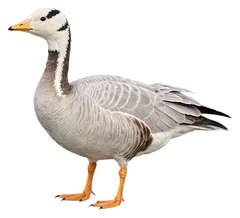 Bar-headed GooseAnser indicus
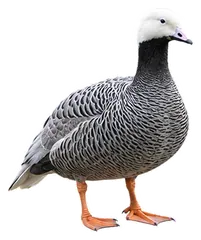 Emperor GooseAnser canagicus
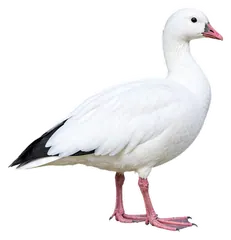 Ross's GooseAnser rossii
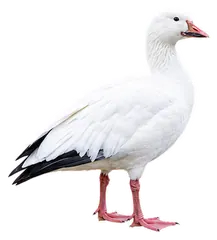 Snow GooseAnser caerulescens
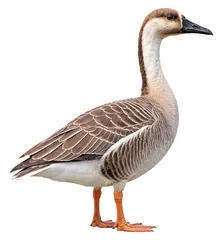 Swan GooseAnser cygnoides
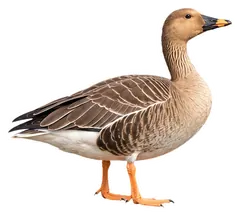 Taiga Bean GooseAnser fabalis
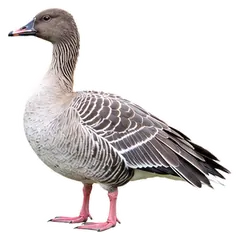 Pink-footed GooseAnser brachyrhynchus
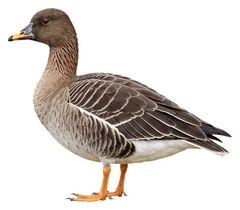 Tundra Bean GooseAnser serrirostris
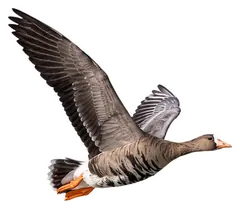 Greater White-fronted GooseAnser albifrons
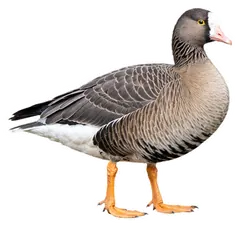 Lesser White-fronted GooseAnser erythropus
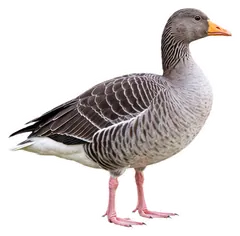
Download illustration
Free to use with credit: “Illustration: Bird Album (birdalbum.com)”. Drawn by AI from a reference photo by Diliff. ↗

Heard it but can't see it? Mingji identifies birds by sound and photo, on your phone.