 Bird Album
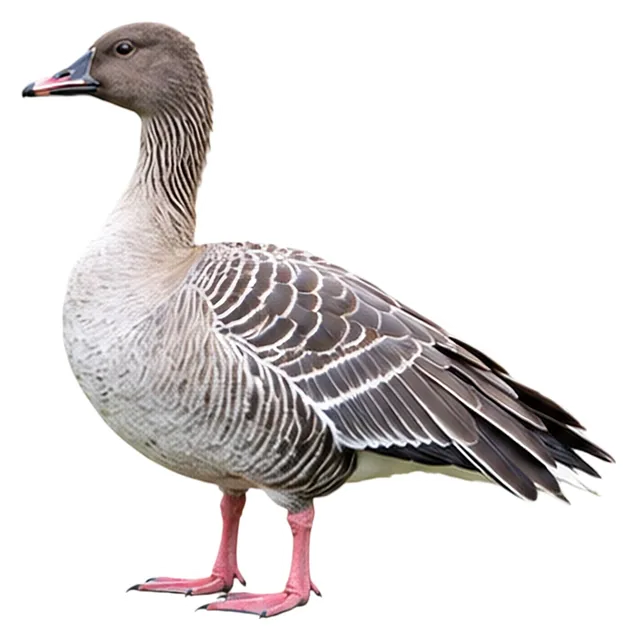
Pink-footed Goose
Anser brachyrhynchus Baillon, 1834
2.6 kgWeight
The pink-footed goose (Anser brachyrhynchus) is a goose which breeds in eastern Greenland, Iceland, Svalbard, and recently Novaya Zemlya.
Busiest months: October · Most records: United Kingdom, Iceland, Norway
Where and when it's recorded
Busiest months: October · Most records: United Kingdom, Iceland, Norway

Pink-footed Goose has been recorded at 427 of the 8,276 birding hotspots we track, in 31 countries and regions.
Records by month Northern Hemisphere
Where it's recorded most
- Titchwell Marsh RSPB ReserveUnited Kingdom2,212 records
- Spurn Bird Observatory Recording AreaUnited Kingdom997 records
- Cley & Salthouse Marshes NWT NR – Cley Marshes including Hides and Visitor CentreUnited Kingdom960 records
More places
- WWT Martin Mere Wetland CentreUnited Kingdom881 records
- Frampton Marsh RSPB ReserveUnited Kingdom867 records
- Aberlady Bay LNRUnited Kingdom862 records
- Burton Mere Wetlands RSPB ReserveUnited Kingdom804 records
- Snettisham RSPB ReserveUnited Kingdom727 records
- Druridge Pools NWT NR and Druridge LinksUnited Kingdom677 records
- Buckenham Marshes RSPB ReserveUnited Kingdom609 records
Countries and regions with the most records
eBird records via GBIF up to 2024-12-31. A record means someone listed it; more records partly mean more birders, not more birds.
About
The pink-footed goose (Anser brachyrhynchus) is a goose which breeds in eastern Greenland, Iceland, Svalbard, and recently Novaya Zemlya. It is migratory, wintering in northwest Europe, especially Ireland, Great Britain, the Netherlands, and western Denmark. The name is often abbreviated in colloquial usage to "pinkfoot" (plural "pinkfeet").
Excerpt from Wikipedia, CC BY-SA 4.0 · authors · Read more on Wikipedia
Questions
How big is the Pink-footed Goose?
The Pink-footed Goose weighs around 2.6 kg.
Where does the Pink-footed Goose live?
Its breeding range: Palearctic: Greenland, Iceland and Svalbard. It is most often recorded in United Kingdom, Iceland and Norway.
When is the best time to see the Pink-footed Goose?
At the hotspots we track, it is recorded most in October (Northern Hemisphere).
Is the Pink-footed Goose endangered?
The IUCN Red List classifies the Pink-footed Goose as Least Concern.
What does the Pink-footed Goose eat?
Main food: Land plants.
What family is the Pink-footed Goose in?
It belongs to the family Ducks, Geese, Swans (Anatidae), order Anseriformes.
At a glance
- Weight
- 2.6 kg
- Habitat
- Grassland
- Diet
- Land plants
- Lifestyle
- Active on the ground
- Migration
- Migratory
- Conservation
- Least Concern
More measurements
- Wing
- 432 mm
- Tail
- 141 mm
- Bill
- 49 mm
- Tarsus
- 74 mm
Averages from the AVONET dataset; length from field guides where available.
Range
Palearctic: Greenland, Iceland and Svalbard
Breeding range, IOC World Bird List 15.2
Classification
- Order
- Anseriformes
- Family
- Ducks, Geese, Swans Anatidae
- Genus
- Anser
Other birds in the genus Anser
 Bar-headed GooseAnser indicus
 Emperor GooseAnser canagicus
 Ross's GooseAnser rossii
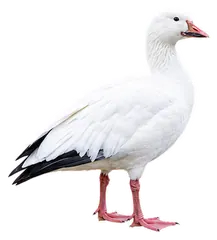 Snow GooseAnser caerulescens
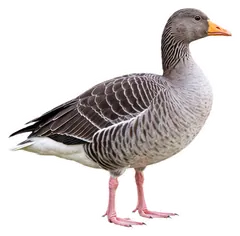 Greylag GooseAnser anser
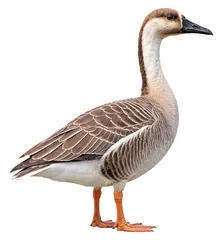 Swan GooseAnser cygnoides
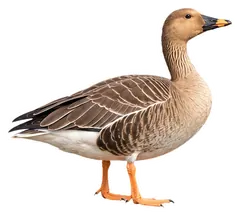 Taiga Bean GooseAnser fabalis
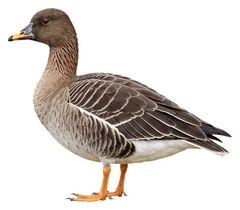 Tundra Bean GooseAnser serrirostris
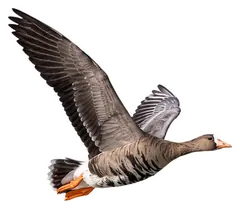 Greater White-fronted GooseAnser albifrons
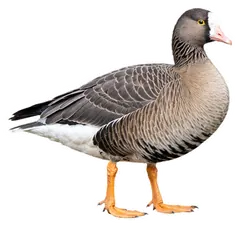 Lesser White-fronted GooseAnser erythropus
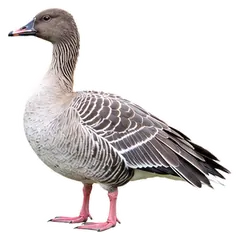
Download illustration
Free to use with credit: “Illustration: Bird Album (birdalbum.com)”. Drawn by AI from a reference photo by Martin Grimm. ↗
Heard it but can't see it? Mingji identifies birds by sound and photo, on your phone.