 Bird Album
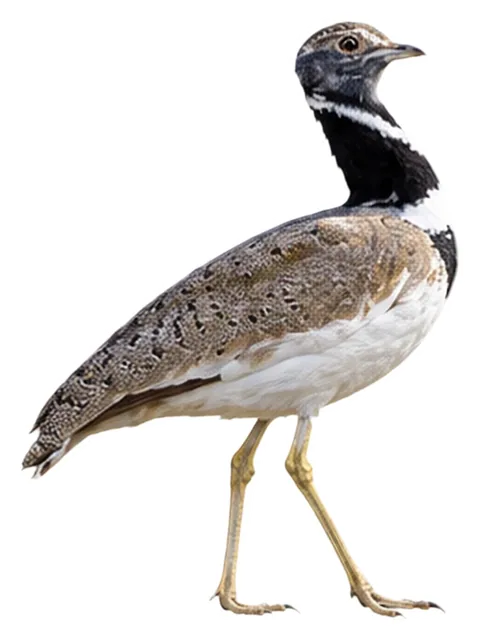
Little Bustard
Tetrax tetrax (Linnaeus, 1758)
42–45 cmLength110 cmWingspan834 gWeight
The male has a white-bordered black neck during the breeding season, and large areas of white show on the wings in flight.
Busiest months: October–November · Most records: Portugal, Spain, Azerbaijan
How to identify
Field marks
- Male in the breeding season has a black neck bordered by one white band above and one below
- Male in the breeding season has a gray head, brown upperparts and white underparts
- Long wings mostly white in flight
Male, female and young
Female and male in the non-breeding season lack the striking neck pattern; female has darker underparts than the male; juvenile resembles the female.
Voice
Both sexes are usually quiet; the male gives a pursed-lip blowing call, rendered as “prrt”.
Where and when it's recorded

Little Bustard has been recorded at 119 of the 8,171 birding hotspots we track, in 20 countries and regions.
Records by month Northern Hemisphere
To protect this bird from disturbance, we don't list exact sites.
Countries and regions with the most records
eBird records via GBIF up to 2024-12-31. A record means someone listed it; more records partly mean more birders, not more birds.
About
The little bustard (Tetrax tetrax) is a bird in the bustard family, the only member of the genus Tetrax. It breeds in Southern Europe and in Western and Central Asia.
Excerpt from Wikipedia, CC BY-SA 4.0 · authors · Read more on Wikipedia
Questions
How big is the Little Bustard?
The Little Bustard is about 42–45 cm long, with a wingspan of 110 cm and weighs around 834 g.
Where does the Little Bustard live?
Its breeding range: Palearctic: southwestern Europe and northwestern Africa to Central Asia. It is most often recorded in Portugal, Spain and Azerbaijan.
When is the best time to see the Little Bustard?
At the hotspots we track, it is recorded most in October and November (Northern Hemisphere).
Is the Little Bustard endangered?
The IUCN Red List classifies the Little Bustard as Near Threatened.
What does the Little Bustard eat?
Main food: Omnivore.
What family is the Little Bustard in?
It belongs to the family Bustards (Otididae), order Otidiformes.
At a glance
- Length
- 42–45 cm
- Wingspan
- 110 cm
- Weight
- 834 g
- Habitat
- Grassland
- Diet
- Omnivore
- Lifestyle
- Active on the ground
- Migration
- Partial migrant
- Conservation
- Near Threatened
More measurements
- Wing
- 239 mm
- Tail
- 100 mm
- Bill
- 30 mm
- Tarsus
- 64 mm
Averages from the AVONET dataset; length from field guides where available.
Range
Palearctic: southwestern Europe and northwestern Africa to Central Asia
Breeding range, IOC World Bird List 15.2
Classification
- Order
- Otidiformes
- Family
- Bustards Otididae
- Genus
- Tetrax
More from the family Bustards
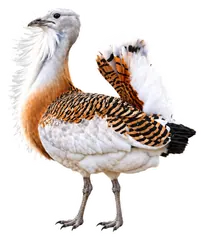 Great BustardOtis tarda
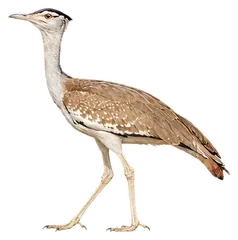 Arabian BustardArdeotis arabs
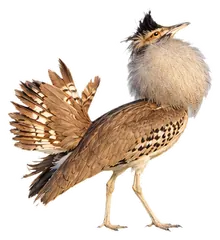 Kori BustardArdeotis kori
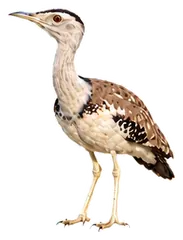 Great Indian BustardArdeotis nigriceps
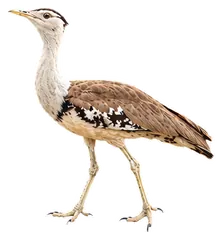 Australian BustardArdeotis australis
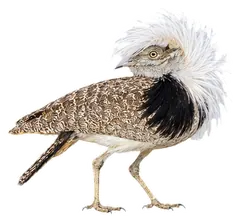 African HoubaraChlamydotis undulata
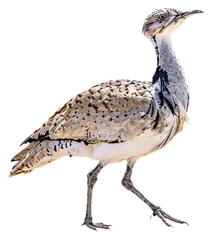 Asian HoubaraChlamydotis macqueenii
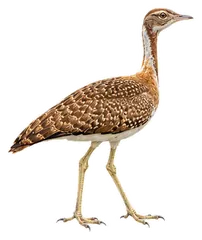 Ludwig's BustardNeotis ludwigii
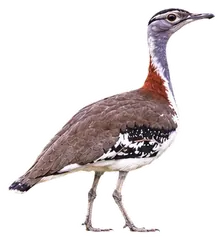 Denham's BustardNeotis denhami
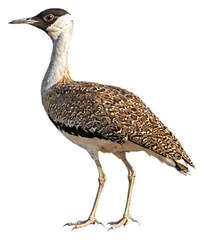 Heuglin's BustardNeotis heuglinii
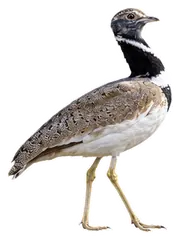
Download illustration
Free to use with credit: “Illustration: Bird Album (birdalbum.com)”. Drawn by AI from a reference photo by Василий Вишневский. ↗
Heard it but can't see it? Mingji identifies birds by sound and photo, on your phone.