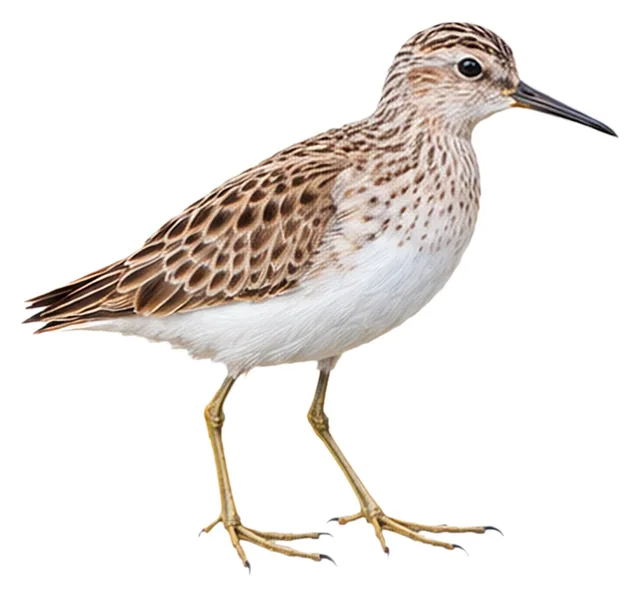
Long-toed Stint
Calidris subminuta (Middendorff, 1853)
13–16 cmLength31 cmWingspan30 gWeight
This small sandpiper has long, slender toes, yellow legs and feet, and a distinctive stance.
Busiest months: April · Most records: China, Thailand, Australia
Looks like Red-necked Stint
How to identify
Field marks
- Legs and feet yellow; toes long and slender
- Crown rufous; pale stripe above the eye
- Upperparts rufous with dark feather centers in the breeding season
- Bill short, straight and dark brown
Male, female and young
Juvenile has vivid reddish-brown upperpart markings and white stripes on the upper back.
Similar species
Where and when it's recorded
Busiest months: April · Most records: China, Thailand, Australia

Long-toed Stint has been recorded at 607 of the 8,276 birding hotspots we track, in 30 countries and regions.
Records by month Northern Hemisphere
Where it's recorded most
- Pak Thale Nature ReserveThailand1,350 records
- Lanyang River Estuary IBA – XinnanTaiwan (China)933 records
- Lizejian IBA – 52-Jia WetlandTaiwan (China)789 records
More places
- Beimen IBA – ShanliaowanTaiwan (China)706 records
- Khlong Tamru – 1 Alley salt pansThailand665 records
- Laem Phak Bia – salt pans E of Hwy. 4028Thailand485 records
- Mai Po Nature ReserveHong Kong (China)473 records
- Nanhui DongtanChina401 records
- Western Treatment Plant – T Section PondsAustralia399 records
- Khok Kham – Bird Center vicinityThailand380 records
Countries and regions with the most records
eBird records via GBIF up to 2024-12-31. A record means someone listed it; more records partly mean more birders, not more birds.
About
The long-toed stint (Calidris subminuta) is a small wader. The genus name is from Ancient Greek kalidris or skalidris, a term used by Aristotle for some grey-coloured waterside birds. The specific subminuta is from Latin sub, "near to" and minuta, "small" from its similarity to the little stint, Calidris minuta.
Excerpt from Wikipedia, CC BY-SA 4.0 · authors · Read more on Wikipedia
Questions
How big is the Long-toed Stint?
The Long-toed Stint is about 13–16 cm long, with a wingspan of 31 cm and weighs around 30 g.
Where does the Long-toed Stint live?
Its breeding range: Palearctic: subarctic to temperate bogs of central, eastern Palearctic: disjunctly from southwest to southern Chukotskiy Peninsula, northern Kuril and Commander islands (eastern Russia); (perhaps) northern Mongolia. It is most often recorded in China, Thailand and Australia.
When is the best time to see the Long-toed Stint?
At the hotspots we track, it is recorded most in April (Northern Hemisphere).
Is the Long-toed Stint endangered?
The IUCN Red List classifies the Long-toed Stint as Least Concern.
What does the Long-toed Stint eat?
Main food: Fish, shrimp & shellfish.
What family is the Long-toed Stint in?
It belongs to the family Sandpipers, Snipes (Scolopacidae), order Charadriiformes.
At a glance
- Length
- 13–16 cm
- Wingspan
- 31 cm
- Weight
- 30 g
- Habitat
- Wetland
- Diet
- Fish, shrimp & shellfish
- Lifestyle
- Active on the ground
- Migration
- Migratory
- Conservation
- Least Concern
More measurements
- Wing
- 88 mm
- Tail
- 36 mm
- Bill
- 20 mm
- Tarsus
- 22 mm
Averages from the AVONET dataset; length from field guides where available.
Range
Palearctic: subarctic to temperate bogs of central, eastern Palearctic: disjunctly from southwest to southern Chukotskiy Peninsula, northern Kuril and Commander islands (eastern Russia); (perhaps) northern Mongolia
Breeding range, IOC World Bird List 15.2
Classification
- Order
- Charadriiformes
- Family
- Sandpipers, Snipes Scolopacidae
- Genus
- Calidris
Other birds in the genus Calidris
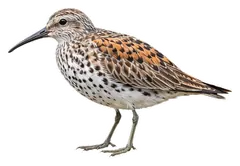 Great KnotCalidris tenuirostris
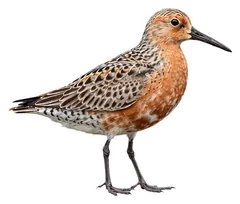 Red KnotCalidris canutus
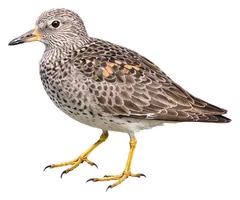 SurfbirdCalidris virgata
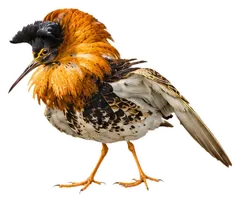 RuffCalidris pugnax
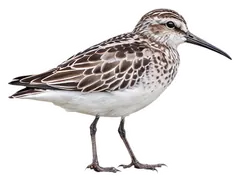 Broad-billed SandpiperCalidris falcinellus
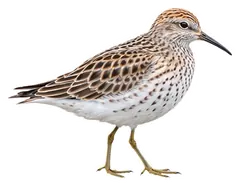 Sharp-tailed SandpiperCalidris acuminata
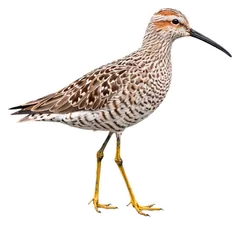 Stilt SandpiperCalidris himantopus
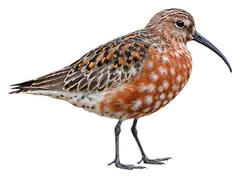 Curlew SandpiperCalidris ferruginea
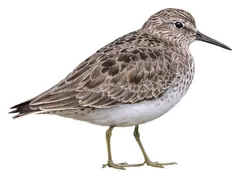 Temminck's StintCalidris temminckii
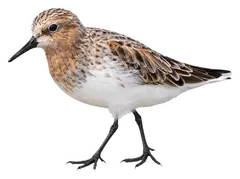 Red-necked StintCalidris ruficollis
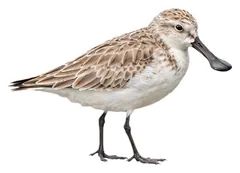 Spoon-billed SandpiperCalidris pygmaea
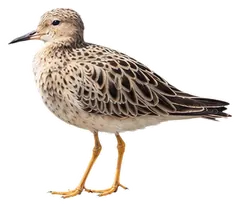 Buff-breasted SandpiperCalidris subruficollis
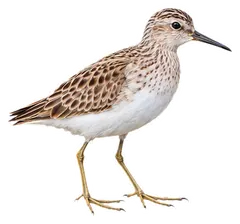
Download illustration
Free to use with credit: “Illustration: Bird Album (birdalbum.com)”. Drawn by AI from a reference photo by JJ Harrison (https://www.jjharrison.com.au/). ↗

Heard it but can't see it? Mingji identifies birds by sound and photo, on your phone.
In other languages
- EnglishLong-toed Stint
- 简体中文长趾滨鹬
- 繁體中文長趾濱鷸
- 日本語ヒバリシギ
- 한국어종달도요
- DeutschLangzehen-Strandläufer
- FrançaisBécasseau à longs doigts
- EspañolCorrelimos dedilargo
- Portuguêspilrito-de-dedos-compridos
- ItalianoGambecchio minore
- NederlandsTaigastrandloper
- РусскийДлиннопалый песочник
- Svenskalångtåsnäppa
- DanskLangtået Ryle
- Polskibiegus smukłonogi