 Bird Album
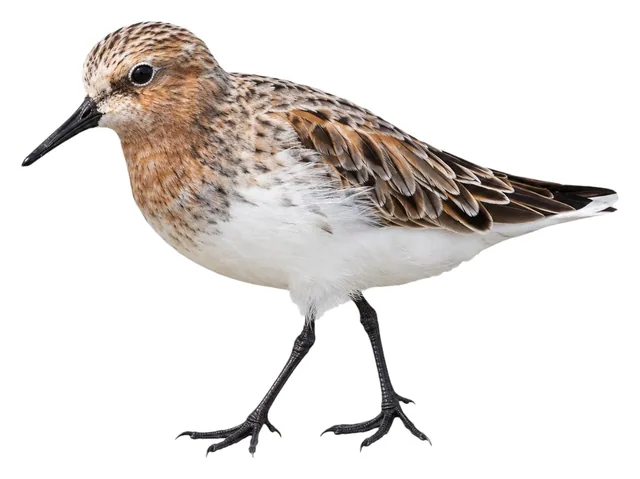
Red-necked Stint
Calidris ruficollis (Pallas, 1776)
13–17 cmLength31 cmWingspan27 gWeight
This is one of the smallest waders, with a slender, dark bill, dark legs and feet, and rather quick movements.
Most records: Australia, China, Thailand
Looks like Little Stint
How to identify
Field marks
- Bill long, slender and dark
- Legs and feet dark
- Breast orange and unmarked in breeding plumage, with dark markings along its lower edge
- White V-shaped marking on the back in breeding plumage
Male, female and young
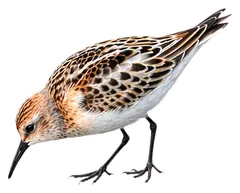
Compared with juvenile Little Stint, juvenile has more contrasting upper back plumage and weaker white lines on the back.
Voice
A harsh “stit”.
Similar species
Where and when it's recorded

Red-necked Stint has been recorded at 714 of the 8,171 birding hotspots we track, in 43 countries and regions.
Records by month Northern Hemisphere
Where it's recorded most
- Western Treatment PlantAustralia7,600 records
- Cairns EsplanadeAustralia3,127 records
- Pak Thale Nature ReserveThailand2,358 records
More places
- Western Treatment Plant – T Section PondsAustralia1,408 records
- Mai Po Nature ReserveHong Kong (China)1,330 records
- Long Reef Aquatic ReserveAustralia1,289 records
- St. Paul IslandUnited States1,178 records
- Lake WollumboolaAustralia1,043 records
- Nanhui DongtanChina1,028 records
- Stockyard PointAustralia1,023 records
Countries and regions with the most records
eBird records via GBIF up to 2024-12-31. A record means someone listed it; more records partly mean more birders, not more birds.
About
The red-necked stint or rufous-necked stint (Calidris ruficollis) is a small migratory wader that breeds in northeast Russia and spends the non-breeding season along the coastlines of Southeast Asia and Australasia.
Excerpt from Wikipedia, CC BY-SA 4.0 · authors · Read more on Wikipedia
Questions
How big is the Red-necked Stint?
The Red-necked Stint is about 13–17 cm long, with a wingspan of 31 cm and weighs around 27 g.
Where does the Red-necked Stint live?
Its breeding range: Palearctic: coastal low Arctic to subarctic tundra of north-central, northeastern Siberia: Taymyr Peninsula (north-central Siberia) east to Chukotskiy Peninsula and south to northern Kamchatka Peninsula (northeastern Russia). It is most often recorded in Australia, China and Thailand.
Is the Red-necked Stint endangered?
The IUCN Red List classifies the Red-necked Stint as Near Threatened.
What does the Red-necked Stint eat?
Main food: Fish, shrimp & shellfish.
What family is the Red-necked Stint in?
It belongs to the family Sandpipers, Snipes (Scolopacidae), order Charadriiformes.
At a glance
- Length
- 13–17 cm
- Wingspan
- 31 cm
- Weight
- 27 g
- Habitat
- Grassland
- Diet
- Fish, shrimp & shellfish
- Lifestyle
- Active on the ground
- Migration
- Migratory
- Conservation
- Near Threatened
More measurements
- Wing
- 100 mm
- Tail
- 44 mm
- Bill
- 19 mm
- Tarsus
- 19 mm
Averages from the AVONET dataset; length from field guides where available.
Range
Palearctic: coastal low Arctic to subarctic tundra of north-central, northeastern Siberia: Taymyr Peninsula (north-central Siberia) east to Chukotskiy Peninsula and south to northern Kamchatka Peninsula (northeastern Russia)
Breeding range, IOC World Bird List 15.2
Classification
- Order
- Charadriiformes
- Family
- Sandpipers, Snipes Scolopacidae
- Genus
- Calidris
Other birds in the genus Calidris
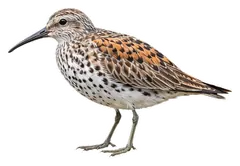 Great KnotCalidris tenuirostris
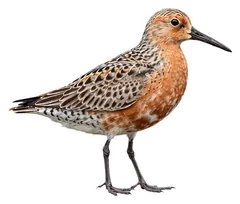 Red KnotCalidris canutus
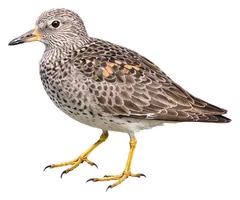 SurfbirdCalidris virgata
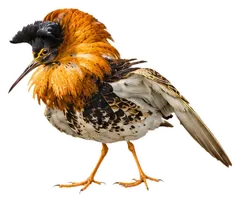 RuffCalidris pugnax
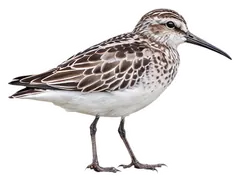 Broad-billed SandpiperCalidris falcinellus
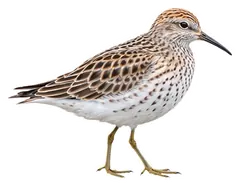 Sharp-tailed SandpiperCalidris acuminata
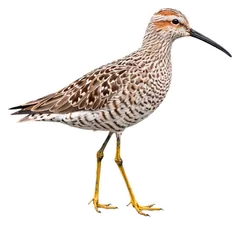 Stilt SandpiperCalidris himantopus
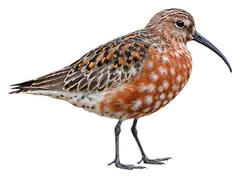 Curlew SandpiperCalidris ferruginea
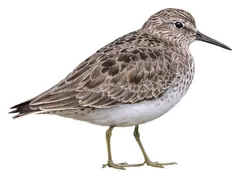 Temminck's StintCalidris temminckii
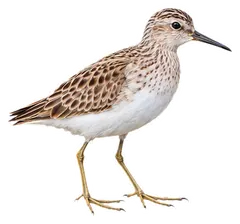 Long-toed StintCalidris subminuta
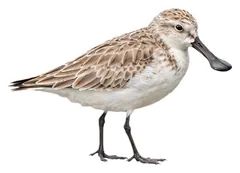 Spoon-billed SandpiperCalidris pygmaea
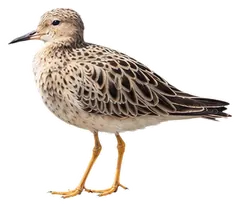 Buff-breasted SandpiperCalidris subruficollis
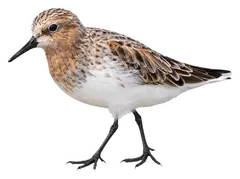
Download illustration
Free to use with credit: “Illustration: Bird Album (birdalbum.com)”. Drawn by AI from a reference photo by Tisha Mukherjee. ↗

Heard it but can't see it? Mingji identifies birds by sound and photo, on your phone.
In other languages
- EnglishRed-necked Stint
- 简体中文红颈滨鹬
- 繁體中文紅胸濱鷸
- 日本語トウネン
- 한국어좀도요
- DeutschRotkehl-Strandläufer
- FrançaisBécasseau à col roux
- EspañolCorrelimos cuellirrojo
- Portuguêspilrito-de-pescoço-ruivo
- ItalianoGambecchio collorosso
- NederlandsRoodkeelstrandloper
- РусскийПесочник-красношейка
- Svenskarödhalsad snäppa
- DanskRødhalset Ryle
- Polskibiegus rdzawoszyi