 Bird Album
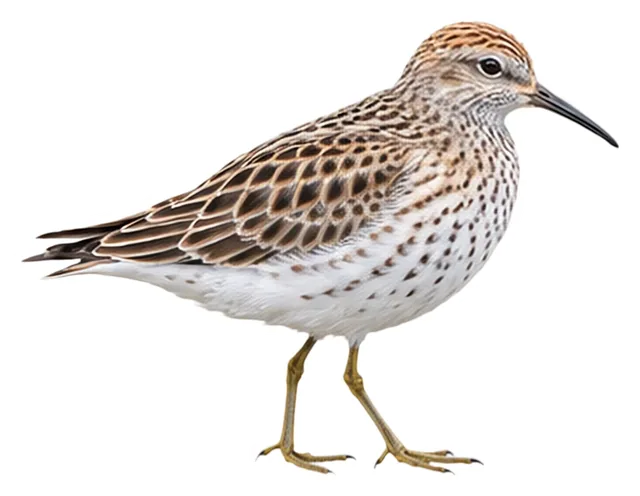
Sharp-tailed Sandpiper
Calidris acuminata (Horsfield, 1821)
≈22 cmLength40 cmWingspan66 gWeight
It is a small to medium-sized sandpiper with a rounded belly, chestnut crown, straight bill and olive to yellow legs.
Most records: Australia, China, United States
Looks like Pectoral Sandpiper, Long-toed Stint
How to identify
Field marks
- Crown chestnut with a rufous eyestripe
- Upperparts mottled chestnut-brown; feather tips and centers dark
- Bill straight, dark gray to black
- Legs olive to yellow
Male, female and young
Breeding plumage brighter than winter plumage; in fall and winter, juvenile is brighter than adult, with a chestnut crown contrasting strongly with white back stripes and a pale yellow breast.
Similar species
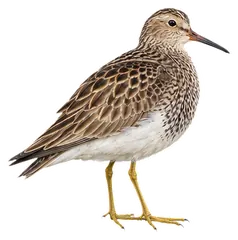
Sharp-tailed Sandpiper lacks a sharply defined breast-band and has “>”-shaped markings on the flanks; its supercilium is more conspicuous and crown more chestnut than in Pectoral Sandpiper.
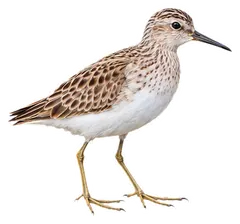
Some resemblance to Long-toed Stint, but Sharp-tailed Sandpiper is much larger.
Where and when it's recorded

Sharp-tailed Sandpiper has been recorded at 674 of the 8,171 birding hotspots we track, in 54 countries and regions.
Records by month Southern Hemisphere
To protect this bird from disturbance, we don't list exact sites.
Countries and regions with the most records
eBird records via GBIF up to 2024-12-31. A record means someone listed it; more records partly mean more birders, not more birds.
About
The sharp-tailed sandpiper (Calidris acuminata) is a small-medium migratory wader or shorebird, found mostly in Siberia during the summer breeding period (June to August) and Australia for wintering (September to March).
Excerpt from Wikipedia, CC BY-SA 4.0 · authors · Read more on Wikipedia
Questions
How big is the Sharp-tailed Sandpiper?
The Sharp-tailed Sandpiper is about ≈22 cm long, with a wingspan of 40 cm and weighs around 66 g.
Where does the Sharp-tailed Sandpiper live?
Its breeding range: Palearctic: low Arctic to subarctic tundra of northeastern Palearctic: Lena to Kolyma rivers (northeastern Siberia). It is most often recorded in Australia, China and United States.
Is the Sharp-tailed Sandpiper endangered?
The IUCN Red List classifies the Sharp-tailed Sandpiper as Vulnerable.
What does the Sharp-tailed Sandpiper eat?
Main food: Fish, shrimp & shellfish.
What family is the Sharp-tailed Sandpiper in?
It belongs to the family Sandpipers, Snipes (Scolopacidae), order Charadriiformes.
At a glance
- Length
- ≈22 cm
- Wingspan
- 40 cm
- Weight
- 66 g
- Habitat
- Wetland
- Diet
- Fish, shrimp & shellfish
- Lifestyle
- Active on the ground
- Migration
- Migratory
- Conservation
- Vulnerable
More measurements
- Wing
- 129 mm
- Tail
- 53 mm
- Bill
- 27 mm
- Tarsus
- 29 mm
Averages from the AVONET dataset; length from field guides where available.
Range
Palearctic: low Arctic to subarctic tundra of northeastern Palearctic: Lena to Kolyma rivers (northeastern Siberia)
Breeding range, IOC World Bird List 15.2
Classification
- Order
- Charadriiformes
- Family
- Sandpipers, Snipes Scolopacidae
- Genus
- Calidris
Other birds in the genus Calidris
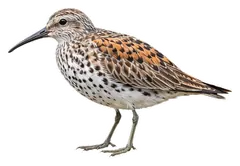 Great KnotCalidris tenuirostris
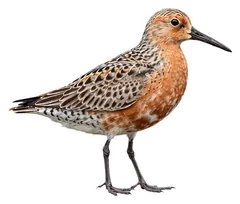 Red KnotCalidris canutus
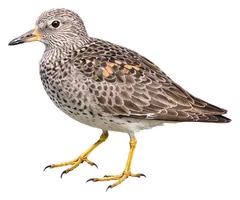 SurfbirdCalidris virgata
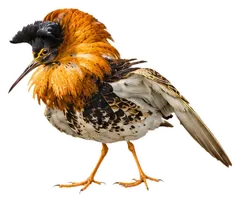 RuffCalidris pugnax
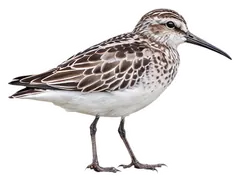 Broad-billed SandpiperCalidris falcinellus
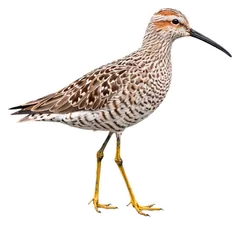 Stilt SandpiperCalidris himantopus
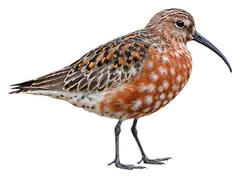 Curlew SandpiperCalidris ferruginea
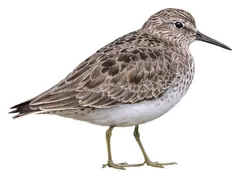 Temminck's StintCalidris temminckiiLong-toed StintCalidris subminuta
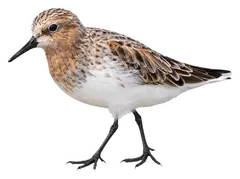 Red-necked StintCalidris ruficollis
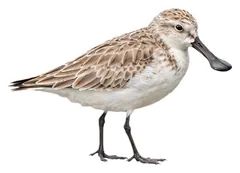 Spoon-billed SandpiperCalidris pygmaea
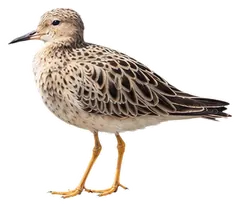 Buff-breasted SandpiperCalidris subruficollis
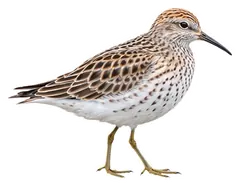
Download illustration
Free to use with credit: “Illustration: Bird Album (birdalbum.com)”. Drawn by AI from a reference photo by Alpsdake. ↗

Heard it but can't see it? Mingji identifies birds by sound and photo, on your phone.
In other languages
- EnglishSharp-tailed Sandpiper
- 简体中文尖尾滨鹬
- 繁體中文尖尾濱鷸
- 日本語ウズラシギ
- 한국어메추라기도요
- DeutschSpitzschwanz-Strandläufer
- FrançaisBécasseau à queue pointue
- EspañolCorrelimos acuminado
- Portuguêspilrito-acuminado
- ItalianoPiovanello siberiano
- NederlandsSiberische Strandloper
- РусскийОстрохвостый песочник
- Svenskaspetsstjärtad snäppa
- DanskSpidshalet Ryle
- Polskibiegus ostrosterny