 Bird Album
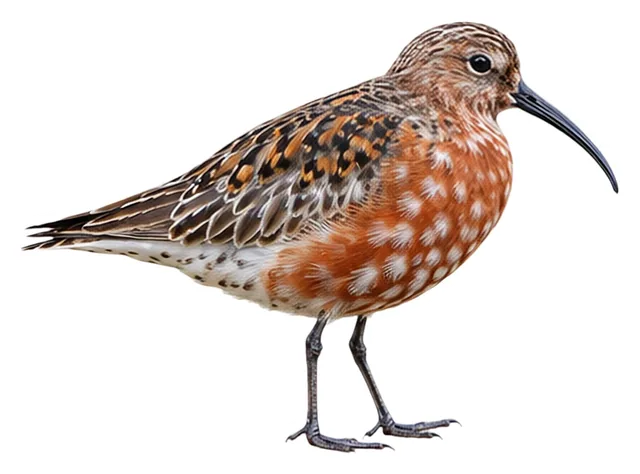
Curlew Sandpiper
Calidris ferruginea (Pontoppidan, 1763)
18–23 cmLength44 cmWingspan58 gWeight
This small sandpiper has a long, decurved bill and brick-red underparts in the breeding season.
Busiest months: August–September · Most records: Australia, Spain, United Kingdom
Looks like Red Knot, Dunlin, Stilt Sandpiper
How to identify
Field marks
- Bill black, long and decurved
- Large white patch on the rump; white band on the upperwing in flight
- Upperparts dark gray with markings and underparts brick-red in the breeding season
- Winter plumage gray above and white below, with a distinct white supercilium
Male, female and young
Male is more intensely rusty in the breeding season; juvenile has a gray-brown back, white belly and peach wash on the breast.
Voice
Often gives a single chirp with a dip in pitch in the middle on take-off; the alarm call on the breeding grounds is a repeated “whik, whik, whik”.
Similar species
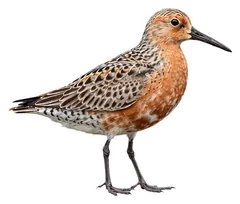
Red Knot also has a red belly in breeding plumage, but is larger, with paler orange-yellow underparts, short greenish legs and feet, and a thicker bill.
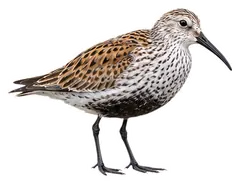
Curlew Sandpiper has a longer, decurved bill, longer neck and legs and feet, and a white rump.
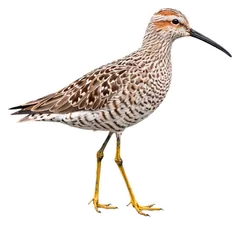
Similar in non-breeding plumage; Stilt Sandpiper lacks the white stripe on the upperwing, has longer, yellow legs and feet, and a flatter head.
Where and when it's recorded

Curlew Sandpiper has been recorded at 1,767 of the 8,171 birding hotspots we track, in 147 countries and regions.
Records by month Northern Hemisphere
To protect this bird from disturbance, we don't list exact sites.
Countries and regions with the most records
eBird records via GBIF up to 2024-12-31. A record means someone listed it; more records partly mean more birders, not more birds.
About
The curlew sandpiper (Calidris ferruginea) is a small wader. It is a long-distance migrant, breeding in the bogs and coastal lowlands of the Siberian Arctic, arriving there in June and staying until August or September. After the breeding season, it migrates south to spend the winter in Africa and along the coasts of Oceania and southern Eurasia, occupying tidal mudflats and saltpans.
Excerpt from Wikipedia, CC BY-SA 4.0 · authors · Read more on Wikipedia
Questions
How big is the Curlew Sandpiper?
The Curlew Sandpiper is about 18–23 cm long, with a wingspan of 44 cm and weighs around 58 g.
Where does the Curlew Sandpiper live?
Its breeding range: Palearctic: drier low Arctic tundra of north-central, northeastern Palearctic: northwestern Siberia from Yamal Peninsula to northwestern Chukotskiy Peninsula (northeastern Siberia), and New Siberian Islands (north of north-central Siberia). It is most often recorded in Australia, Spain and United Kingdom.
When is the best time to see the Curlew Sandpiper?
At the hotspots we track, it is recorded most in August and September (Northern Hemisphere).
Is the Curlew Sandpiper endangered?
The IUCN Red List classifies the Curlew Sandpiper as Vulnerable.
What does the Curlew Sandpiper eat?
Main food: Fish, shrimp & shellfish.
What family is the Curlew Sandpiper in?
It belongs to the family Sandpipers, Snipes (Scolopacidae), order Charadriiformes.
At a glance
- Length
- 18–23 cm
- Wingspan
- 44 cm
- Weight
- 58 g
- Habitat
- Coast & tidal flats
- Diet
- Fish, shrimp & shellfish
- Lifestyle
- Active on the ground
- Migration
- Migratory
- Conservation
- Vulnerable
More measurements
- Wing
- 129 mm
- Tail
- 49 mm
- Bill
- 38 mm
- Tarsus
- 29 mm
Averages from the AVONET dataset; length from field guides where available.
Range
Palearctic: drier low Arctic tundra of north-central, northeastern Palearctic: northwestern Siberia from Yamal Peninsula to northwestern Chukotskiy Peninsula (northeastern Siberia), and New Siberian Islands (north of north-central Siberia)
Breeding range, IOC World Bird List 15.2
Classification
- Order
- Charadriiformes
- Family
- Sandpipers, Snipes Scolopacidae
- Genus
- Calidris
Other birds in the genus Calidris
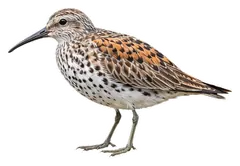 Great KnotCalidris tenuirostrisRed KnotCalidris canutus
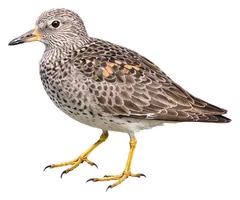 SurfbirdCalidris virgata
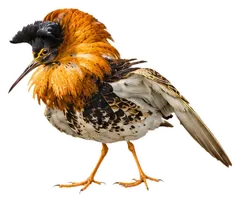 RuffCalidris pugnax
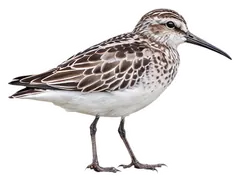 Broad-billed SandpiperCalidris falcinellus
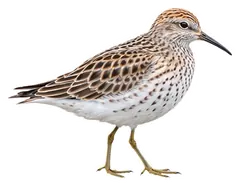 Sharp-tailed SandpiperCalidris acuminataStilt SandpiperCalidris himantopus
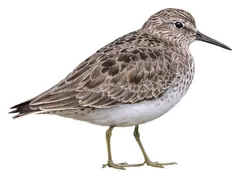 Temminck's StintCalidris temminckii
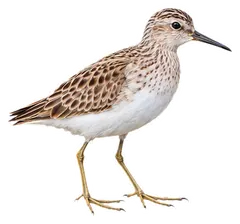 Long-toed StintCalidris subminuta
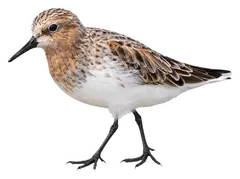 Red-necked StintCalidris ruficollis
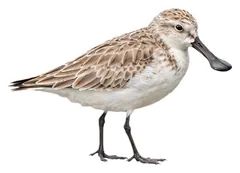 Spoon-billed SandpiperCalidris pygmaea
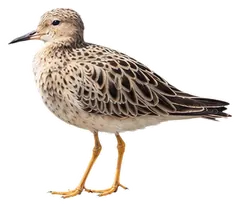 Buff-breasted SandpiperCalidris subruficollis
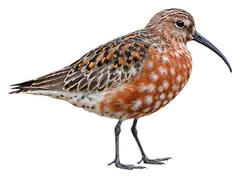
Download illustration
Free to use with credit: “Illustration: Bird Album (birdalbum.com)”. Drawn by AI from a reference photo by Imran Shah. ↗

Heard it but can't see it? Mingji identifies birds by sound and photo, on your phone.