 Bird Album
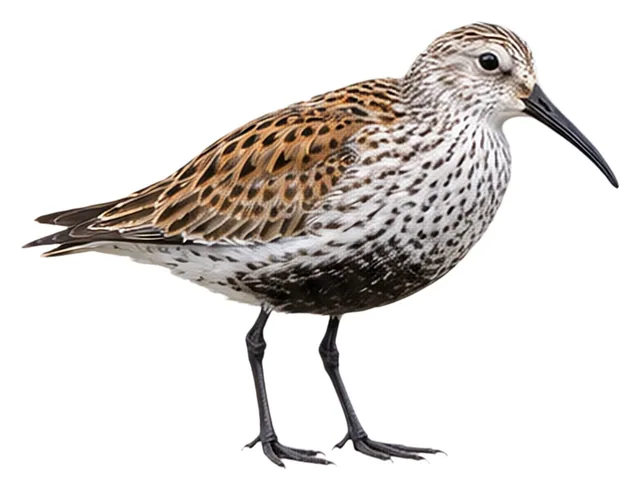
Dunlin
Calidris alpina (Linnaeus, 1758)
16–20 cmLength36 cmWingspan52 gWeight
It is a small wader with a black belly in the breeding season and a black, slightly decurved bill.
Busiest months: May · Most records: United States, United Kingdom, Canada
How to identify
Field marks
- Belly black in breeding plumage
- Upperparts gray-brown and underparts white in winter plumage
- Legs black; bill black and slightly decurved
- A single narrow white wing patch in flight
Male, female and young
Juvenile has rufous upperparts with two indistinct white V-shaped markings on the back; female has a longer bill than male.
Voice
A typical sandpiper “chreep”; sings a rough trill during display.
Where and when it's recorded

Dunlin has been recorded at 2,289 of the 8,171 birding hotspots we track, in 129 countries and regions.
Records by month Northern Hemisphere
Where it's recorded most
- Edwin B. Forsythe NWRUnited States11,542 records
- Fort De Soto ParkUnited States10,683 records
- Bombay Hook National Wildlife RefugeUnited States10,258 records
More places
- Howard Marsh MetroparkUnited States9,030 records
- Edwin B. Forsythe NWR – Wildlife DriveUnited States8,656 records
- Parker River NWRUnited States8,524 records
- Hillman Marsh CACanada7,224 records
- Titchwell Marsh RSPB ReserveUnited Kingdom6,928 records
- Bolivar Flats Shorebird SanctuaryUnited States5,958 records
- Billy Frank Jr. Nisqually NWRUnited States5,218 records
Countries and regions with the most records
eBird records via GBIF up to 2024-12-31. A record means someone listed it; more records partly mean more birders, not more birds.
About
The dunlin (Calidris alpina) is a small wader in the genus Calidris. The English name is a dialect form of "dunling", first recorded in 1531–1532.
Excerpt from Wikipedia, CC BY-SA 4.0 · authors · Read more on Wikipedia
Questions
How big is the Dunlin?
The Dunlin is about 16–20 cm long, with a wingspan of 36 cm and weighs around 52 g.
Where does the Dunlin live?
Its breeding range: North America, Palearctic: low (locally high) Arctic to temperate wet tundra of Holarctic: southwest to northeastern Greenland, Iceland, Faroe Islands, northern British Isles, Scandinavia, Baltic states east through northern Russia including Novaya Zemlya (north of northwestern Siberia) and New Siberian Islands (north of east-central Russia), through Chukotskiy Peninsula, western Kamchatka, northern Kurile and northern Sakhalin islands (eastern Russia); Aleutian Islands, western, northern Alaska, northwestern Canada, north-central Canada northern and west of Hudson Bay. It is most often recorded in United States, United Kingdom and Canada.
When is the best time to see the Dunlin?
At the hotspots we track, it is recorded most in May (Northern Hemisphere).
Is the Dunlin endangered?
The IUCN Red List classifies the Dunlin as Near Threatened.
What does the Dunlin eat?
Main food: Fish, shrimp & shellfish.
What family is the Dunlin in?
It belongs to the family Sandpipers, Snipes (Scolopacidae), order Charadriiformes.
At a glance
- Length
- 16–20 cm
- Wingspan
- 36 cm
- Weight
- 52 g
- Habitat
- Wetland
- Diet
- Fish, shrimp & shellfish
- Lifestyle
- Active on the ground
- Migration
- Migratory
- Conservation
- Near Threatened
More measurements
- Wing
- 115 mm
- Tail
- 49 mm
- Bill
- 37 mm
- Tarsus
- 25 mm
Averages from the AVONET dataset; length from field guides where available.
Range
North America, Palearctic: low (locally high) Arctic to temperate wet tundra of Holarctic: southwest to northeastern Greenland, Iceland, Faroe Islands, northern British Isles, Scandinavia, Baltic states east through northern Russia including Novaya Zemlya (north of northwestern Siberia) and New Siberian Islands (north of east-central Russia), through Chukotskiy Peninsula, western Kamchatka, northern Kurile and northern Sakhalin islands (eastern Russia); Aleutian Islands, western, northern Alaska, northwestern Canada, north-central Canada northern and west of Hudson Bay
Breeding range, IOC World Bird List 15.2
Subspecies · 2
- Calidris alpina sakhalina ne Russia to Chukotskiy Pen. | non-breeding: e China, Korean Pen., Japan and Taiwan (China)
- Calidris alpina arcticola nw Alaska to nw Canada | non-breeding: e China, Korean Pen. and Japan
Classification
- Order
- Charadriiformes
- Family
- Sandpipers, Snipes Scolopacidae
- Genus
- Calidris
Other birds in the genus Calidris
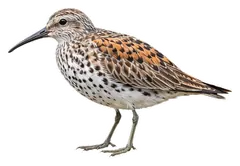 Great KnotCalidris tenuirostris
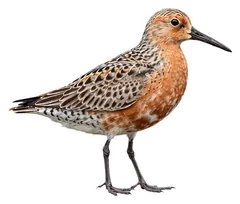 Red KnotCalidris canutus
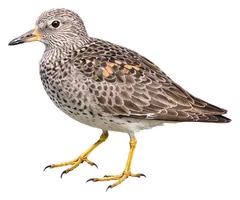 SurfbirdCalidris virgata
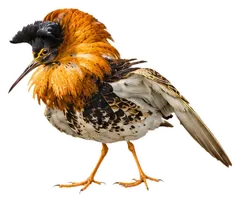 RuffCalidris pugnax
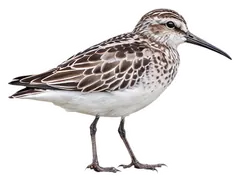 Broad-billed SandpiperCalidris falcinellus
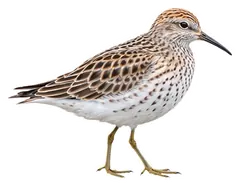 Sharp-tailed SandpiperCalidris acuminata
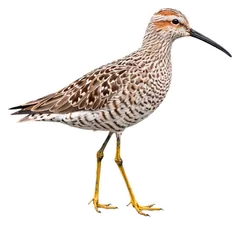 Stilt SandpiperCalidris himantopus
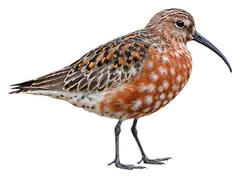 Curlew SandpiperCalidris ferruginea
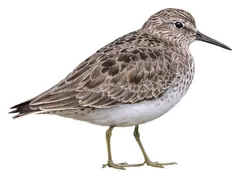 Temminck's StintCalidris temminckii
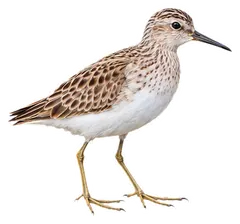 Long-toed StintCalidris subminuta
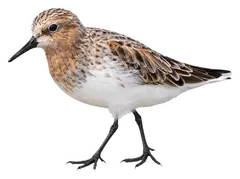 Red-necked StintCalidris ruficollis
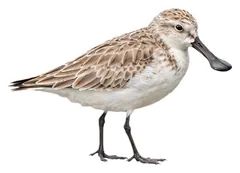 Spoon-billed SandpiperCalidris pygmaea
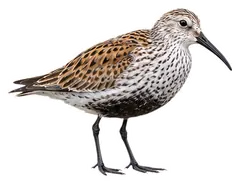
Download illustration
Free to use with credit: “Illustration: Bird Album (birdalbum.com)”. Drawn by AI from a reference photo by Charles Homler d/b/a FocusOnWildlife. ↗

Heard it but can't see it? Mingji identifies birds by sound and photo, on your phone.