 Bird Album
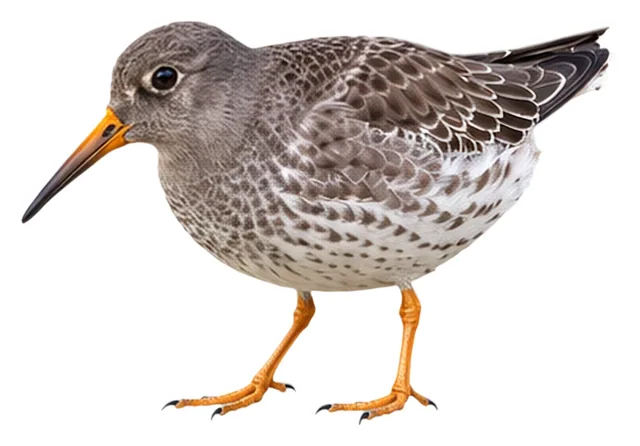
Purple Sandpiper
Calidris maritima (Brünnich, 1764)
65 gWeight
The purple sandpiper (Calidris maritima) is a small shorebird in the sandpiper family Scolopacidae.
Busiest months: November–January · Most records: United States, Canada, United Kingdom
Where and when it's recorded
Busiest months: November–January · Most records: United States, Canada, United Kingdom

Purple Sandpiper has been recorded at 414 of the 8,276 birding hotspots we track, in 32 countries and regions.
Records by month Northern Hemisphere
Where it's recorded most
- Barnegat Lighthouse SPUnited States5,909 records
- Ocean City InletUnited States4,476 records
- Húsavík – hafnarsvæðiIceland1,427 records
More places
- Stone Harbor PointUnited States1,328 records
- Quai, Pointe-au-PèreCanada1,173 records
- Halibut Point SPUnited States1,118 records
- Hammonasset Beach SPUnited States1,070 records
- GirdlenessUnited Kingdom945 records
- Cape Island – CMP – Coral Ave. dune crossingUnited States888 records
- Jones Beach SP – West EndUnited States719 records
Countries and regions with the most records
eBird records via GBIF up to 2024-12-31. A record means someone listed it; more records partly mean more birders, not more birds.
About
The purple sandpiper (Calidris maritima) is a small shorebird in the sandpiper family Scolopacidae. This is a hardy sandpiper that breeds in the arctic and subarctic regions of Eurasia and North America and winters further south on the Atlantic coast.
Excerpt from Wikipedia, CC BY-SA 4.0 · authors · Read more on Wikipedia
Questions
How big is the Purple Sandpiper?
The Purple Sandpiper weighs around 65 g.
Where does the Purple Sandpiper live?
Its breeding range: North America, Palearctic: high to low montane Arctic of North Atlantic and Arctic oceans: Greenland (except northern, northeastern), Iceland, Jan Mayen (northeast of Iceland), Bear Island and Svalbard (north of Norway), Scandinavia to far northwestern Russia, Franz Josef Land and Novaya Zemlya (north of northwestern Siberia) and Severnaya Zemlya and Taymyr Peninsula (north-central Siberia); Banks to southern Ellesmere and Baffin islands (north-central Canada). It is most often recorded in United States, Canada and United Kingdom.
When is the best time to see the Purple Sandpiper?
At the hotspots we track, it is recorded most in January, November and December (Northern Hemisphere).
Is the Purple Sandpiper endangered?
The IUCN Red List classifies the Purple Sandpiper as Least Concern.
What does the Purple Sandpiper eat?
Main food: Fish, shrimp & shellfish.
What family is the Purple Sandpiper in?
It belongs to the family Sandpipers, Snipes (Scolopacidae), order Charadriiformes.
At a glance
- Weight
- 65 g
- Habitat
- Grassland
- Diet
- Fish, shrimp & shellfish
- Lifestyle
- Active on the ground
- Migration
- Migratory
- Conservation
- Least Concern
More measurements
- Wing
- 121 mm
- Tail
- 55 mm
- Bill
- 33 mm
- Tarsus
- 22 mm
Averages from the AVONET dataset; length from field guides where available.
Range
North America, Palearctic: high to low montane Arctic of North Atlantic and Arctic oceans: Greenland (except northern, northeastern), Iceland, Jan Mayen (northeast of Iceland), Bear Island and Svalbard (north of Norway), Scandinavia to far northwestern Russia, Franz Josef Land and Novaya Zemlya (north of northwestern Siberia) and Severnaya Zemlya and Taymyr Peninsula (north-central Siberia); Banks to southern Ellesmere and Baffin islands (north-central Canada)
Breeding range, IOC World Bird List 15.2
Classification
- Order
- Charadriiformes
- Family
- Sandpipers, Snipes Scolopacidae
- Genus
- Calidris
Other birds in the genus Calidris
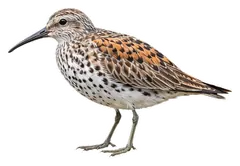 Great KnotCalidris tenuirostris
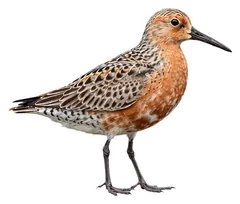 Red KnotCalidris canutus
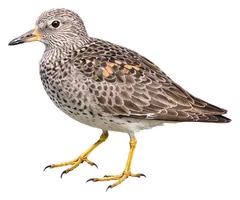 SurfbirdCalidris virgata
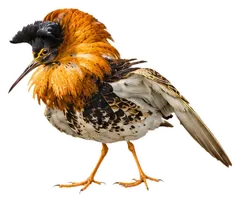 RuffCalidris pugnax
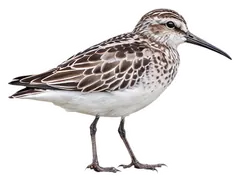 Broad-billed SandpiperCalidris falcinellus
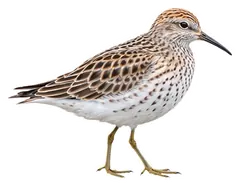 Sharp-tailed SandpiperCalidris acuminata
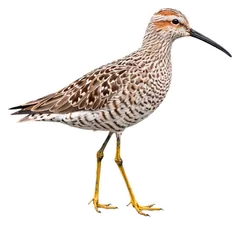 Stilt SandpiperCalidris himantopus
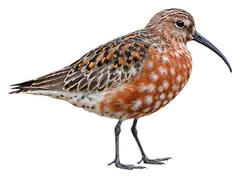 Curlew SandpiperCalidris ferruginea
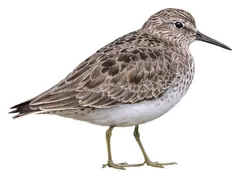 Temminck's StintCalidris temminckii
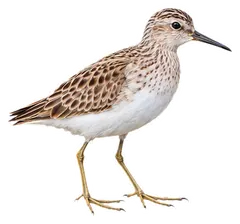 Long-toed StintCalidris subminuta
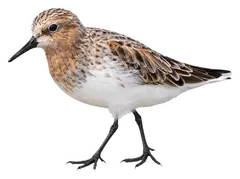 Red-necked StintCalidris ruficollis
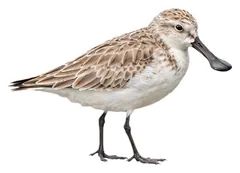 Spoon-billed SandpiperCalidris pygmaea
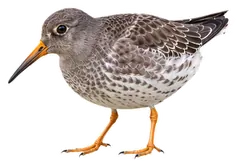
Download illustration
Free to use with credit: “Illustration: Bird Album (birdalbum.com)”. Drawn by AI from a reference photo by Kyle Blaney. ↗
Heard it but can't see it? Mingji identifies birds by sound and photo, on your phone.