 Bird Album
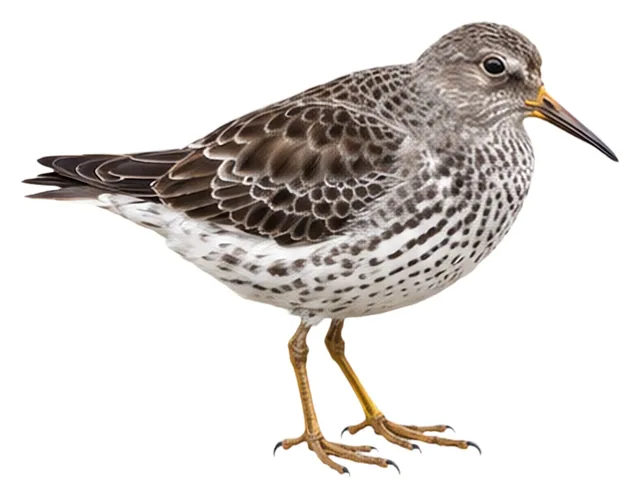
Rock Sandpiper
Calidris ptilocnemis (Coues, 1873)
≈24 cmLength40 cmWingspan81 gWeight
This cold-tolerant sandpiper has short legs and feet and a slender, dark bill as an adult, and migrates to rocky coasts in winter.
Busiest months: June · Most records: United States, Canada, Japan
How to identify
Field marks
- Adult legs and feet short
- Adult bill slender and dark
- Adult upperparts rather dark; underparts mostly white
- Adult breast washed gray; rump black
Where and when it's recorded

Rock Sandpiper has been recorded at 23 of the 8,171 birding hotspots we track, in 3 countries and regions.
Records by month Northern Hemisphere
Where it's recorded most
- St. Paul IslandUnited States8,131 records
- GambellUnited States2,148 records
- Southeast Farallon IslandUnited States1,871 records
More places
- Heron's Head ParkUnited States1,229 records
- Clover PointCanada162 records
- Tsawwassen Ferry Terminal JettyCanada87 records
- Oak Bay – Cattle PointCanada81 records
- Neah Bay – town and bay onlyUnited States43 records
- Pillar Point HarborUnited States40 records
- Iona IslandCanada32 records
Countries and regions with the most records
eBird records via GBIF up to 2024-12-31. A record means someone listed it; more records partly mean more birders, not more birds.
About
The rock sandpiper (Calidris ptilocnemis) is a small shorebird in the sandpiper family Scolopacidae. This is a hardy sandpiper that breeds in the arctic and subarctic regions of Alaska and the Chukotka and Kamchatka Peninsulas. It is closely related to the purple sandpiper that breeds in arctic regions of northeast Canada and the northwest Palearctic, and in the past was often considered conspecific with it.
Excerpt from Wikipedia, CC BY-SA 4.0 · authors · Read more on Wikipedia
Questions
How big is the Rock Sandpiper?
The Rock Sandpiper is about ≈24 cm long, with a wingspan of 40 cm and weighs around 81 g.
Where does the Rock Sandpiper live?
Its breeding range: Palearctic, North America: coastal low Arctic to subarctic tundra of far northern Pacific: eastern Chukotskiy Peninsula to (disjunctly) southern Kamchatka, Commander and (perhaps) northern Kuril islands (eastern Russia), Aleutian and Bering Sea islands, western Alaska from Seward Peninsula to Gulf of Alaska islands. It is most often recorded in United States, Canada and Japan.
When is the best time to see the Rock Sandpiper?
At the hotspots we track, it is recorded most in June (Northern Hemisphere).
Is the Rock Sandpiper endangered?
The IUCN Red List classifies the Rock Sandpiper as Least Concern.
What does the Rock Sandpiper eat?
Main food: Fish, shrimp & shellfish.
What family is the Rock Sandpiper in?
It belongs to the family Sandpipers, Snipes (Scolopacidae), order Charadriiformes.
At a glance
- Length
- ≈24 cm
- Wingspan
- 40 cm
- Weight
- 81 g
- Habitat
- Grassland
- Diet
- Fish, shrimp & shellfish
- Lifestyle
- Active on the ground
- Migration
- Migratory
- Conservation
- Least Concern
More measurements
- Wing
- 130 mm
- Tail
- 59 mm
- Bill
- 34 mm
- Tarsus
- 24 mm
Averages from the AVONET dataset; length from field guides where available.
Range
Palearctic, North America: coastal low Arctic to subarctic tundra of far northern Pacific: eastern Chukotskiy Peninsula to (disjunctly) southern Kamchatka, Commander and (perhaps) northern Kuril islands (eastern Russia), Aleutian and Bering Sea islands, western Alaska from Seward Peninsula to Gulf of Alaska islands
Breeding range, IOC World Bird List 15.2
Classification
- Order
- Charadriiformes
- Family
- Sandpipers, Snipes Scolopacidae
- Genus
- Calidris
Other birds in the genus Calidris
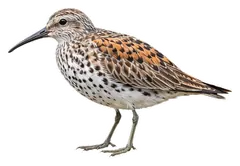 Great KnotCalidris tenuirostris
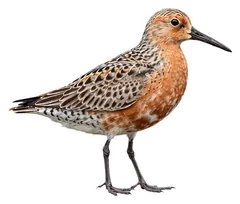 Red KnotCalidris canutus
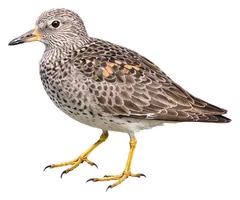 SurfbirdCalidris virgata
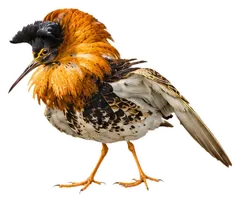 RuffCalidris pugnax
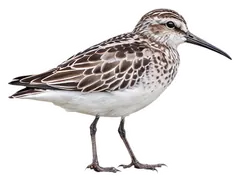 Broad-billed SandpiperCalidris falcinellus
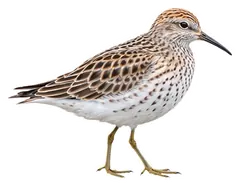 Sharp-tailed SandpiperCalidris acuminata
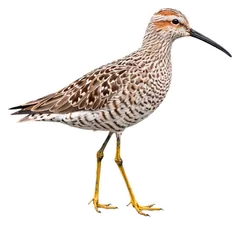 Stilt SandpiperCalidris himantopus
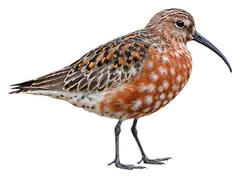 Curlew SandpiperCalidris ferruginea
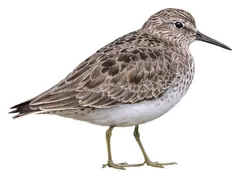 Temminck's StintCalidris temminckii
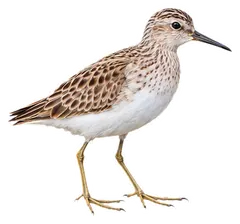 Long-toed StintCalidris subminuta
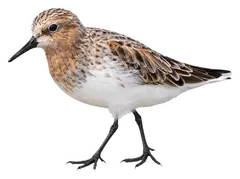 Red-necked StintCalidris ruficollis
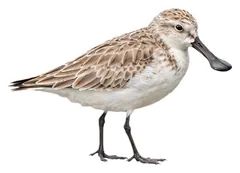 Spoon-billed SandpiperCalidris pygmaea
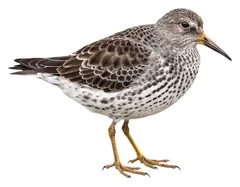
Download illustration
Free to use with credit: “Illustration: Bird Album (birdalbum.com)”. Drawn by AI from a reference photo by André Giraldi. ↗
Heard it but can't see it? Mingji identifies birds by sound and photo, on your phone.