 Bird Album
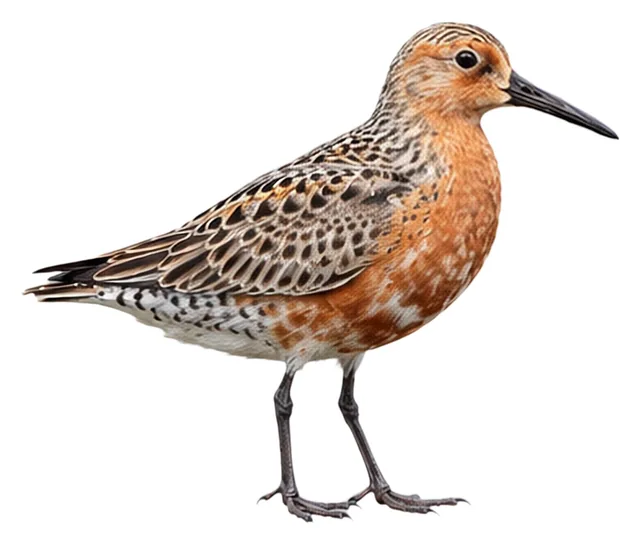
Red Knot
Calidris canutus (Linnaeus, 1758)
23–26 cmLength50 cmWingspan142 gWeight
This medium-sized shorebird has a cinnamon face, throat and breast in breeding plumage and is pale gray overall in winter plumage.
Busiest months: August–September · Most records: United States, United Kingdom, Canada
How to identify
Field marks
- White wing-bar in flight; rump and tail gray
- Face, throat and breast cinnamon in breeding plumage
- Legs and feet short and dark green, giving a low stance when foraging
- Bill dark, moderately slender and no longer than the head
Male, female and young
Sexes similar in winter plumage; female slightly paler in breeding plumage, with a fainter eyestripe; first-year juvenile has brown coverts with distinct submarginal lines.
Voice
Gives a low single note, “knutt”, in flock flight, and a double note, “knuup-knuup”, on migration.
Where and when it's recorded
Busiest months: August–September · Most records: United States, United Kingdom, Canada

Red Knot has been recorded at 1,556 of the 8,276 birding hotspots we track, in 127 countries and regions.
Records by month Northern Hemisphere
Where it's recorded most
- Fort De Soto ParkUnited States7,072 records
- Titchwell Marsh RSPB ReserveUnited Kingdom3,595 records
- Bolivar Flats Shorebird SanctuaryUnited States2,889 records
More places
- Spurn Bird Observatory Recording AreaUnited Kingdom2,378 records
- Bolsa Chica Ecological ReserveUnited States2,342 records
- Paul do Cabo da PraiaPortugal2,014 records
- Longridge PointCanada2,000 records
- Parker River NWRUnited States1,940 records
- Stone Harbor PointUnited States1,922 records
- Huguenot Memorial City ParkUnited States1,754 records
Countries and regions with the most records
eBird records via GBIF up to 2024-12-31. A record means someone listed it; more records partly mean more birders, not more birds.
About
The red knot or just knot (Calidris canutus) is a medium-sized shorebird which breeds in tundra and the Arctic Cordillera in the far north of Canada, Europe, and Russia. It is the type species of the genus Calidris. Six subspecies are recognised.
Excerpt from Wikipedia, CC BY-SA 4.0 · authors · Read more on Wikipedia
Questions
How big is the Red Knot?
The Red Knot is about 23–26 cm long, with a wingspan of 50 cm and weighs around 142 g.
Where does the Red Knot live?
Its breeding range: North America, Palearctic: patchily in high Arctic (mainly) tundra of Holarctic: northwestern, eastern Greenland, north-central Siberia, islands north of north-central and northeastern Siberia, and northern Chukotskiy Peninsula (northeastern Siberia). It is most often recorded in United States, United Kingdom and Canada.
When is the best time to see the Red Knot?
At the hotspots we track, it is recorded most in August and September (Northern Hemisphere).
Is the Red Knot endangered?
The IUCN Red List classifies the Red Knot as Near Threatened.
What does the Red Knot eat?
Main food: Fish, shrimp & shellfish.
What family is the Red Knot in?
It belongs to the family Sandpipers, Snipes (Scolopacidae), order Charadriiformes.
At a glance
- Length
- 23–26 cm
- Wingspan
- 50 cm
- Weight
- 142 g
- Habitat
- Coast & tidal flats
- Diet
- Fish, shrimp & shellfish
- Lifestyle
- Active on the ground
- Migration
- Migratory
- Conservation
- Near Threatened
More measurements
- Wing
- 164 mm
- Tail
- 60 mm
- Bill
- 38 mm
- Tarsus
- 30 mm
Averages from the AVONET dataset; length from field guides where available.
Range
North America, Palearctic: patchily in high Arctic (mainly) tundra of Holarctic: northwestern, eastern Greenland, north-central Siberia, islands north of north-central and northeastern Siberia, and northern Chukotskiy Peninsula (northeastern Siberia)
Breeding range, IOC World Bird List 15.2
Classification
- Order
- Charadriiformes
- Family
- Sandpipers, Snipes Scolopacidae
- Genus
- Calidris
Other birds in the genus Calidris
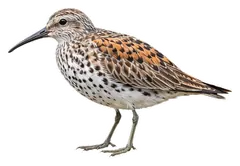 Great KnotCalidris tenuirostris
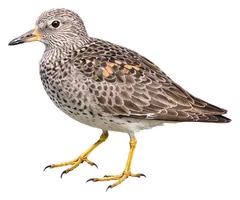 SurfbirdCalidris virgata
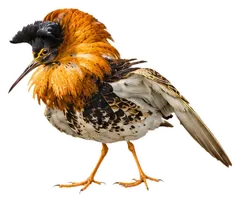 RuffCalidris pugnax
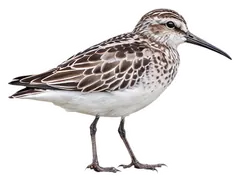 Broad-billed SandpiperCalidris falcinellus
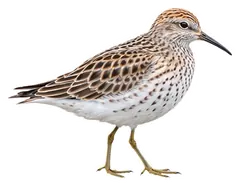 Sharp-tailed SandpiperCalidris acuminata
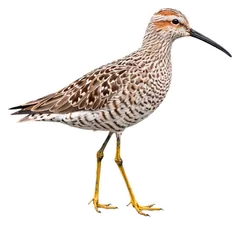 Stilt SandpiperCalidris himantopus
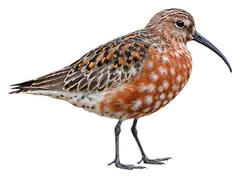 Curlew SandpiperCalidris ferruginea
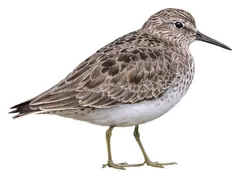 Temminck's StintCalidris temminckii
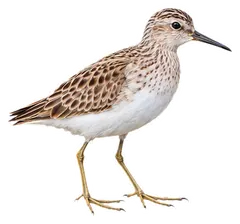 Long-toed StintCalidris subminuta
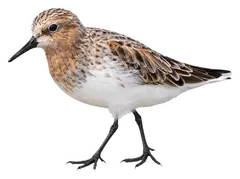 Red-necked StintCalidris ruficollis
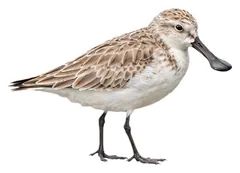 Spoon-billed SandpiperCalidris pygmaea
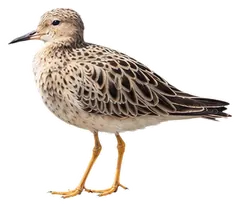 Buff-breasted SandpiperCalidris subruficollis
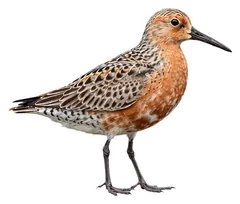
Download illustration
Free to use with credit: “Illustration: Bird Album (birdalbum.com)”. Drawn by AI from a reference photo by Chuck Homler d/b/a Focus On Wildlife. ↗

Heard it but can't see it? Mingji identifies birds by sound and photo, on your phone.