 Bird Album
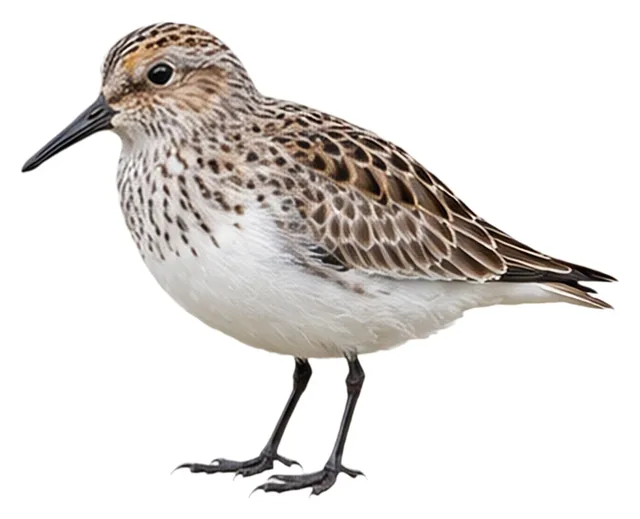
How to identify
Field marks
- Almost entirely white in winter plumage, with dark patches on scapulars
- No hind toe
- Conspicuous white wing-bar in flight
- Face and throat turn brick-red in summer plumage
Male, female and young
Juvenile has black-and-white feathers, with stronger contrast than in the adult.
Similar species
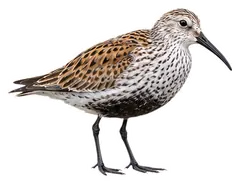
Where and when it's recorded

Sanderling has been recorded at 2,231 of the 8,171 birding hotspots we track, in 182 countries and regions.
Records by month Northern Hemisphere
Where it's recorded most
- Fort De Soto ParkUnited States17,158 records
- Parker River NWRUnited States8,600 records
- Bolivar Flats Shorebird SanctuaryUnited States8,491 records
More places
- Montrose Point Bird Sanctuary, Lincoln Park, ChicagoUnited States8,397 records
- Stone Harbor PointUnited States6,461 records
- San Carlos Bay/Bunche Beach PreserveUnited States6,213 records
- Huntington Beach SPUnited States6,113 records
- Milford Point, CT AudubonUnited States5,769 records
- Chincoteague NWRUnited States5,668 records
- Long Point – TipCanada5,502 records
Countries and regions with the most records
eBird records via GBIF up to 2024-12-31. A record means someone listed it; more records partly mean more birders, not more birds.
About
The sanderling (Calidris alba) is a small wading bird. It is a circumpolar Arctic breeder, being among the most extreme northern breeding birds in the world, nesting only on the coldest tundra, north of the 5°C July isotherm; in Europe, its southernmost breeding locality is Svalbard, where only a handful (5–15) pairs breed. It is a long-distance migrant, wintering south to South America, western and southern Europe, Africa, and Australia.
Excerpt from Wikipedia, CC BY-SA 4.0 · authors · Read more on Wikipedia
Questions
How big is the Sanderling?
The Sanderling is about 18–20 cm long, with a wingspan of 35 cm and weighs around 52 g.
Where does the Sanderling live?
Its breeding range: North America, Palearctic: high Arctic tundra wetlands of Holarctic: northwestern, southeastern Greenland, Svalbard (north of Norway), northern Taymyr Peninsula and Severnaya Zemlya (to northern), Lena Delta and New Siberian Islands (north-central Siberia), Alaskan North Slope (rare), Canadian Arctic islands from Banks to Ellesmere and south to Southampton. It is most often recorded in United States, Canada and United Kingdom.
When is the best time to see the Sanderling?
At the hotspots we track, it is recorded most in September (Northern Hemisphere).
Is the Sanderling endangered?
The IUCN Red List classifies the Sanderling as Least Concern.
What does the Sanderling eat?
Main food: Fish, shrimp & shellfish.
What family is the Sanderling in?
It belongs to the family Sandpipers, Snipes (Scolopacidae), order Charadriiformes.
At a glance
- Length
- 18–20 cm
- Wingspan
- 35 cm
- Weight
- 52 g
- Habitat
- Coast & tidal flats
- Diet
- Fish, shrimp & shellfish
- Lifestyle
- Active on the ground
- Migration
- Migratory
- Conservation
- Least Concern
More measurements
- Wing
- 120 mm
- Tail
- 50 mm
- Bill
- 30 mm
- Tarsus
- 23 mm
Averages from the AVONET dataset; length from field guides where available.
Range
North America, Palearctic: high Arctic tundra wetlands of Holarctic: northwestern, southeastern Greenland, Svalbard (north of Norway), northern Taymyr Peninsula and Severnaya Zemlya (to northern), Lena Delta and New Siberian Islands (north-central Siberia), Alaskan North Slope (rare), Canadian Arctic islands from Banks to Ellesmere and south to Southampton
Breeding range, IOC World Bird List 15.2
Classification
- Order
- Charadriiformes
- Family
- Sandpipers, Snipes Scolopacidae
- Genus
- Calidris
Other birds in the genus Calidris
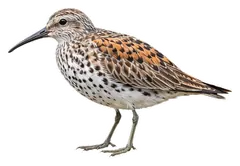 Great KnotCalidris tenuirostris
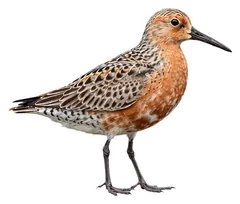 Red KnotCalidris canutus
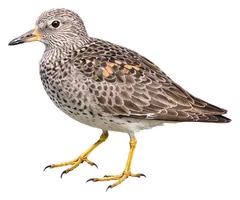 SurfbirdCalidris virgata
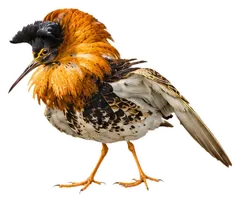 RuffCalidris pugnax
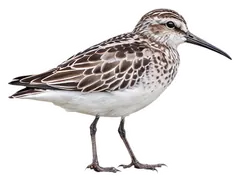 Broad-billed SandpiperCalidris falcinellus
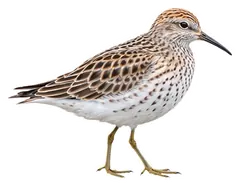 Sharp-tailed SandpiperCalidris acuminata
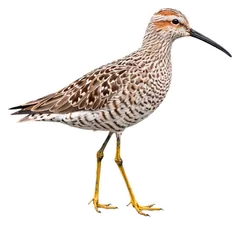 Stilt SandpiperCalidris himantopus
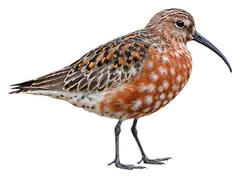 Curlew SandpiperCalidris ferruginea
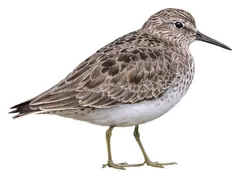 Temminck's StintCalidris temminckii
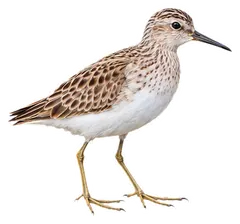 Long-toed StintCalidris subminuta
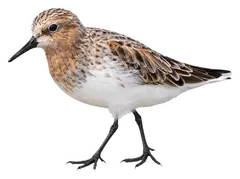 Red-necked StintCalidris ruficollis
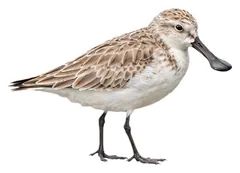 Spoon-billed SandpiperCalidris pygmaea
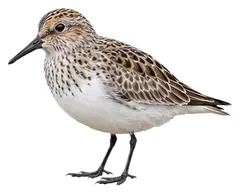
Download illustration
Free to use with credit: “Illustration: Bird Album (birdalbum.com)”. Drawn by AI from a reference photo by Chuck Homler, Focus On Wildlife. ↗

Heard it but can't see it? Mingji identifies birds by sound and photo, on your phone.