 Bird Album
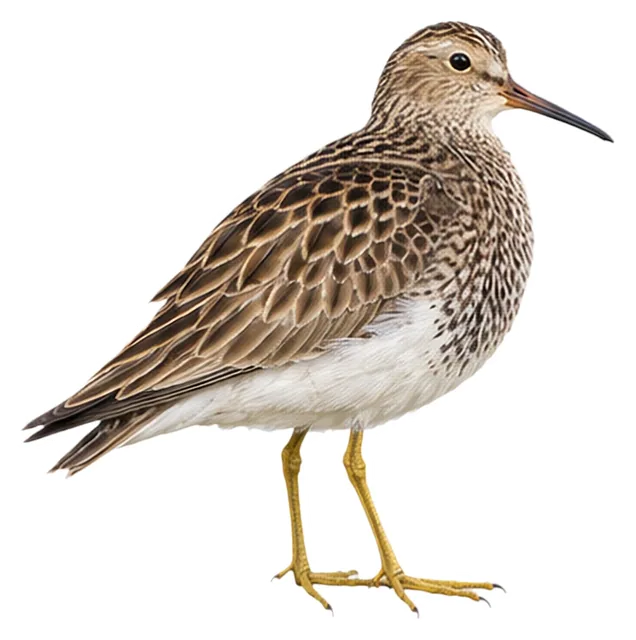
Pectoral Sandpiper
Calidris melanotos (Vieillot, 1819)
21 cmLength41 cmWingspan80 gWeight
The sharply defined lower edge of its gray breast-band gives this bird its English name.
Busiest months: September · Most records: United States, Canada, Australia
Looks like Sharp-tailed Sandpiper
How to identify
Field marks
- Breast gray, with a sharply defined lower edge
- Bill olive, with a darker tip
- Legs and feet yellowish-brown
- Back gray-brown, grayest in winter
Male, female and young
Juvenile has more vivid upperpart markings, with rufous and white patches on the back; male has a blacker breast dotted with white spots in the breeding season.
Similar species
Where and when it's recorded

Pectoral Sandpiper has been recorded at 1,703 of the 8,171 birding hotspots we track, in 124 countries and regions.
Records by month Northern Hemisphere
Where it's recorded most
- Hornsby BendUnited States7,231 records
- Eagle Bluffs CAUnited States4,764 records
- Hagerman NWRUnited States4,352 records
More places
- Cape Island – South Cape May MeadowsUnited States4,177 records
- Ensley Bottoms – Maxson Wastewater Lagoons/Earth ComplexUnited States4,001 records
- St. Paul IslandUnited States3,047 records
- Muskegon Wastewater SystemUnited States3,002 records
- Pte. Mouillee SGAUnited States2,676 records
- Edwin B. Forsythe NWRUnited States2,636 records
- Bald Knob NWRUnited States2,467 records
Countries and regions with the most records
eBird records via GBIF up to 2024-12-31. A record means someone listed it; more records partly mean more birders, not more birds.
About
The pectoral sandpiper (Calidris melanotos), often abbreviated pec, is a small, migratory wader that breeds in arctic regions of North America and Asia, wintering in South America and Oceania. It eats small invertebrates. Its nest, a hole scraped in the ground and with a thick lining, is deep enough to protect its four eggs from the cool breezes of its breeding grounds.
Excerpt from Wikipedia, CC BY-SA 4.0 · authors · Read more on Wikipedia
Questions
How big is the Pectoral Sandpiper?
The Pectoral Sandpiper is about 21 cm long, with a wingspan of 41 cm and weighs around 80 g.
Where does the Pectoral Sandpiper live?
Its breeding range: North America, Palearctic: high to low Arctic wet tundra of Holarctic: Yamal Peninsula (northwestern Siberia) east to Chukotskiy Peninsula, south to Anadyr, including New Siberian and Wrangel islands (northeastern Russia); western, northern Alaska through northeastern Canada, including Arctic islands from Banks to Devon and Southampton (northeastern Canada). It is most often recorded in United States, Canada and Australia.
When is the best time to see the Pectoral Sandpiper?
At the hotspots we track, it is recorded most in September (Northern Hemisphere).
Is the Pectoral Sandpiper endangered?
The IUCN Red List classifies the Pectoral Sandpiper as Least Concern.
What does the Pectoral Sandpiper eat?
Main food: Fish, shrimp & shellfish.
What family is the Pectoral Sandpiper in?
It belongs to the family Sandpipers, Snipes (Scolopacidae), order Charadriiformes.
At a glance
- Length
- 21 cm
- Wingspan
- 41 cm
- Weight
- 80 g
- Habitat
- Wetland
- Diet
- Fish, shrimp & shellfish
- Lifestyle
- Active on the ground
- Migration
- Migratory
- Conservation
- Least Concern
More measurements
- Wing
- 125 mm
- Tail
- 54 mm
- Bill
- 32 mm
- Tarsus
- 26 mm
Averages from the AVONET dataset; length from field guides where available.
Range
North America, Palearctic: high to low Arctic wet tundra of Holarctic: Yamal Peninsula (northwestern Siberia) east to Chukotskiy Peninsula, south to Anadyr, including New Siberian and Wrangel islands (northeastern Russia); western, northern Alaska through northeastern Canada, including Arctic islands from Banks to Devon and Southampton (northeastern Canada)
Breeding range, IOC World Bird List 15.2
Classification
- Order
- Charadriiformes
- Family
- Sandpipers, Snipes Scolopacidae
- Genus
- Calidris
Other birds in the genus Calidris
 Great KnotCalidris tenuirostris
 Red KnotCalidris canutus
 SurfbirdCalidris virgata
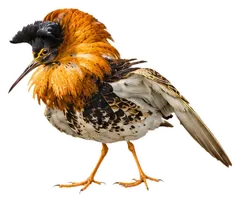 RuffCalidris pugnax
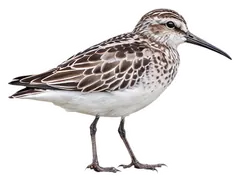 Broad-billed SandpiperCalidris falcinellus
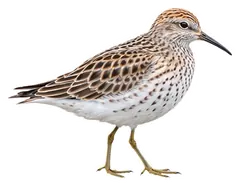 Sharp-tailed SandpiperCalidris acuminata
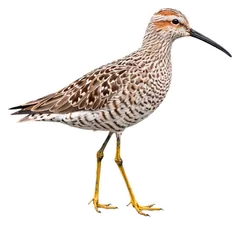 Stilt SandpiperCalidris himantopus
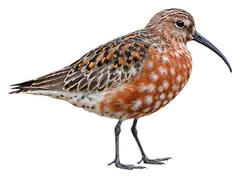 Curlew SandpiperCalidris ferruginea
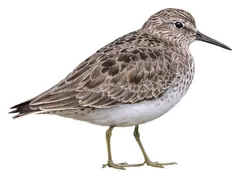 Temminck's StintCalidris temminckii
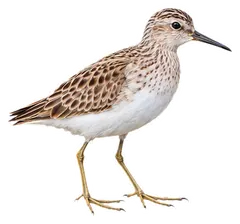 Long-toed StintCalidris subminuta
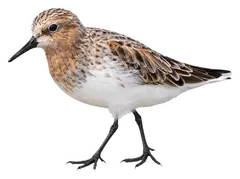 Red-necked StintCalidris ruficollis
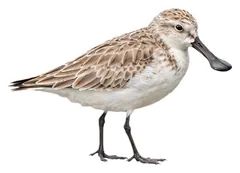 Spoon-billed SandpiperCalidris pygmaea
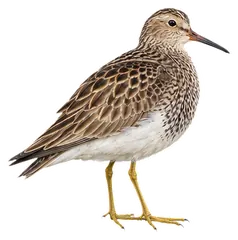
Download illustration
Free to use with credit: “Illustration: Bird Album (birdalbum.com)”. Drawn by AI from a reference photo by Tom_Reichner. ↗
Heard it but can't see it? Mingji identifies birds by sound and photo, on your phone.
In other languages
- EnglishPectoral Sandpiper
- 简体中文斑胸滨鹬
- 繁體中文美洲尖尾濱鷸
- 日本語アメリカウズラシギ
- 한국어아메리카메추라기도요
- DeutschGraubrust-Strandläufer
- FrançaisBécasseau à poitrine cendrée
- EspañolCorrelimos pectoral
- Portuguêspilrito-de-colete
- ItalianoPiovanello pettorale
- NederlandsGestreepte Strandloper
- РусскийДутыш
- Svenskatuvsnäppa
- DanskStribet Ryle
- Polskibiegus arktyczny