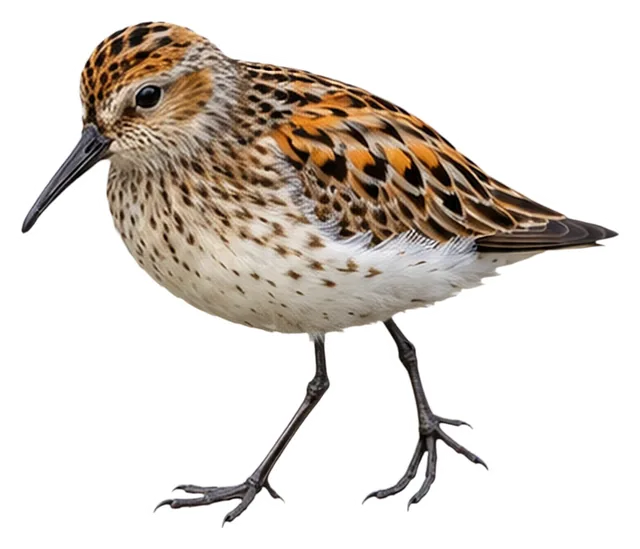
Western Sandpiper
Calidris mauri (Cabanis, 1857)
≈16 cmLength33 cmWingspan28 gWeight
This small sandpiper has dark legs and feet and a short, slender, dark bill tapering to a finer tip as an adult.
Busiest months: August–September · Most records: United States, Canada, Mexico
How to identify
Field marks
- Adult crown may be rufous
- Adult bill short, slender and dark, tapering to a finer tip
- Adult legs and feet dark
- Adult upperparts may be rufous; underparts white
Where and when it's recorded
Busiest months: August–September · Most records: United States, Canada, Mexico

Western Sandpiper has been recorded at 787 of the 8,276 birding hotspots we track, in 56 countries and regions.
Records by month Northern Hemisphere
Where it's recorded most
- IRWD San Joaquin Marsh & Wildlife Sanctuary, IrvineUnited States8,751 records
- Bolsa Chica Ecological ReserveUnited States7,862 records
- San Diego River mudflatsUnited States7,804 records
More places
- Willcox – Lake Cochise and Twin Lakes Golf CourseUnited States7,271 records
- Fort De Soto ParkUnited States6,683 records
- Bolivar Flats Shorebird SanctuaryUnited States5,187 records
- Billy Frank Jr. Nisqually NWRUnited States5,022 records
- San Carlos Bay/Bunche Beach PreserveUnited States4,683 records
- Arcata Marsh and Wildlife SanctuaryUnited States4,344 records
- Edwin B. Forsythe NWRUnited States3,893 records
Countries and regions with the most records
eBird records via GBIF up to 2024-12-31. A record means someone listed it; more records partly mean more birders, not more birds.
About
The western sandpiper (Calidris mauri) is a small migratory shorebird. The genus name is from Ancient Greek kalidris or skalidris, a term used by Aristotle for some grey-coloured waterside birds. The specific mauri commemorates Italian botanist Ernesto Mauri (1791–1836).
Excerpt from Wikipedia, CC BY-SA 4.0 · authors · Read more on Wikipedia
Questions
How big is the Western Sandpiper?
The Western Sandpiper is about ≈16 cm long, with a wingspan of 33 cm and weighs around 28 g.
Where does the Western Sandpiper live?
Its breeding range: North America, Palearctic: Chukotskiy Peninsula south to Anadyr (northeastern Siberia; few), St. Lawrence Island (Bering Sea) and western, northern Alaska mainland. It is most often recorded in United States, Canada and Mexico.
When is the best time to see the Western Sandpiper?
At the hotspots we track, it is recorded most in August and September (Northern Hemisphere).
Is the Western Sandpiper endangered?
The IUCN Red List classifies the Western Sandpiper as Least Concern.
What does the Western Sandpiper eat?
Main food: Fish, shrimp & shellfish.
What family is the Western Sandpiper in?
It belongs to the family Sandpipers, Snipes (Scolopacidae), order Charadriiformes.
At a glance
- Length
- ≈16 cm
- Wingspan
- 33 cm
- Weight
- 28 g
- Habitat
- Shrubland
- Diet
- Fish, shrimp & shellfish
- Lifestyle
- Active on the ground
- Migration
- Migratory
- Conservation
- Least Concern
More measurements
- Wing
- 92 mm
- Tail
- 38 mm
- Bill
- 21 mm
- Tarsus
- 21 mm
Averages from the AVONET dataset; length from field guides where available.
Range
North America, Palearctic: Chukotskiy Peninsula south to Anadyr (northeastern Siberia; few), St. Lawrence Island (Bering Sea) and western, northern Alaska mainland
Breeding range, IOC World Bird List 15.2
Classification
- Order
- Charadriiformes
- Family
- Sandpipers, Snipes Scolopacidae
- Genus
- Calidris
Other birds in the genus Calidris
 Great KnotCalidris tenuirostris
 Red KnotCalidris canutus
 SurfbirdCalidris virgata
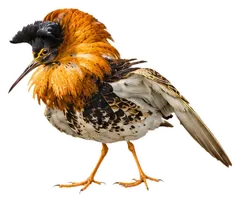 RuffCalidris pugnax
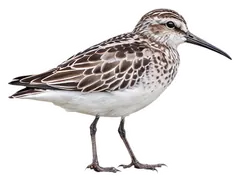 Broad-billed SandpiperCalidris falcinellus
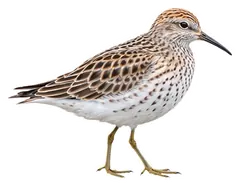 Sharp-tailed SandpiperCalidris acuminata
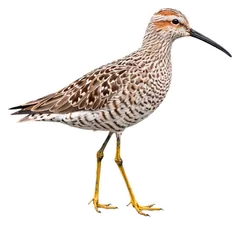 Stilt SandpiperCalidris himantopus
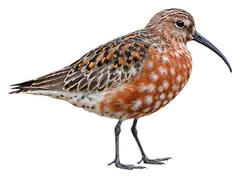 Curlew SandpiperCalidris ferruginea
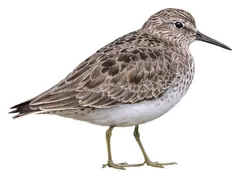 Temminck's StintCalidris temminckii
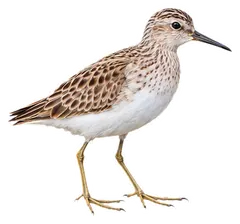 Long-toed StintCalidris subminuta
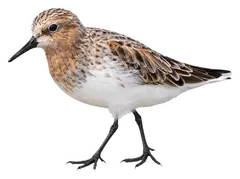 Red-necked StintCalidris ruficollis
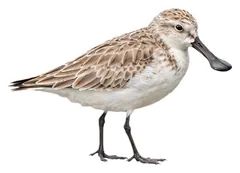 Spoon-billed SandpiperCalidris pygmaea
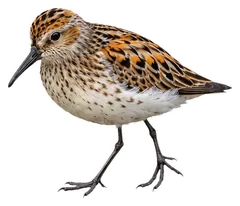
Download illustration
Free to use with credit: “Illustration: Bird Album (birdalbum.com)”. Drawn by AI from a reference photo by Dan Vickers. ↗
Heard it but can't see it? Mingji identifies birds by sound and photo, on your phone.
In other languages
- EnglishWestern Sandpiper
- 简体中文西方滨鹬
- 繁體中文西濱鷸
- 日本語ヒメハマシギ
- 한국어긴부리좀도요
- DeutschBergstrandläufer
- FrançaisBécasseau d’Alaska
- EspañolCorrelimos de Alaska
- Portuguêspilrito-miúdo
- ItalianoGambecchio dell’Alaska
- NederlandsAlaskastrandloper
- РусскийПерепончатопалый песочник
- Svenskatundrasnäppa
- DanskAlaskaryle
- Polskibiegus alaskański