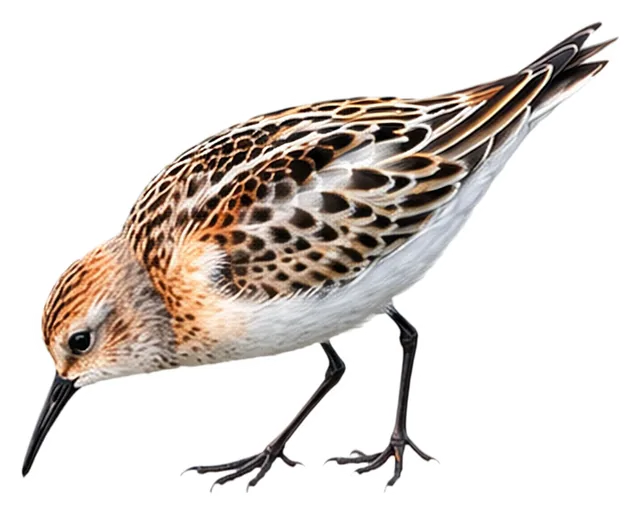
Little Stint
Calidris minuta (Leisler, 1812)
≈15 cmLength36 cmWingspan21 gWeight
This very small wader has a slender bill and dark legs and feet, and moves faster than most waders.
Busiest months: September · Most records: Spain, Israel, India
How to identify
Field marks
- Bill long, slender and dark; legs and feet dark
- Long primary projection; toes without webbing
- Breast orange and throat white in the breeding season
- White V-shaped marking on the back in the breeding season
Male, female and young
Juvenile has pale stripes on the crown and a pinkish breast.
Voice
A sharp “stit”.
Where and when it's recorded
Busiest months: September · Most records: Spain, Israel, India

Little Stint has been recorded at 1,731 of the 8,276 birding hotspots we track, in 133 countries and regions.
Records by month Northern Hemisphere
Where it's recorded most
- International Birding and Research Center Eilat (IBRCE)Israel4,768 records
- Eilat – KM20 Flamingo Pools 20Israel3,613 records
- Private estate near Green MubazzarahUnited Arab Emirates2,549 records
More places
- Paul do Cabo da PraiaPortugal1,752 records
- Titchwell Marsh RSPB ReserveUnited Kingdom1,649 records
- Desembocadura del Guadalhorce – ÁreaSpain1,430 records
- Frampton Marsh RSPB ReserveUnited Kingdom1,374 records
- Cley & Salthouse Marshes NWT NR – Cley Marshes including Hides and Visitor CentreUnited Kingdom1,330 records
- L'Albufera PNat – El Raco de l'OllaSpain1,189 records
- Hama'apil FishpondsIsrael1,179 records
Countries and regions with the most records
eBird records via GBIF up to 2024-12-31. A record means someone listed it; more records partly mean more birders, not more birds.
About
The little stint (Calidris minuta) is a very small wader. It breeds in arctic Europe and Asia, and is a long-distance migrant, wintering south to Africa and south Asia. It occasionally is a vagrant to North America and to Australia.
Excerpt from Wikipedia, CC BY-SA 4.0 · authors · Read more on Wikipedia
Questions
How big is the Little Stint?
The Little Stint is about ≈15 cm long, with a wingspan of 36 cm and weighs around 21 g.
Where does the Little Stint live?
Its breeding range: Palearctic: high to low Arctic drier tundra of northern Palearctic: far northern Scandinavia, White Sea coast, southern Novaya Zemlya, through northern Russia to New Siberian Islands (east-central Siberia). It is most often recorded in Spain, Israel and India.
When is the best time to see the Little Stint?
At the hotspots we track, it is recorded most in September (Northern Hemisphere).
Is the Little Stint endangered?
The IUCN Red List classifies the Little Stint as Least Concern.
What does the Little Stint eat?
Main food: Fish, shrimp & shellfish.
What family is the Little Stint in?
It belongs to the family Sandpipers, Snipes (Scolopacidae), order Charadriiformes.
At a glance
- Length
- ≈15 cm
- Wingspan
- 36 cm
- Weight
- 21 g
- Habitat
- Grassland
- Diet
- Fish, shrimp & shellfish
- Lifestyle
- Active on the ground
- Migration
- Migratory
- Conservation
- Least Concern
More measurements
- Wing
- 93 mm
- Tail
- 36 mm
- Bill
- 20 mm
- Tarsus
- 22 mm
Averages from the AVONET dataset; length from field guides where available.
Range
Palearctic: high to low Arctic drier tundra of northern Palearctic: far northern Scandinavia, White Sea coast, southern Novaya Zemlya, through northern Russia to New Siberian Islands (east-central Siberia)
Breeding range, IOC World Bird List 15.2
Classification
- Order
- Charadriiformes
- Family
- Sandpipers, Snipes Scolopacidae
- Genus
- Calidris
Other birds in the genus Calidris
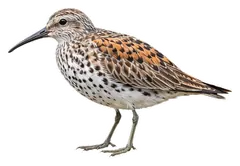 Great KnotCalidris tenuirostris
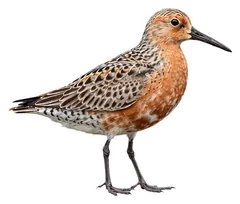 Red KnotCalidris canutus
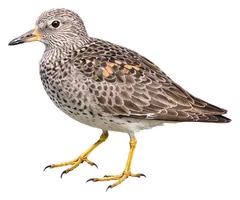 SurfbirdCalidris virgata
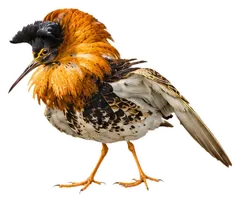 RuffCalidris pugnax
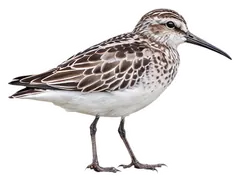 Broad-billed SandpiperCalidris falcinellus
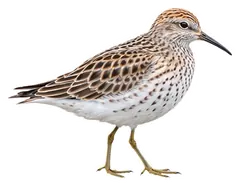 Sharp-tailed SandpiperCalidris acuminata
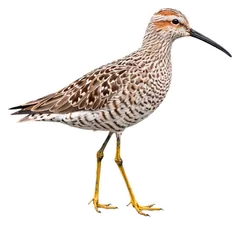 Stilt SandpiperCalidris himantopus
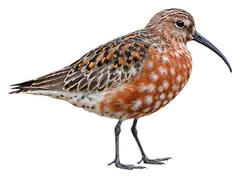 Curlew SandpiperCalidris ferruginea
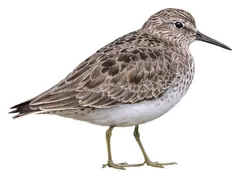 Temminck's StintCalidris temminckii
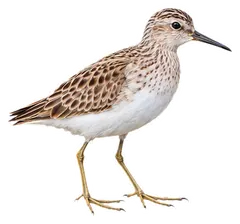 Long-toed StintCalidris subminuta
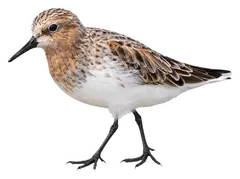 Red-necked StintCalidris ruficollis
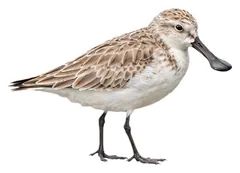 Spoon-billed SandpiperCalidris pygmaea
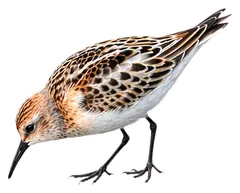
Download illustration
Free to use with credit: “Illustration: Bird Album (birdalbum.com)”. Drawn by AI from a reference photo by naturpel. ↗
Heard it but can't see it? Mingji identifies birds by sound and photo, on your phone.