 Bird Album
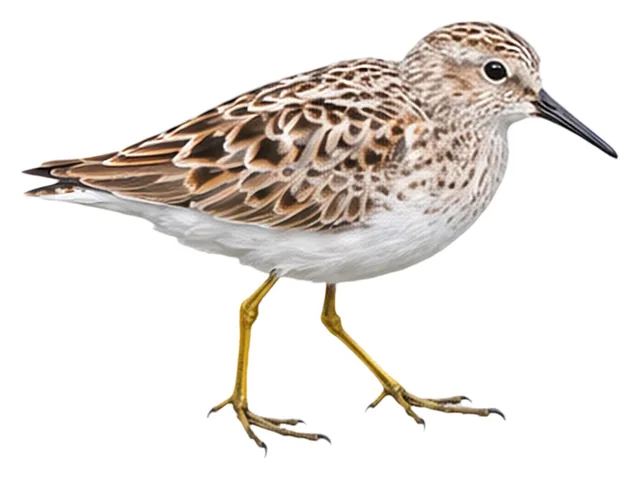
Least Sandpiper
Calidris minutilla (Vieillot, 1819)
13–15 cmLength23 gWeight
The least sandpiper (Calidris minutilla) is the smallest shorebird.
Busiest months: August · Most records: United States, Canada, Mexico
Where and when it's recorded

Least Sandpiper has been recorded at 1,314 of the 8,171 birding hotspots we track, in 61 countries and regions.
Records by month Northern Hemisphere
Where it's recorded most
- Riparian Preserve at Gilbert Water RanchUnited States17,997 records
- Hornsby BendUnited States16,237 records
- Estero Llano Grande SP WBCUnited States14,908 records
More places
- Fort De Soto ParkUnited States11,133 records
- Cape Island – South Cape May MeadowsUnited States10,561 records
- Parker River NWRUnited States10,089 records
- Willcox – Lake Cochise and Twin Lakes Golf CourseUnited States9,682 records
- Edwin B. Forsythe NWRUnited States9,061 records
- Billy Frank Jr. Nisqually NWRUnited States8,737 records
- IRWD San Joaquin Marsh & Wildlife Sanctuary, IrvineUnited States8,524 records
Countries and regions with the most records
eBird records via GBIF up to 2024-12-31. A record means someone listed it; more records partly mean more birders, not more birds.
About
The least sandpiper (Calidris minutilla) is the smallest shorebird. The genus name is from Ancient Greek kalidris or skalidris, a term used by Aristotle for some grey-coloured waterside birds. The specific minutilla is Medieval Latin for "very small".
Excerpt from Wikipedia, CC BY-SA 4.0 · authors · Read more on Wikipedia
Questions
How big is the Least Sandpiper?
The Least Sandpiper is about 13–15 cm long and weighs around 23 g.
Where does the Least Sandpiper live?
Its breeding range: North America: low Arctic and subarctic northern Nearctic tundra and taiga wetlands: eastern Aleutian Islands, all Alaskan mainland, northern Canada from northern Yukon to northern British Columbia, east to southern James Bay, Ungava Peninsula, Labrador and Nova Scotia. It is most often recorded in United States, Canada and Mexico.
When is the best time to see the Least Sandpiper?
At the hotspots we track, it is recorded most in August (Northern Hemisphere).
Is the Least Sandpiper endangered?
The IUCN Red List classifies the Least Sandpiper as Near Threatened.
What does the Least Sandpiper eat?
Main food: Fish, shrimp & shellfish.
What family is the Least Sandpiper in?
It belongs to the family Sandpipers, Snipes (Scolopacidae), order Charadriiformes.
At a glance
- Length
- 13–15 cm
- Weight
- 23 g
- Habitat
- Wetland
- Diet
- Fish, shrimp & shellfish
- Lifestyle
- Active on the ground
- Migration
- Migratory
- Conservation
- Near Threatened
More measurements
- Wing
- 86 mm
- Tail
- 39 mm
- Bill
- 20 mm
- Tarsus
- 18 mm
Averages from the AVONET dataset; length from field guides where available.
Range
North America: low Arctic and subarctic northern Nearctic tundra and taiga wetlands: eastern Aleutian Islands, all Alaskan mainland, northern Canada from northern Yukon to northern British Columbia, east to southern James Bay, Ungava Peninsula, Labrador and Nova Scotia
Breeding range, IOC World Bird List 15.2
Classification
- Order
- Charadriiformes
- Family
- Sandpipers, Snipes Scolopacidae
- Genus
- Calidris
Other birds in the genus Calidris
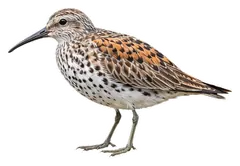 Great KnotCalidris tenuirostris
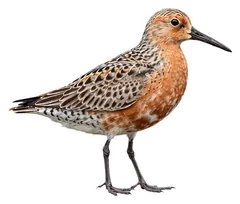 Red KnotCalidris canutus
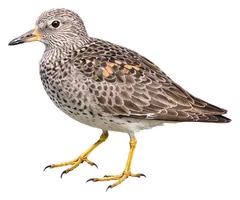 SurfbirdCalidris virgata
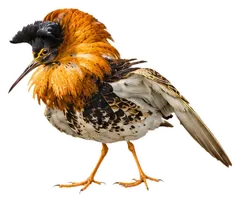 RuffCalidris pugnax
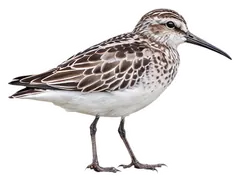 Broad-billed SandpiperCalidris falcinellus
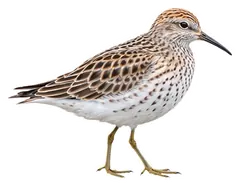 Sharp-tailed SandpiperCalidris acuminata
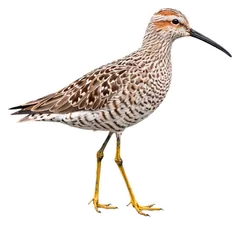 Stilt SandpiperCalidris himantopus
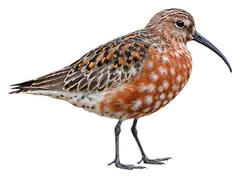 Curlew SandpiperCalidris ferruginea
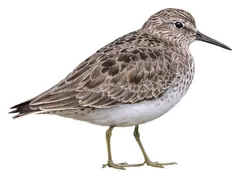 Temminck's StintCalidris temminckii
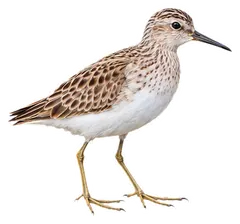 Long-toed StintCalidris subminuta
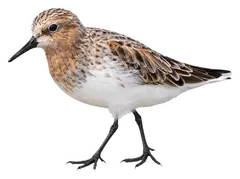 Red-necked StintCalidris ruficollis
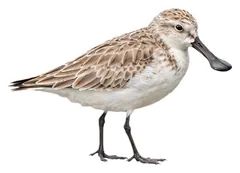 Spoon-billed SandpiperCalidris pygmaea
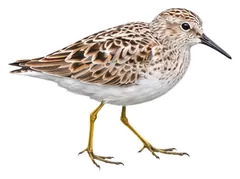
Download illustration
Free to use with credit: “Illustration: Bird Album (birdalbum.com)”. Drawn by AI from a reference photo by Greg Lasley. ↗
Heard it but can't see it? Mingji identifies birds by sound and photo, on your phone.