 Bird Album
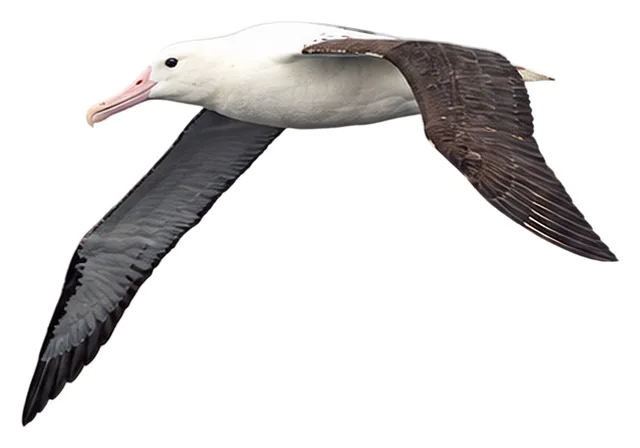
Northern Royal Albatross
Diomedea sanfordi Murphy, 1917
8.9 kgWeight
The northern royal albatross or toroa, (Diomedea sanfordi) is a large seabird in the albatross family.
Busiest months: November–December · Most records: New Zealand, Chile, Australia
Where and when it's recorded

Northern Royal Albatross has been recorded at 32 of the 8,171 birding hotspots we track, in 7 countries and regions.
Records by month Southern Hemisphere
Where it's recorded most
- Kaikoura – offshore – Albatross Encounter pelagicNew Zealand3,508 records
- Eaglehawk Neck Pelagic TripAustralia941 records
- Taiaroa Head – Royal Albatross CentreNew Zealand912 records
More places
- Quintero – PelágicoChile534 records
- Taiaroa Head/Harbour EntranceNew Zealand455 records
- Valparaíso – PelágicoChile416 records
- Aramoana Mole/Harbour EntranceNew Zealand302 records
- Cook Strait FerryNew Zealand142 records
- Poor Knights Shelf AreaNew Zealand124 records
- Kaikoura – Point Kean Seal ColonyNew Zealand89 records
Countries and regions with the most records
eBird records via GBIF up to 2024-12-31. A record means someone listed it; more records partly mean more birders, not more birds.
About
The northern royal albatross or toroa, (Diomedea sanfordi) is a large seabird in the albatross family. It was split from the closely related southern royal albatross as recently as 1998, though not all scientists support that conclusion and some consider both of them to be subspecies of the royal albatross.
Excerpt from Wikipedia, CC BY-SA 4.0 · authors · Read more on Wikipedia
Questions
How big is the Northern Royal Albatross?
The Northern Royal Albatross weighs around 8.9 kg.
Where does the Northern Royal Albatross live?
Its breeding range: Pacific Ocean: Otago Peninsula (southeastern South Island) and Sisters and Forty Fours (Chatham Islands, east of South Island; New Zealand). It is most often recorded in New Zealand, Chile and Australia.
When is the best time to see the Northern Royal Albatross?
At the hotspots we track, it is recorded most in November and December (Southern Hemisphere).
Is the Northern Royal Albatross endangered?
The IUCN Red List classifies the Northern Royal Albatross as Endangered.
What does the Northern Royal Albatross eat?
Main food: Fish, shrimp & shellfish.
What family is the Northern Royal Albatross in?
It belongs to the family Albatrosses (Diomedeidae), order Procellariiformes.
At a glance
- Weight
- 8.9 kg
- Diet
- Fish, shrimp & shellfish
- Lifestyle
- On the water surface
- Migration
- Migratory
- Conservation
- Endangered
More measurements
- Wing
- 611 mm
- Tail
- 176 mm
- Bill
- 173 mm
- Tarsus
- 122 mm
Averages from the AVONET dataset; length from field guides where available.
Range
Pacific Ocean: Otago Peninsula (southeastern South Island) and Sisters and Forty Fours (Chatham Islands, east of South Island; New Zealand)
Breeding range, IOC World Bird List 15.2
Classification
- Order
- Procellariiformes
- Family
- Albatrosses Diomedeidae
- Genus
- Diomedea
Other birds in the genus Diomedea
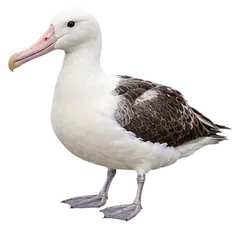 Southern Royal AlbatrossDiomedea epomophora
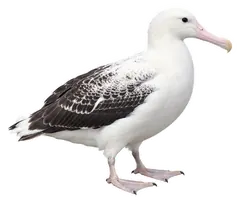 Snowy AlbatrossDiomedea exulans
 Tristan AlbatrossDiomedea dabbenena
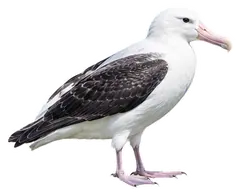 Antipodean AlbatrossDiomedea antipodensis
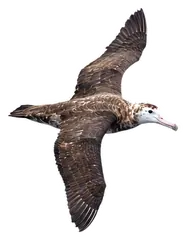 Amsterdam AlbatrossDiomedea amsterdamensis
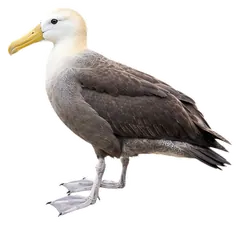 Waved AlbatrossPhoebastria irrorata
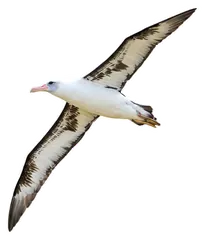 Laysan AlbatrossPhoebastria immutabilis
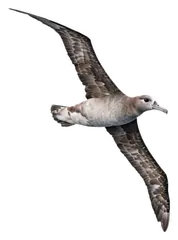 Black-footed AlbatrossPhoebastria nigripes
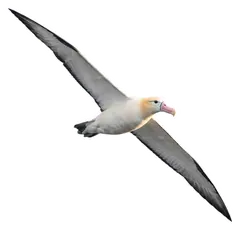 Short-tailed AlbatrossPhoebastria albatrus
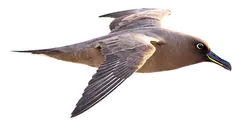 Sooty AlbatrossPhoebetria fusca
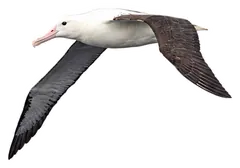
Download illustration
Free to use with credit: “Illustration: Bird Album (birdalbum.com)”. Drawn by AI from a reference photo by Oscar Thomas. ↗
Heard it but can't see it? Mingji identifies birds by sound and photo, on your phone.
In other languages
- EnglishNorthern Royal Albatross
- 简体中文北皇信天翁
- 繁體中文北方皇家信天翁
- 日本語キタシロアホウドリ
- DeutschSchwarzflügelalbatros
- FrançaisAlbatros de Sanford
- EspañolAlbatros real septentrional
- Portuguêsalbatroz-real-setentrional
- ItalianoAlbatros reale del nord
- NederlandsNoordelijke Koningsalbatros
- РусскийСеверный королевский альбатрос
- Svenskanordlig kungsalbatross
- DanskNordlig Kongealbatros
- Polskialbatros ciemnoskrzydły