 Bird Album
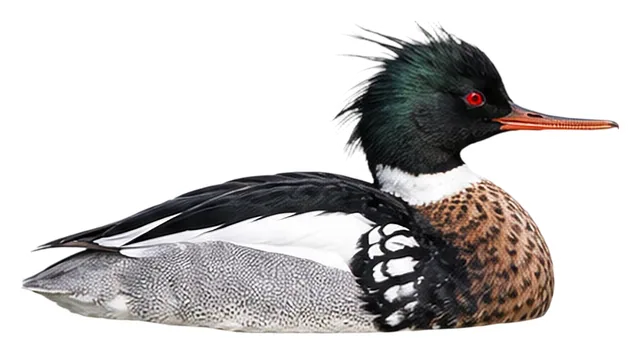
Red-breasted Merganser
Mergus serrator Linnaeus, 1758
51–64 cmLength87 cmWingspan1 kgWeight
It has a pointed crest and a long, slender, red serrated bill, with a reddish-brown breast in the male during the breeding season.
Busiest months: April · Most records: United States, Canada, Iceland
Looks like Common Merganser
How to identify
Field marks
- Pointed crest on the head
- Bill long, slender and red, with tooth-like projections along the edges
- Breeding male has a dark head with a green metallic gloss, and white neck
- Breeding male has a reddish-brown breast, black back and white belly
Male, female and young
Female has a reddish-brown head and gray body; juvenile resembles female, with smaller white wing patches.
Voice
During courtship, female gives a harsh “prrak prrak” and male a cat-like “meow”; mostly quiet at other times.
Similar species
Where and when it's recorded
Busiest months: April · Most records: United States, Canada, Iceland

Red-breasted Merganser has been recorded at 1,602 of the 8,276 birding hotspots we track, in 79 countries and regions.
Records by month Northern Hemisphere
Where it's recorded most
- Point Pelee National ParkCanada14,493 records
- Montrose Point Bird Sanctuary, Lincoln Park, ChicagoUnited States13,898 records
- Tommy Thompson ParkCanada12,153 records
More places
- Toronto – Colonel Samuel Smith ParkCanada12,016 records
- Parker River NWRUnited States9,271 records
- Fort De Soto ParkUnited States8,545 records
- Sandy HookUnited States6,881 records
- Whitefish PointUnited States6,290 records
- Barnegat Lighthouse SPUnited States6,200 records
- Bolsa Chica Ecological ReserveUnited States5,986 records
Countries and regions with the most records
eBird records via GBIF up to 2024-12-31. A record means someone listed it; more records partly mean more birders, not more birds.
About
The red-breasted merganser (Mergus serrator) is a duck species that is native to much of the temperate to subarctic Northern Hemisphere. The red breast that gives the species its common name is only displayed by males in breeding plumage. Individuals fly rapidly, and feed by diving from the surface to pursue aquatic animals underwater, using serrated bills to capture slippery fish.
Excerpt from Wikipedia, CC BY-SA 4.0 · authors · Read more on Wikipedia
Questions
How big is the Red-breasted Merganser?
The Red-breasted Merganser is about 51–64 cm long, with a wingspan of 87 cm and weighs around 1 kg.
Where does the Red-breasted Merganser live?
Its breeding range: North America, Palearctic: southern Greenland, Iceland, northern British Isles, Scandinavia to Sakhalin and Kamchatka peninsulas, and Kuril and Commander islands (southeastern Russia), south through northern Kazakhstan and northeastern China; western Alaska mainland through mainland Canada from Arctic to northern Great Lakes and east to Nova Scotia. It is most often recorded in United States, Canada and Iceland.
When is the best time to see the Red-breasted Merganser?
At the hotspots we track, it is recorded most in April (Northern Hemisphere).
Is the Red-breasted Merganser endangered?
The IUCN Red List classifies the Red-breasted Merganser as Least Concern.
What does the Red-breasted Merganser eat?
Main food: Fish, shrimp & shellfish.
What family is the Red-breasted Merganser in?
It belongs to the family Ducks, Geese, Swans (Anatidae), order Anseriformes.
At a glance
- Length
- 51–64 cm
- Wingspan
- 87 cm
- Weight
- 1 kg
- Habitat
- Wetland
- Diet
- Fish, shrimp & shellfish
- Lifestyle
- On the water surface
- Migration
- Migratory
- Conservation
- Least Concern
More measurements
- Wing
- 234 mm
- Tail
- 76 mm
- Bill
- 65 mm
- Tarsus
- 46 mm
Averages from the AVONET dataset; length from field guides where available.
Range
North America, Palearctic: southern Greenland, Iceland, northern British Isles, Scandinavia to Sakhalin and Kamchatka peninsulas, and Kuril and Commander islands (southeastern Russia), south through northern Kazakhstan and northeastern China; western Alaska mainland through mainland Canada from Arctic to northern Great Lakes and east to Nova Scotia
Breeding range, IOC World Bird List 15.2
Classification
- Order
- Anseriformes
- Family
- Ducks, Geese, Swans Anatidae
- Genus
- Mergus
Other birds in the genus Mergus
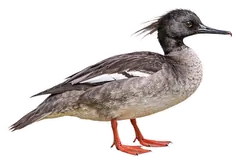 Brazilian MerganserMergus octosetaceus
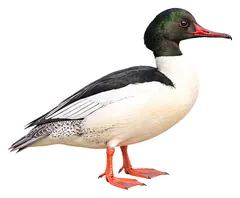 Common MerganserMergus merganser
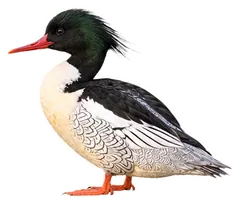 Scaly-sided MerganserMergus squamatus
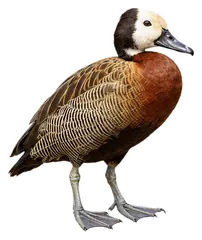 White-faced Whistling DuckDendrocygna viduata
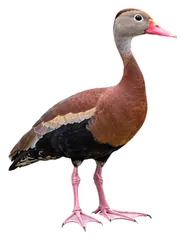 Black-bellied Whistling DuckDendrocygna autumnalis
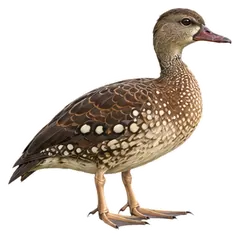 Spotted Whistling DuckDendrocygna guttata
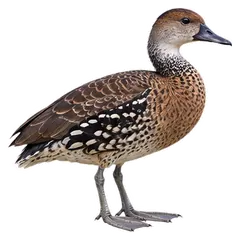 West Indian Whistling DuckDendrocygna arborea
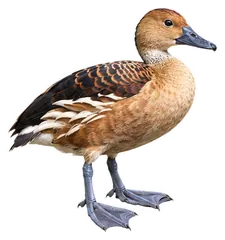 Fulvous Whistling DuckDendrocygna bicolor
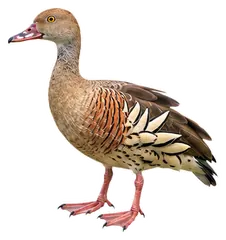 Plumed Whistling DuckDendrocygna eytoni
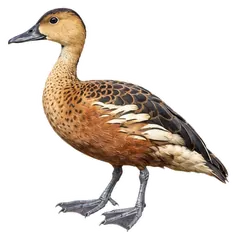 Wandering Whistling DuckDendrocygna arcuata
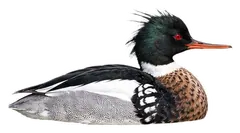
Download illustration
Free to use with credit: “Illustration: Bird Album (birdalbum.com)”. Drawn by AI from a reference photo by Needsmoreritalin. ↗

Heard it but can't see it? Mingji identifies birds by sound and photo, on your phone.