 Bird Album
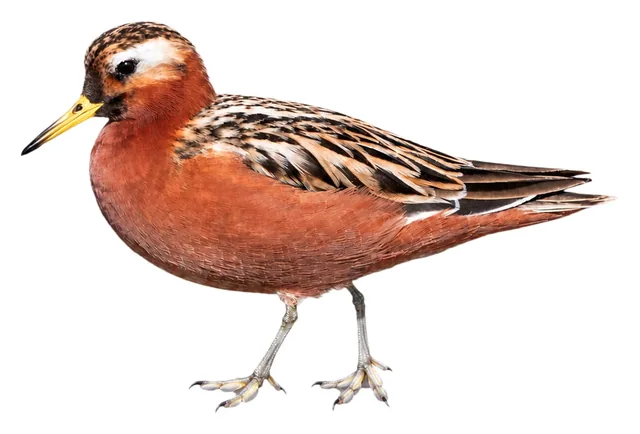
Red Phalarope
Phalaropus fulicarius (Linnaeus, 1758)
≈22 cmLength42 cmWingspan56 gWeight
When foraging, this bird often spins rapidly on the water, stirring up small whirlpools.
Busiest months: November · Most records: United States, Spain, United Kingdom
How to identify
Field marks
- Winter plumage gray above and white below; eye patch black
- Bill black in winter
- Breeding female has a red belly and white cheeks
- Breeding female has a yellow bill with a black tip
Male, female and young
Female is larger and more brightly colored than male; juvenile has a pale gray and rufous back, yellowish-brown belly and dark eye patch.
Voice
A short “beek”.
Where and when it's recorded
Busiest months: November · Most records: United States, Spain, United Kingdom

Red Phalarope has been recorded at 696 of the 8,276 birding hotspots we track, in 74 countries and regions.
Records by month Northern Hemisphere
Where it's recorded most
- St. Paul IslandUnited States4,620 records
- Pt. Pinos – seawatch onlyUnited States3,970 records
- Southeast Farallon IslandUnited States2,419 records
More places
- GambellUnited States2,309 records
- Estaca de Bares – Observatorio de aves y entornoSpain415 records
- Valparaíso – PelágicoChile358 records
- Toronto – Colonel Samuel Smith ParkCanada240 records
- Pt. PinosUnited States240 records
- Quintero – PelágicoChile236 records
- Muskegon Wastewater SystemUnited States216 records
Countries and regions with the most records
eBird records via GBIF up to 2024-12-31. A record means someone listed it; more records partly mean more birders, not more birds.
About
The red phalarope or grey phalarope (Phalaropus fulicarius) is a small wader. This phalarope breeds in the Arctic regions of North America and Eurasia. It is migratory, and, unusually for a wader, migrates mainly on oceanic routes, wintering at sea on tropical oceans.
Excerpt from Wikipedia, CC BY-SA 4.0 · authors · Read more on Wikipedia
Questions
How big is the Red Phalarope?
The Red Phalarope is about ≈22 cm long, with a wingspan of 42 cm and weighs around 56 g.
Where does the Red Phalarope live?
Its breeding range: North America, Palearctic: mostly high (locally low) Arctic marshy tundra of Holarctic: from southwestern, east-central Greenland, Iceland (local), Svalbard (north of Norway), Novaya Zemlya and northern Siberia to Bering Strait; northern Alaska and northern Canada including southern tier of Arctic Canadian islands. It is most often recorded in United States, Spain and United Kingdom.
When is the best time to see the Red Phalarope?
At the hotspots we track, it is recorded most in November (Northern Hemisphere).
Is the Red Phalarope endangered?
The IUCN Red List classifies the Red Phalarope as Least Concern.
What does the Red Phalarope eat?
Main food: Fish, shrimp & shellfish.
What family is the Red Phalarope in?
It belongs to the family Sandpipers, Snipes (Scolopacidae), order Charadriiformes.
At a glance
- Length
- ≈22 cm
- Wingspan
- 42 cm
- Weight
- 56 g
- Habitat
- Ocean
- Diet
- Fish, shrimp & shellfish
- Lifestyle
- Active on the ground
- Migration
- Migratory
- Conservation
- Least Concern
More measurements
- Wing
- 126 mm
- Tail
- 52 mm
- Bill
- 31 mm
- Tarsus
- 27 mm
Averages from the AVONET dataset; length from field guides where available.
Range
North America, Palearctic: mostly high (locally low) Arctic marshy tundra of Holarctic: from southwestern, east-central Greenland, Iceland (local), Svalbard (north of Norway), Novaya Zemlya and northern Siberia to Bering Strait; northern Alaska and northern Canada including southern tier of Arctic Canadian islands
Breeding range, IOC World Bird List 15.2
Classification
- Order
- Charadriiformes
- Family
- Sandpipers, Snipes Scolopacidae
- Genus
- Phalaropus
Other birds in the genus Phalaropus
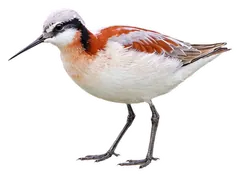 Wilson's PhalaropePhalaropus tricolor
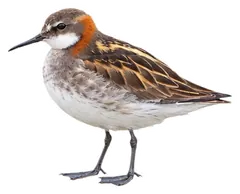 Red-necked PhalaropePhalaropus lobatus
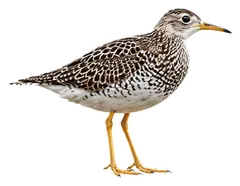 Upland SandpiperBartramia longicauda
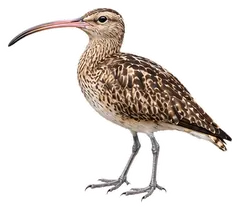 Bristle-thighed CurlewNumenius tahitiensis
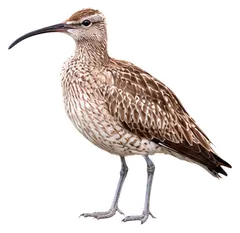 Eurasian WhimbrelNumenius phaeopus
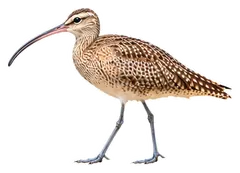 Hudsonian WhimbrelNumenius hudsonicus
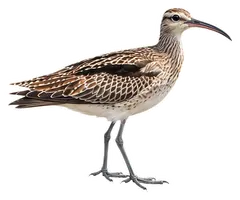 Little CurlewNumenius minutus
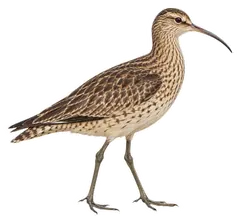 Eskimo CurlewNumenius borealis
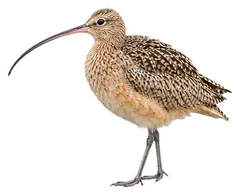 Long-billed CurlewNumenius americanus
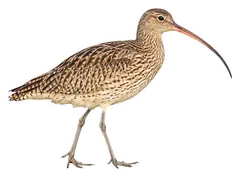 Far Eastern CurlewNumenius madagascariensis
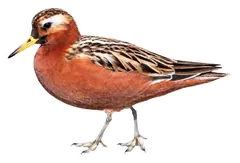
Download illustration
Free to use with credit: “Illustration: Bird Album (birdalbum.com)”. Drawn by AI from a reference photo by cello caruso-turiello. ↗
Heard it but can't see it? Mingji identifies birds by sound and photo, on your phone.
In other languages
- EnglishRed Phalarope
- 简体中文灰瓣蹼鹬
- 繁體中文灰瓣足鷸
- 日本語ハイイロヒレアシシギ
- 한국어붉은배지느러미발도요
- DeutschThorshühnchen
- FrançaisPhalarope à bec large
- EspañolFalaropo picogrueso
- Portuguêsfalaropo-de-bico-grosso
- ItalianoFalaropo beccolargo
- NederlandsRosse Franjepoot
- РусскийПлосконосый плавунчик
- Svenskabrednäbbad simsnäppa
- DanskThorshane
- Polskipłatkonóg płaskodzioby