 Bird Album
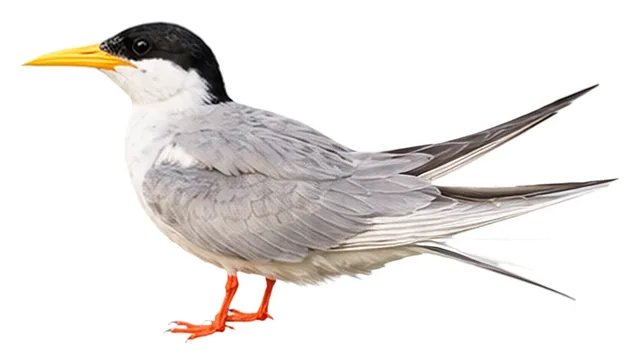
River Tern
Sterna aurantia Gray, JE, 1831
≈42 cmLength67 cmWingspan209 gWeight
In summer it has a yellow bill, red legs and a long, forked tail trailing long, slender tail feathers.
Busiest months: December–February · Most records: India, Pakistan, China
How to identify
Field marks
- Bill thick and bright yellow in summer
- Legs bright red
- Black crown extends below eye in breeding plumage
- Adult upperparts dark gray; underparts white or pale gray
Male, female and young
Sexes similar; juvenile has a brown head, gray upperparts with brown patches and a yellowish bill with a dark tip.
Where and when it's recorded

River Tern has been recorded at 173 of the 8,171 birding hotspots we track, in 9 countries and regions.
Records by month Northern Hemisphere
To protect this bird from disturbance, we don't list exact sites.
Countries and regions with the most records
eBird records via GBIF up to 2024-12-31. A record means someone listed it; more records partly mean more birders, not more birds.
About
The river tern or Indian river tern (Sterna aurantia) is a tern in the family Laridae, the largest species currently included in the genus Sterna of typical terns. It is a resident breeder along inland rivers from Pakistan east through the Indian subcontinent, to Myanmar, Thailand, and Cambodia, where it is uncommon. Unlike most Sterna terns, it is almost exclusively found on freshwater, rarely venturing even to tidal creeks.
Excerpt from Wikipedia, CC BY-SA 4.0 · authors · Read more on Wikipedia
Questions
How big is the River Tern?
The River Tern is about ≈42 cm long, with a wingspan of 67 cm and weighs around 209 g.
Where does the River Tern live?
Its breeding range: Oriental: rivers of Indus Valley (central Pakistan), sub-Himalayan India, northwestern, central Myanmar, southwestern China, to southeastern Cambodia (formerly southern Vietnam). It is most often recorded in India, Pakistan and China.
When is the best time to see the River Tern?
At the hotspots we track, it is recorded most in January, February and December (Northern Hemisphere).
Is the River Tern endangered?
The IUCN Red List classifies the River Tern as Vulnerable.
What does the River Tern eat?
Main food: Fish, shrimp & shellfish.
What family is the River Tern in?
It belongs to the family Gulls, Terns, Skimmers (Laridae), order Charadriiformes.
At a glance
- Length
- ≈42 cm
- Wingspan
- 67 cm
- Weight
- 209 g
- Habitat
- Rivers & streams
- Diet
- Fish, shrimp & shellfish
- Lifestyle
- Feeds in the air
- Migration
- Partial migrant
- Conservation
- Vulnerable
More measurements
- Wing
- 262 mm
- Tail
- 168 mm
- Bill
- 44 mm
- Tarsus
- 20 mm
Averages from the AVONET dataset; length from field guides where available.
Range
Oriental: rivers of Indus Valley (central Pakistan), sub-Himalayan India, northwestern, central Myanmar, southwestern China, to southeastern Cambodia (formerly southern Vietnam)
Breeding range, IOC World Bird List 15.2
Classification
- Order
- Charadriiformes
- Family
- Gulls, Terns, Skimmers Laridae
- Genus
- Sterna
Other birds in the genus Sterna
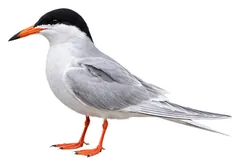 Forster's TernSterna forsteri
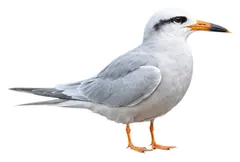 Snowy-crowned TernSterna trudeaui
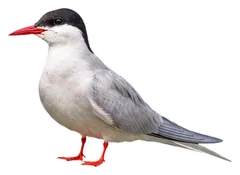 Arctic TernSterna paradisaea
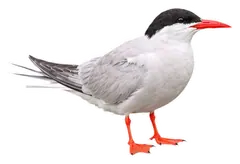 South American TernSterna hirundinacea
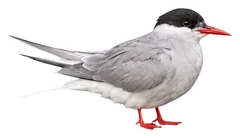 Antarctic TernSterna vittata
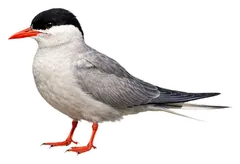 Kerguelen TernSterna virgata
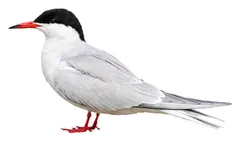 Common TernSterna hirundo
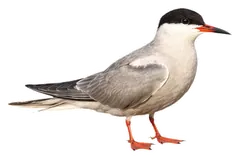 White-cheeked TernSterna repressa
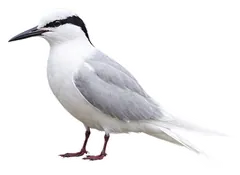 Black-naped TernSterna sumatrana
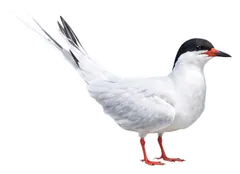 Roseate TernSterna dougallii
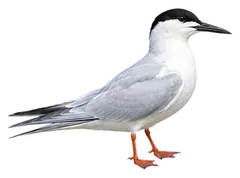 White-fronted TernSterna striata
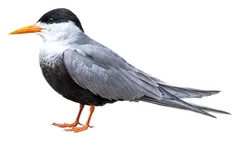 Black-bellied TernSterna acuticauda
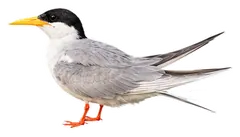
Download illustration
Free to use with credit: “Illustration: Bird Album (birdalbum.com)”. Drawn by AI from a reference photo by Håvard Rosenlund. ↗
Heard it but can't see it? Mingji identifies birds by sound and photo, on your phone.