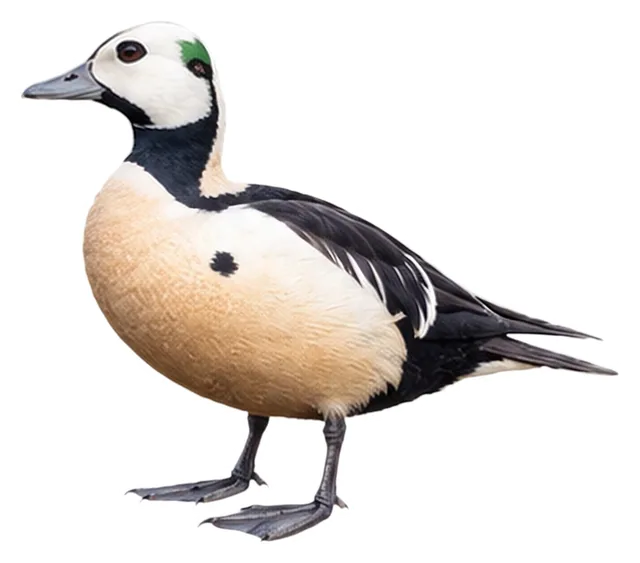
Steller's Eider
Polysticta stelleri (Pallas, 1769)
≈42 cmLength807 gWeight
Steller's eider (Polysticta stelleri) is a migratory Arctic sea duck that breeds along the coastlines of Russia and Alaska, as well as in the Baltic Sea.
Busiest months: May–June · Most records: United States, Norway, Sweden
How to identify
Field marks
- Male in breeding plumage has pale green patches at the rear of the head and in front of the eye
- Upperwing has a blue-purple speculum edged with white
Male, female and young
Female dark brown to cinnamon-brown, with a whitish eye-ring; male dark brown from midsummer to autumn, resembling female but retaining white on the inner forewing.
Where and when it's recorded
Busiest months: May–June · Most records: United States, Norway, Sweden

Steller's Eider has been recorded at 46 of the 8,276 birding hotspots we track, in 13 countries and regions.
Records by month Northern Hemisphere
To protect this bird from disturbance, we don't list exact sites.
Countries and regions with the most records
eBird records via GBIF up to 2024-12-31. A record means someone listed it; more records partly mean more birders, not more birds.
About
Steller's eider (Polysticta stelleri) is a migratory Arctic sea duck that breeds along the coastlines of Russia and Alaska, as well as in the Baltic Sea. It is the smallest, and fastest flying of the duck species known as eiders; it is closely related to the other species of eider in the genus Somateria, but sufficiently distinct to be given separate recognition as the only member of the genus Polysticta.
Excerpt from Wikipedia, CC BY-SA 4.0 · authors · Read more on Wikipedia
Questions
How big is the Steller's Eider?
The Steller's Eider is about ≈42 cm long and weighs around 807 g.
Where does the Steller's Eider live?
Its breeding range: North America, Palearctic: northwestern, northeastern Siberia from Yamal Peninsula to Chukotka; and Arctic Coastal Plain, northern Alaska. It is most often recorded in United States, Norway and Sweden.
When is the best time to see the Steller's Eider?
At the hotspots we track, it is recorded most in May and June (Northern Hemisphere).
Is the Steller's Eider endangered?
The IUCN Red List classifies the Steller's Eider as Vulnerable.
What does the Steller's Eider eat?
Main food: Fish, shrimp & shellfish.
What family is the Steller's Eider in?
It belongs to the family Ducks, Geese, Swans (Anatidae), order Anseriformes.
At a glance
- Length
- ≈42 cm
- Weight
- 807 g
- Habitat
- Ocean
- Diet
- Fish, shrimp & shellfish
- Lifestyle
- On the water surface
- Migration
- Migratory
- Conservation
- Vulnerable
More measurements
- Wing
- 204 mm
- Tail
- 79 mm
- Bill
- 39 mm
- Tarsus
- 34 mm
Averages from the AVONET dataset; length from field guides where available.
Range
North America, Palearctic: northwestern, northeastern Siberia from Yamal Peninsula to Chukotka; and Arctic Coastal Plain, northern Alaska
Breeding range, IOC World Bird List 15.2
Classification
- Order
- Anseriformes
- Family
- Ducks, Geese, Swans Anatidae
- Genus
- Polysticta
More from the family Ducks, Geese, Swans
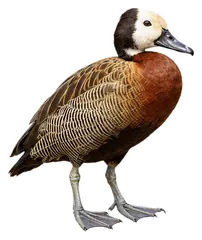 White-faced Whistling DuckDendrocygna viduata
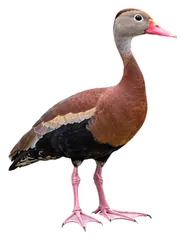 Black-bellied Whistling DuckDendrocygna autumnalis
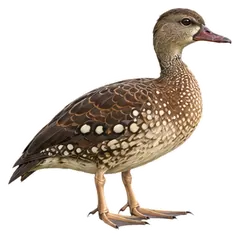 Spotted Whistling DuckDendrocygna guttata
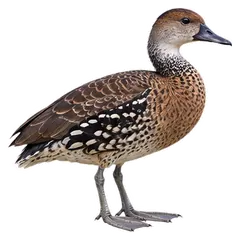 West Indian Whistling DuckDendrocygna arborea
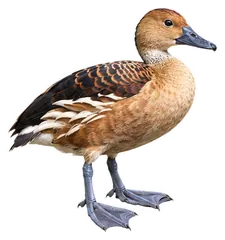 Fulvous Whistling DuckDendrocygna bicolor
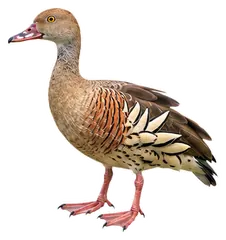 Plumed Whistling DuckDendrocygna eytoni
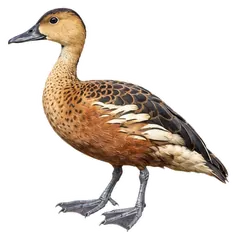 Wandering Whistling DuckDendrocygna arcuata
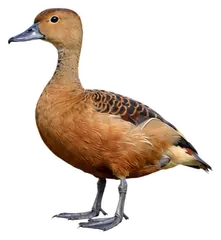 Lesser Whistling DuckDendrocygna javanica
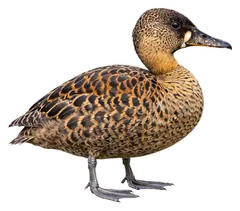 White-backed DuckThalassornis leuconotus
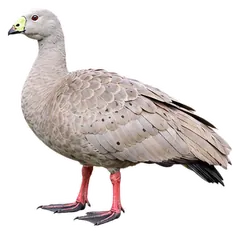 Cape Barren GooseCereopsis novaehollandiae
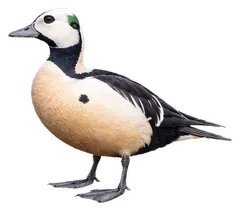
Download illustration
Free to use with credit: “Illustration: Bird Album (birdalbum.com)”. Drawn by AI from a reference photo by Ben Knoot. ↗
Heard it but can't see it? Mingji identifies birds by sound and photo, on your phone.