 Bird Album
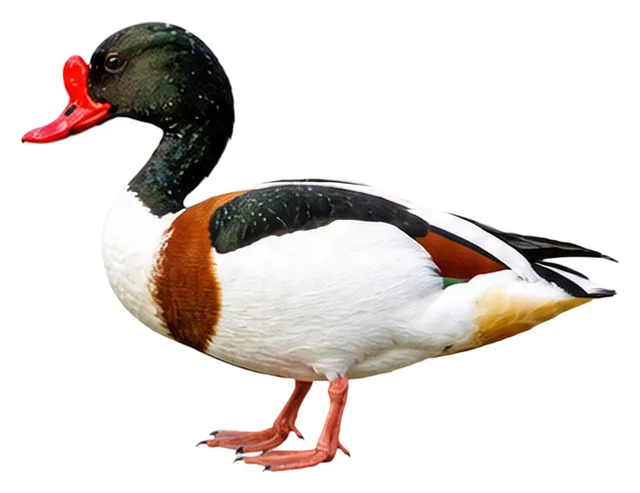
Common Shelduck
Tadorna tadorna (Linnaeus, 1758)
60 cmLength112 cmWingspan1.1 kgWeight
This conspicuous duck has a white body, a dark head with a green metallic gloss and a red bill, with a red knob at the base of the bill in the male.
Busiest months: April–May · Most records: United Kingdom, Spain, Portugal
How to identify
Field marks
- Head and upper neck blackish-brown with a green metallic gloss
- Body white; black primaries and green-tinged secondaries visible in flight
- A single chestnut band across the breast
- Bill red
Male, female and young
Female slightly smaller, often with fine white spots on the green face; male in the breeding season has a bright red bill with a conspicuous knob at its base. Juvenile already has the adult wing pattern.
Voice
Loud “honk” calls.
Where and when it's recorded

Common Shelduck has been recorded at 1,579 of the 8,171 birding hotspots we track, in 88 countries and regions.
Records by month Northern Hemisphere
Where it's recorded most
- Titchwell Marsh RSPB ReserveUnited Kingdom7,904 records
- Minsmere RSPB ReserveUnited Kingdom5,565 records
- Cley & Salthouse Marshes NWT NR – Cley Marshes including Hides and Visitor CentreUnited Kingdom4,567 records
More places
- Desembocadura del Guadalhorce – ÁreaSpain3,894 records
- Frampton Marsh RSPB ReserveUnited Kingdom3,528 records
- WWT Slimbridge Wetland CentreUnited Kingdom3,390 records
- Rainham Marshes RSPB Reserve, SSSI and LNRUnited Kingdom3,193 records
- Spurn Bird Observatory Recording AreaUnited Kingdom3,076 records
- Beddington FarmlandsUnited Kingdom2,818 records
- Rutland WaterUnited Kingdom2,665 records
Countries and regions with the most records
eBird records via GBIF up to 2024-12-31. A record means someone listed it; more records partly mean more birders, not more birds.
About
The common shelduck (Tadorna tadorna) is a waterfowl species of the shelduck genus Tadorna. It is widespread and common in the Palearctic, in Europe and northwest Africa mainly breeding on temperate coasts, saline pools and estuaries, and in Asia on inland salt lakes; increasingly it is also using open freshwater habitats inland. Wintering is in temperate to subtropical regions.
Excerpt from Wikipedia, CC BY-SA 4.0 · authors · Read more on Wikipedia
Questions
How big is the Common Shelduck?
The Common Shelduck is about 60 cm long, with a wingspan of 112 cm and weighs around 1.1 kg.
Where does the Common Shelduck live?
Its breeding range: Palearctic: western Europe to northeastern China. It is most often recorded in United Kingdom, Spain and Portugal.
When is the best time to see the Common Shelduck?
At the hotspots we track, it is recorded most in April and May (Northern Hemisphere).
Is the Common Shelduck endangered?
The IUCN Red List classifies the Common Shelduck as Least Concern.
What does the Common Shelduck eat?
Main food: Fish, shrimp & shellfish.
What family is the Common Shelduck in?
It belongs to the family Ducks, Geese, Swans (Anatidae), order Anseriformes.
At a glance
- Length
- 60 cm
- Wingspan
- 112 cm
- Weight
- 1.1 kg
- Habitat
- Coast & tidal flats
- Diet
- Fish, shrimp & shellfish
- Lifestyle
- Varied
- Migration
- Partial migrant
- Conservation
- Least Concern
More measurements
- Wing
- 314 mm
- Tail
- 110 mm
- Bill
- 54 mm
- Tarsus
- 52 mm
Averages from the AVONET dataset; length from field guides where available.
Range
Palearctic: western Europe to northeastern China
Breeding range, IOC World Bird List 15.2
Classification
- Order
- Anseriformes
- Family
- Ducks, Geese, Swans Anatidae
- Genus
- Tadorna
Other birds in the genus Tadorna
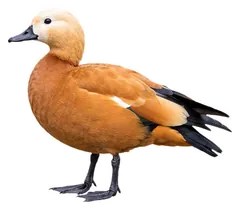 Ruddy ShelduckTadorna ferruginea
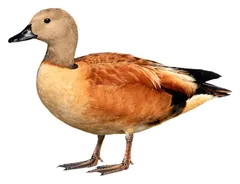 South African ShelduckTadorna cana
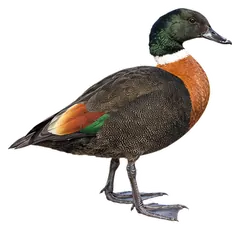 Australian ShelduckTadorna tadornoides
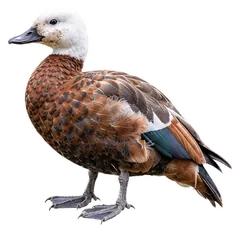 Paradise ShelduckTadorna variegata
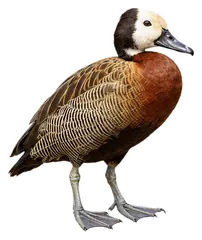 White-faced Whistling DuckDendrocygna viduata
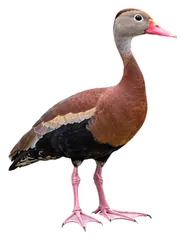 Black-bellied Whistling DuckDendrocygna autumnalis
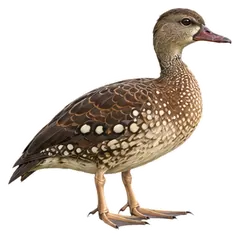 Spotted Whistling DuckDendrocygna guttata
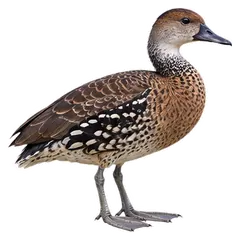 West Indian Whistling DuckDendrocygna arborea
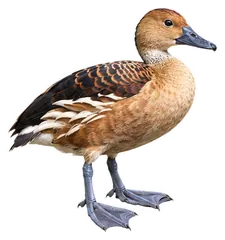 Fulvous Whistling DuckDendrocygna bicolor
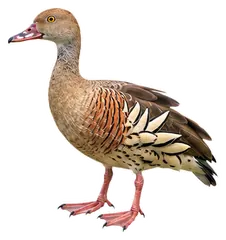 Plumed Whistling DuckDendrocygna eytoni
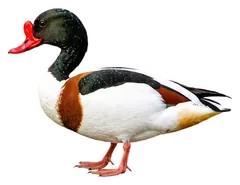
Download illustration
Free to use with credit: “Illustration: Bird Album (birdalbum.com)”. Drawn by AI from a reference photo by Bernard DUPONT. ↗

Heard it but can't see it? Mingji identifies birds by sound and photo, on your phone.