 Bird Album
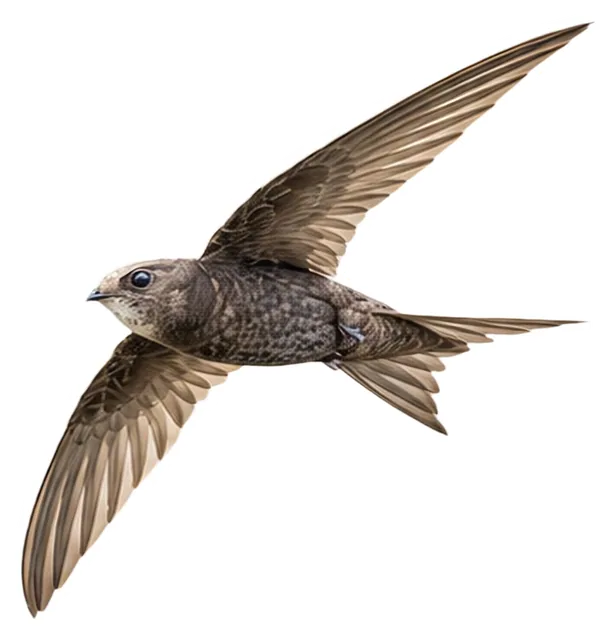
Common Swift
Apus apus (Linnaeus, 1758)
16–17 cmLength40 cmWingspan38 gWeight
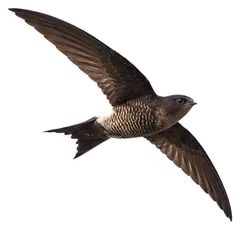
Blackish-brown overall, with long wings swept back into a crescent, this swift spends almost all its time in the air except during nest-building.
Busiest months: May · Most records: United Kingdom, Spain, Portugal
Looks like Barn Swallow, Western House Martin
How to identify
Field marks
- Blackish-brown, with a small white or pale gray chin patch invisible at a distance
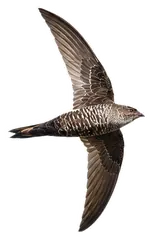
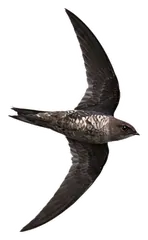
- Long, swept-back wings shaped like a crescent or boomerang
- Short, forked tail
- Narrow, sickle-shaped wings longer than the body
Voice
Loud shrieks at two pitches, the higher one given by the female.
Similar species
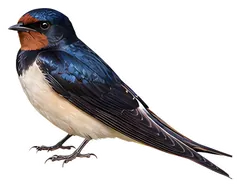
Common Swift is slightly larger than Barn Swallow, with narrow, sickle-shaped wings longer than its body; its calls are shrill shrieks, while the swallow gives unobtrusive twitters.
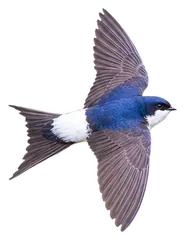
Common Swift is slightly larger than Western House Martin, with narrow, sickle-shaped wings longer than its body; its calls are shrill shrieks, while the martin gives unobtrusive twitters.
Where and when it's recorded

Common Swift has been recorded at 2,278 of the 8,171 birding hotspots we track, in 137 countries and regions.
Records by month Northern Hemisphere
Where it's recorded most
- Jerusalem Bird ObservatoryIsrael2,136 records
- Amwell HMWT NRUnited Kingdom1,991 records
- Titchwell Marsh RSPB ReserveUnited Kingdom1,945 records
More places
- Brent ReservoirUnited Kingdom1,752 records
- International Birding and Research Center Eilat (IBRCE)Israel1,715 records
- Beddington FarmlandsUnited Kingdom1,581 records
- Minsmere RSPB ReserveUnited Kingdom1,557 records
- Desembocadura del Guadalhorce – ÁreaSpain1,401 records
- Elton ReservoirUnited Kingdom1,387 records
- Walthamstow WetlandsUnited Kingdom1,305 records
Countries and regions with the most records
eBird records via GBIF up to 2024-12-31. A record means someone listed it; more records partly mean more birders, not more birds.
About
The common swift (Apus apus) is a medium-sized bird, superficially similar to the barn swallow or house martin but somewhat larger, though not stemming from those passerine species, being in the order Apodiformes. The resemblances between the groups are due to convergent evolution, reflecting similar contextual development. The swifts' nearest relatives are the New World hummingbirds and the Southeast Asian treeswifts.
Excerpt from Wikipedia, CC BY-SA 4.0 · authors · Read more on Wikipedia
Questions
How big is the Common Swift?
The Common Swift is about 16–17 cm long, with a wingspan of 40 cm and weighs around 38 g.
Where does the Common Swift live?
Its breeding range: Palearctic: widespread. It is most often recorded in United Kingdom, Spain and Portugal.
When is the best time to see the Common Swift?
At the hotspots we track, it is recorded most in May (Northern Hemisphere).
Is the Common Swift endangered?
The IUCN Red List classifies the Common Swift as Least Concern.
What does the Common Swift eat?
Main food: Insects & other invertebrates.
What family is the Common Swift in?
It belongs to the family Swifts (Apodidae), order Apodiformes.
At a glance
- Length
- 16–17 cm
- Wingspan
- 40 cm
- Weight
- 38 g
- Habitat
- Towns & farmland
- Diet
- Insects & other invertebrates
- Lifestyle
- Feeds in the air
- Migration
- Migratory
- Conservation
- Least Concern
More measurements
- Wing
- 161 mm
- Tail
- 67 mm
- Bill
- 10 mm
- Tarsus
- 9 mm
Averages from the AVONET dataset; length from field guides where available.
Range
Palearctic: widespread
Breeding range, IOC World Bird List 15.2
Subspecies · 1
- Apus apus pekinensis n Iran to n China and Mongolia | non-breeding: s AF
Classification
- Order
- Apodiformes
- Family
- Swifts Apodidae
- Genus
- Apus
Other birds in the genus Apus
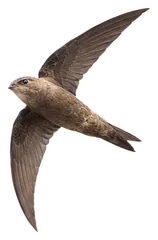 Cape Verde SwiftApus alexandri
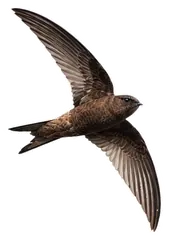 Plain SwiftApus unicolor
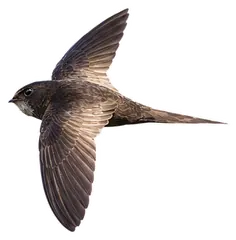 Nyanza SwiftApus niansae
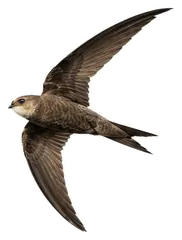 Pallid SwiftApus pallidus
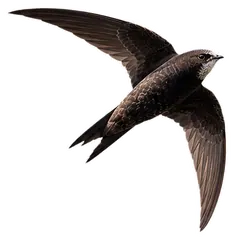 African Black SwiftApus barbatus
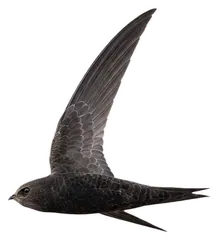 Malagasy Black SwiftApus balstoni
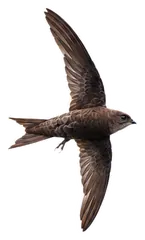 Forbes-Watson's SwiftApus berliozi
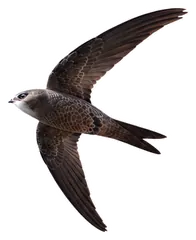 Bradfield's SwiftApus bradfieldi
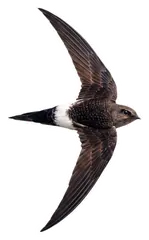 Pacific SwiftApus pacificus
 Blyth's SwiftApus leuconyx
 Cook's SwiftApus cooki
 Dark-rumped SwiftApus acuticauda
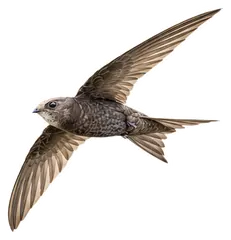
Download illustration
Free to use with credit: “Illustration: Bird Album (birdalbum.com)”. Drawn by AI from a reference photo by Alexis Lours. ↗

Heard it but can't see it? Mingji identifies birds by sound and photo, on your phone.