 Bird Album
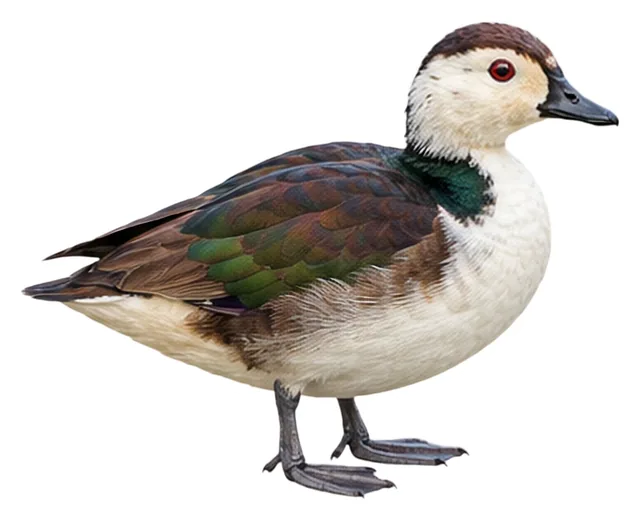
Cotton Pygmy Goose
Nettapus coromandelianus (Gmelin, JF, 1789)
26 cmLength57 cmWingspan391 gWeight
It is one of the smallest waterfowl; in the breeding season, the male has a mostly white head, neck and underparts, with a broad black-green collar at the base of the neck.
Busiest months: December–February · Most records: India, Australia, Cambodia
How to identify
Field marks
- Male has a dark brown forehead and crown, with a broad black-green collar at the base of the neck
- Sides of head and neck white
- Back, wing coverts and scapulars dark brown with a green and purple metallic gloss
- Bill short and goose-like, deeper at the base
Male, female and young
Female has a darker crown and rufous eyestripe, without a black collar; male in the non-breeding season resembles female, but has a broader white wing-bar.
Voice
Low quacking calls.
Where and when it's recorded
Busiest months: December–February · Most records: India, Australia, Cambodia

Cotton Pygmy Goose has been recorded at 447 of the 8,276 birding hotspots we track, in 25 countries and regions.
Records by month Northern Hemisphere
Where it's recorded most
- Changaram Wetlands – EzhupunnaIndia2,482 records
- Kanha NP – Mukki ZoneIndia1,477 records
- Bharatpur – Keoladeo Ghana NPIndia1,423 records
More places
- Manjeera Wildlife SanctuaryIndia804 records
- Hadinaru KereIndia726 records
- Ang Trapeang ThmorCambodia619 records
- Gorewada LakeIndia568 records
- Baruipur MarshesIndia568 records
- Tyto WetlandsAustralia512 records
- Dowse LagoonAustralia504 records
Countries and regions with the most records
eBird records via GBIF up to 2024-12-31. A record means someone listed it; more records partly mean more birders, not more birds.
About
The cotton pygmy goose or cotton teal (Nettapus coromandelianus) is a small perching duck which breeds in South and Southeast Asia extending to Queensland in Australia where they are sometimes called white-quilled pygmy goose. They are among the smallest waterfowl in the world and are found in small to large waterbodies with good aquatic vegetation. They are usually seen in pairs or larger groups of pairs, roosting and nesting on trees near water.
Excerpt from Wikipedia, CC BY-SA 4.0 · authors · Read more on Wikipedia
Questions
How big is the Cotton Pygmy Goose?
The Cotton Pygmy Goose is about 26 cm long, with a wingspan of 57 cm and weighs around 391 g.
Where does the Cotton Pygmy Goose live?
Its breeding range: Oriental, Australasia: India to northeastern Australia. It is most often recorded in India, Australia and Cambodia.
When is the best time to see the Cotton Pygmy Goose?
At the hotspots we track, it is recorded most in January, February and December (Northern Hemisphere).
Is the Cotton Pygmy Goose endangered?
The IUCN Red List classifies the Cotton Pygmy Goose as Least Concern.
What does the Cotton Pygmy Goose eat?
Main food: Aquatic plants.
What family is the Cotton Pygmy Goose in?
It belongs to the family Ducks, Geese, Swans (Anatidae), order Anseriformes.
At a glance
- Length
- 26 cm
- Wingspan
- 57 cm
- Weight
- 391 g
- Habitat
- Wetland
- Diet
- Aquatic plants
- Lifestyle
- On the water surface
- Migration
- Resident (barely migrates)
- Conservation
- Least Concern
More measurements
- Wing
- 158 mm
- Tail
- 64 mm
- Bill
- 27 mm
- Tarsus
- 24 mm
Averages from the AVONET dataset; length from field guides where available.
Range
Oriental, Australasia: India to northeastern Australia
Breeding range, IOC World Bird List 15.2
Subspecies · 1
- Nettapus coromandelianus coromandelianus India to s China, Indonesian Arch. and New Guinea
Classification
- Order
- Anseriformes
- Family
- Ducks, Geese, Swans Anatidae
- Genus
- Nettapus
Other birds in the genus Nettapus
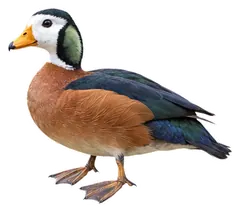 African Pygmy GooseNettapus auritus
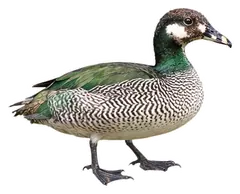 Green Pygmy GooseNettapus pulchellus
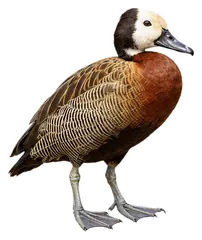 White-faced Whistling DuckDendrocygna viduata
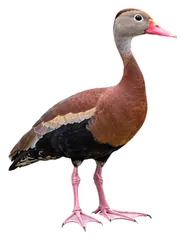 Black-bellied Whistling DuckDendrocygna autumnalis
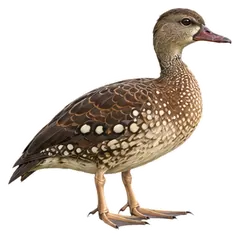 Spotted Whistling DuckDendrocygna guttata
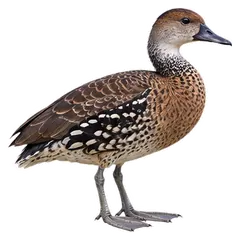 West Indian Whistling DuckDendrocygna arborea
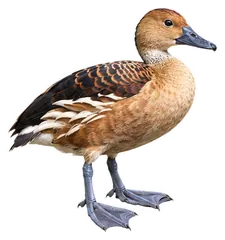 Fulvous Whistling DuckDendrocygna bicolor
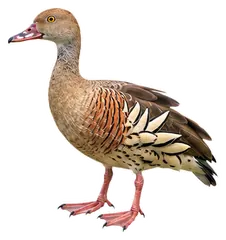 Plumed Whistling DuckDendrocygna eytoni
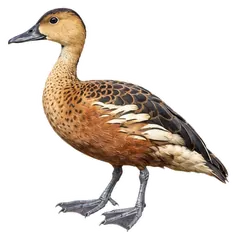 Wandering Whistling DuckDendrocygna arcuata
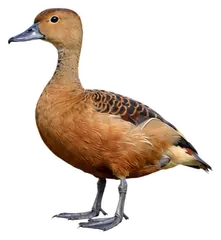 Lesser Whistling DuckDendrocygna javanica
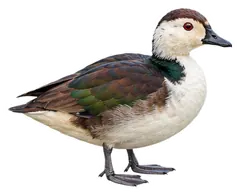
Download illustration
Free to use with credit: “Illustration: Bird Album (birdalbum.com)”. Drawn by AI from a reference photo by sunnyjosef. ↗

Heard it but can't see it? Mingji identifies birds by sound and photo, on your phone.
In other languages
- EnglishCotton Pygmy Goose
- 简体中文棉凫
- 繁體中文棉鴨
- 日本語ナンキンオシ
- DeutschKoromandelzwergente
- FrançaisAnserelle de Coromandel
- EspañolGansito asiático
- Portuguêsgansinho-oriental
- ItalianoOca pigmea indiana
- NederlandsCoromandeleend
- РусскийХлопковый блестящий чирок
- Svenskabomullsdvärgand
- DanskIndisk Dværgand
- Polskikaczuszka azjatycka