 Bird Album
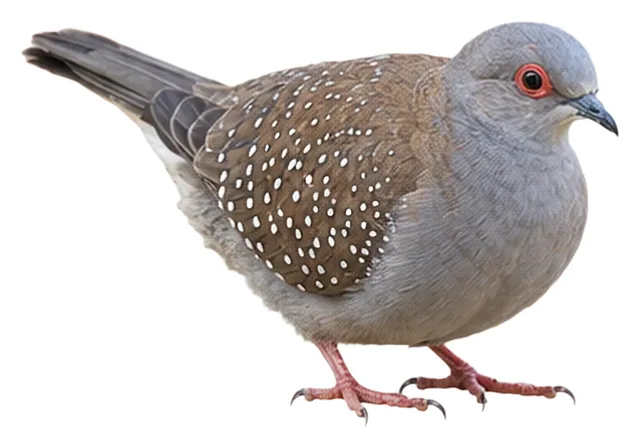
Diamond Dove
Geopelia cuneata (Latham, 1801)
19–21 cmLength32 gWeight
The adult has white patches scattered over the wings and is one of Australia’s smallest pigeons and doves.
Busiest months: August–October · Most records: Australia, United Arab Emirates, United States
How to identify
Field marks
- Adult: white patches on wings; wing edges black
- Adult: eyes red, eye-ring orange
- Adult: bill dark gray; legs and feet pink
- Adult: belly cream; tail rufous-gray
Male, female and young
Female has paler eye-rings and more rufous plumage; male has a pale gray-blue crown, neck, and breast; juvenile lacks white wing patches and has a pale gray bill.
Voice
Calls are varied, slow, and somewhat mournful; also gives soft falsetto cooing: two long coos, a pause, then three coos, long–short–long; alarm consists of several short, loud coos.
Where and when it's recorded
Busiest months: August–October · Most records: Australia, United Arab Emirates, United States

Diamond Dove has been recorded at 64 of the 8,276 birding hotspots we track, in 11 countries and regions.
Records by month Southern Hemisphere
Where it's recorded most
- Bowra Wildlife SanctuaryAustralia2,314 records
- Broome Bird ObservatoryAustralia1,253 records
- Taylors LagoonAustralia358 records
More places
- Roebuck Plains StationAustralia285 records
- Cumberland DamAustralia279 records
- Alice Springs Sewage PondsAustralia265 records
- Lake EdaAustralia243 records
- Katherine Wastewater Treatment PlantAustralia174 records
- Broome South Wastewater Treatment PlantAustralia129 records
- Muirhead bushlandAustralia32 records
Countries and regions with the most records
eBird records via GBIF up to 2024-12-31. A record means someone listed it; more records partly mean more birders, not more birds.
About
The diamond dove (Geopelia cuneata) is a resident bird in Australia. The pigeon predominantly exists in areas near water but which are lightly arid or semi-arid in nature, being Central, West and Northern Australia. They are one of Australia's smallest pigeons along with the peaceful dove.
Excerpt from Wikipedia, CC BY-SA 4.0 · authors · Read more on Wikipedia
Questions
How big is the Diamond Dove?
The Diamond Dove is about 19–21 cm long and weighs around 32 g.
Where does the Diamond Dove live?
Its breeding range: Australasia: Australia (except southern, Tasmania). It is most often recorded in Australia, United Arab Emirates and United States.
When is the best time to see the Diamond Dove?
At the hotspots we track, it is recorded most in August, September and October (Southern Hemisphere).
Is the Diamond Dove endangered?
The IUCN Red List classifies the Diamond Dove as Least Concern.
What does the Diamond Dove eat?
Main food: Seeds.
What family is the Diamond Dove in?
It belongs to the family Pigeons, Doves (Columbidae), order Columbiformes.
At a glance
- Length
- 19–21 cm
- Weight
- 32 g
- Habitat
- Grassland
- Diet
- Seeds
- Lifestyle
- Active on the ground
- Migration
- Resident (barely migrates)
- Conservation
- Least Concern
More measurements
- Wing
- 89 mm
- Tail
- 100 mm
- Bill
- 13 mm
- Tarsus
- 14 mm
Averages from the AVONET dataset; length from field guides where available.
Range
Australasia: Australia (except southern, Tasmania)
Breeding range, IOC World Bird List 15.2
Classification
- Order
- Columbiformes
- Family
- Pigeons, Doves Columbidae
- Genus
- Geopelia
Other birds in the genus Geopelia
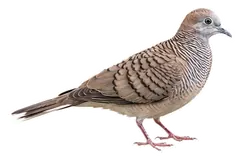 Zebra DoveGeopelia striata
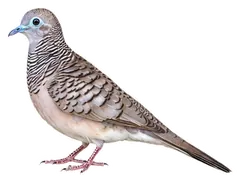 Peaceful DoveGeopelia placida
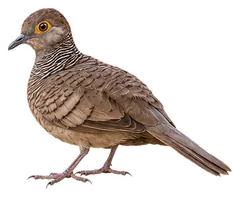 Barred DoveGeopelia maugeus
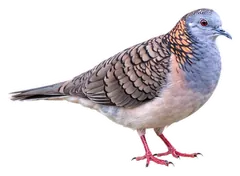 Bar-shouldered DoveGeopelia humeralis
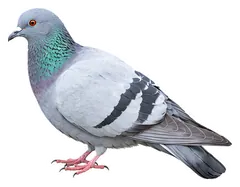 Rock DoveColumba livia
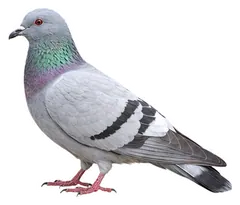 Hill PigeonColumba rupestris
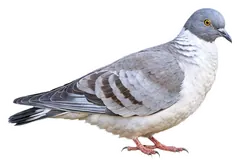 Snow PigeonColumba leuconota
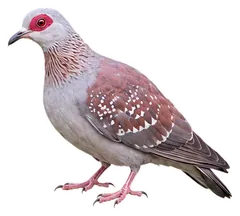 Speckled PigeonColumba guinea
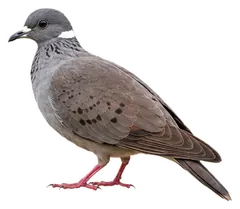 White-collared PigeonColumba albitorques
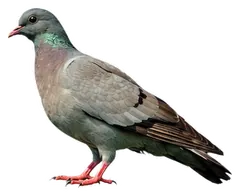 Stock DoveColumba oenas
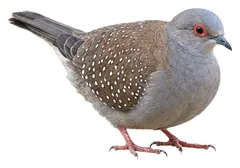
Download illustration
Free to use with credit: “Illustration: Bird Album (birdalbum.com)”. Drawn by AI from a reference photo by Annette Sutton. ↗
Heard it but can't see it? Mingji identifies birds by sound and photo, on your phone.