 Bird Album
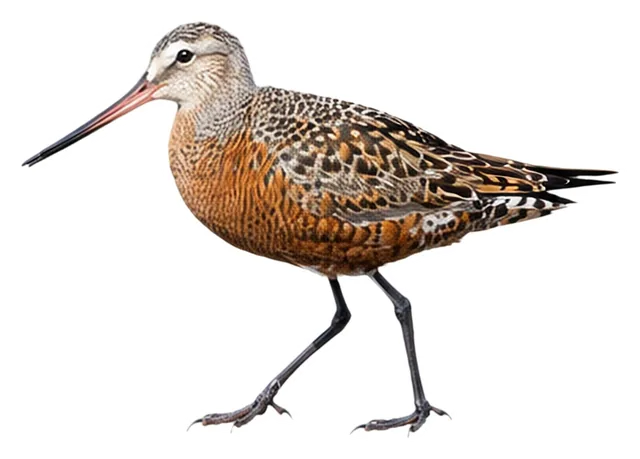
Hudsonian Godwit
Limosa haemastica (Linnaeus, 1758)
253 gWeight
The Hudsonian godwit (Limosa haemastica) is a large shorebird in the sandpiper family, Scolopacidae.
Most records: United States, Canada, Chile
Where and when it's recorded
Most records: United States, Canada, Chile

Hudsonian Godwit has been recorded at 528 of the 8,276 birding hotspots we track, in 47 countries and regions.
Records by month Northern Hemisphere
Where it's recorded most
- Longridge PointCanada2,288 records
- Parker River NWRUnited States1,476 records
- Little Piskwamish PointCanada1,149 records
More places
- SN Humedal Río Maipo – DesembocaduraChile1,146 records
- ChurchillCanada1,130 records
- Bombay Hook National Wildlife RefugeUnited States1,066 records
- Reserva Natural Municipal Punta RasaArgentina876 records
- Cheyenne Bottoms WAUnited States875 records
- Jamaica Bay Wildlife RefugeUnited States872 records
- Hagerman NWRUnited States817 records
Countries and regions with the most records
eBird records via GBIF up to 2024-12-31. A record means someone listed it; more records partly mean more birders, not more birds.
About
The Hudsonian godwit (Limosa haemastica) is a large shorebird in the sandpiper family, Scolopacidae. It is an extreme long-distance migrant, breeding at remote sites in Subarctic North America and flying nonstop in the fall to wintering sites in southern South America. Due to its remote breeding and wintering grounds and rapid, direct migration, it was a poorly-known species and was considered very rare until the mid-20th century, when major staging sites were discovered around James Bay and breeding sites were found around Churchill, Manitoba.
Excerpt from Wikipedia, CC BY-SA 4.0 · authors · Read more on Wikipedia
Questions
How big is the Hudsonian Godwit?
The Hudsonian Godwit weighs around 253 g.
Where does the Hudsonian Godwit live?
Its breeding range: North America: patchily in low Arctic bogs near treeline, western Alaska to central Canada: western, south-central Alaska, northern and south-central Northwest Territories, southwestern shores of Hudson Bay in northern Manitoba and northern Ontario (east-central Canada). It is most often recorded in United States, Canada and Chile.
Is the Hudsonian Godwit endangered?
The IUCN Red List classifies the Hudsonian Godwit as Vulnerable.
What does the Hudsonian Godwit eat?
Main food: Fish, shrimp & shellfish.
What family is the Hudsonian Godwit in?
It belongs to the family Sandpipers, Snipes (Scolopacidae), order Charadriiformes.
At a glance
- Weight
- 253 g
- Habitat
- Wetland
- Diet
- Fish, shrimp & shellfish
- Lifestyle
- Active on the ground
- Migration
- Migratory
- Conservation
- Vulnerable
More measurements
- Wing
- 210 mm
- Tail
- 73 mm
- Bill
- 86 mm
- Tarsus
- 56 mm
Averages from the AVONET dataset; length from field guides where available.
Range
North America: patchily in low Arctic bogs near treeline, western Alaska to central Canada: western, south-central Alaska, northern and south-central Northwest Territories, southwestern shores of Hudson Bay in northern Manitoba and northern Ontario (east-central Canada)
Breeding range, IOC World Bird List 15.2
Classification
- Order
- Charadriiformes
- Family
- Sandpipers, Snipes Scolopacidae
- Genus
- Limosa
Other birds in the genus Limosa
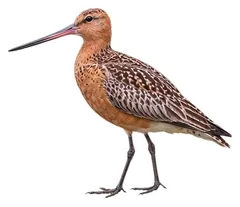 Bar-tailed GodwitLimosa lapponica
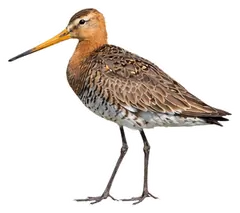 Black-tailed GodwitLimosa limosa
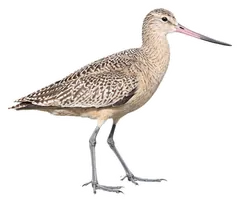 Marbled GodwitLimosa fedoa
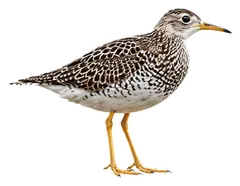 Upland SandpiperBartramia longicauda
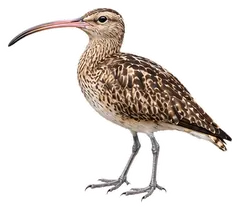 Bristle-thighed CurlewNumenius tahitiensis
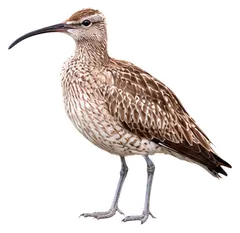 Eurasian WhimbrelNumenius phaeopus
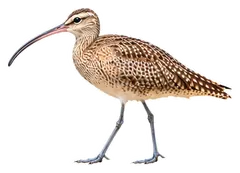 Hudsonian WhimbrelNumenius hudsonicus
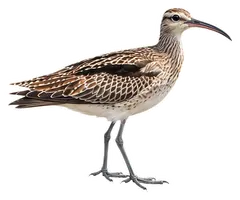 Little CurlewNumenius minutus
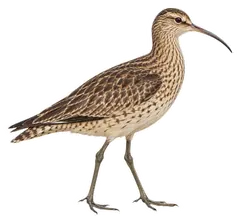 Eskimo CurlewNumenius borealis
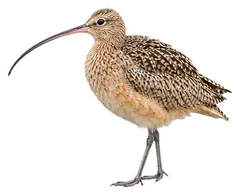 Long-billed CurlewNumenius americanus
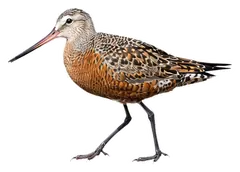
Download illustration
Free to use with credit: “Illustration: Bird Album (birdalbum.com)”. Drawn by AI from a reference photo by Gustavo Masuzzo. ↗
Heard it but can't see it? Mingji identifies birds by sound and photo, on your phone.