 Bird Album
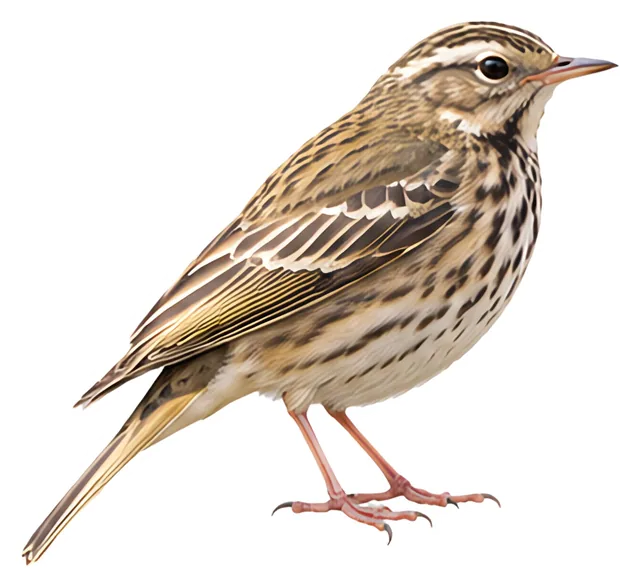
Olive-backed Pipit
Anthus hodgsoni Blackwelder, 1907
≈15 cmLength21 gWeight
It runs on the ground while foraging, flies into trees when alarmed, and has a white supercilium above the eye.
Busiest months: December–January and April · Most records: China, India, Thailand
How to identify
Field marks
- Upperparts greenish-brown with dark brown stripes
- White supercilium and white stripes on both wings
- Breast and flanks with dark brown stripes
- Outermost tail feathers mostly white
Male, female and young
Sexes similar.
Voice
The song resembles that of Eurasian Skylark and is given in the air; it is similar to Tree Pipit's but faster and higher-pitched; single calls of “tseep” or “spek”.
Where and when it's recorded
Busiest months: December–January and April · Most records: China, India, Thailand

Olive-backed Pipit has been recorded at 1,855 of the 8,276 birding hotspots we track, in 44 countries and regions.
Records by month Northern Hemisphere
Where it's recorded most
- Mai Po Nature ReserveHong Kong (China)1,872 records
- Long ValleyHong Kong (China)1,000 records
- Matsu – Dongyin Vegetable FarmChina994 records
More places
- Kinmen – Botanical GardenChina840 records
- Nandi HillsIndia829 records
- Nanhui DongtanChina784 records
- Doi Pha Hom Pok NP – Doi Lang (W), AKA Doi San JuThailand755 records
- Taipei – Tianliaoyang WetlandTaiwan (China)648 records
- Lam Tsuen ValleyHong Kong (China)632 records
- Jinshan – Jinshan Youth Activity CenterTaiwan (China)600 records
Countries and regions with the most records
eBird records via GBIF up to 2024-12-31. A record means someone listed it; more records partly mean more birders, not more birds.
About
The olive-backed pipit (Anthus hodgsoni) is a small passerine bird of the pipit (Anthus) genus, which breeds across southern, north central and eastern Asia, as well as in the north-eastern European Russia. It is a long-distance migrant moving in winter to southern Asia and Indonesia. Sometimes it is also called Indian pipit or Hodgson's pipit, as well as tree pipit owing to its resemblance with the tree pipit.
Excerpt from Wikipedia, CC BY-SA 4.0 · authors · Read more on Wikipedia
Questions
How big is the Olive-backed Pipit?
The Olive-backed Pipit is about ≈15 cm long and weighs around 21 g.
Where does the Olive-backed Pipit live?
Its breeding range: Palearctic: western Russia to Kamchatka, Sakhalin and Kuril Islands (eastern Russia), northern Korean Peninsula and northern, central Japan; disjunctly in Himalayas to east-central China. It is most often recorded in China, India and Thailand.
When is the best time to see the Olive-backed Pipit?
At the hotspots we track, it is recorded most in January, April and December (Northern Hemisphere).
Is the Olive-backed Pipit endangered?
The IUCN Red List classifies the Olive-backed Pipit as Least Concern.
What does the Olive-backed Pipit eat?
Main food: Insects & other invertebrates.
What family is the Olive-backed Pipit in?
It belongs to the family Wagtails, Pipits (Motacillidae), order Passerines (Passeriformes).
At a glance
- Length
- ≈15 cm
- Weight
- 21 g
- Habitat
- Grassland
- Diet
- Insects & other invertebrates
- Lifestyle
- Active on the ground
- Migration
- Migratory
- Conservation
- Least Concern
More measurements
- Wing
- 81 mm
- Tail
- 58 mm
- Bill
- 14 mm
- Tarsus
- 20 mm
Averages from the AVONET dataset; length from field guides where available.
Range
Palearctic: western Russia to Kamchatka, Sakhalin and Kuril Islands (eastern Russia), northern Korean Peninsula and northern, central Japan; disjunctly in Himalayas to east-central China
Breeding range, IOC World Bird List 15.2
Subspecies · 2
- Anthus hodgsoni hodgsoni Himalayas to ec China, n Korean Pen. (race?), Hokkaido (race?) and Honshu (n, c Japan) | non-breeding: Himalayas through se Asia, se China and c Honshu through Ryukyu Is. (Japan) and Philippines
- Anthus hodgsoni yunnanensis nw Russia to Kamchatka, Sakhalin and Kuril Is. (e Russia) s to n Mongolia and ne China | non-breeding: s, se Asia to Philippines
Classification
- Order
- Passerines Passeriformes
- Family
- Wagtails, Pipits Motacillidae
- Genus
- Anthus
Other birds in the genus Anthus
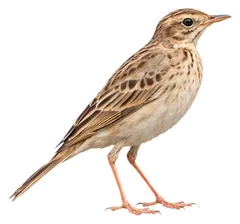 Richard's PipitAnthus richardi
 Paddyfield PipitAnthus rufulus
 Australian PipitAnthus australis
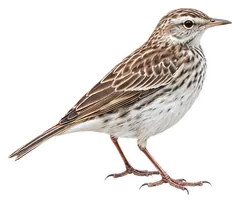 New Zealand PipitAnthus novaeseelandiae
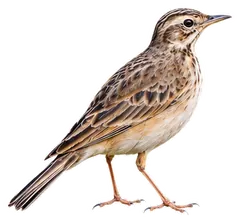 African PipitAnthus cinnamomeus
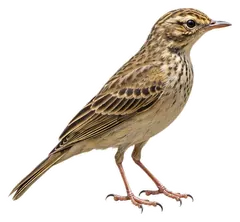 Mountain PipitAnthus hoeschi
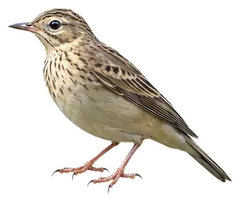 Blyth's PipitAnthus godlewskii
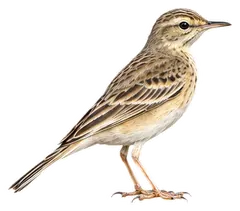 Tawny PipitAnthus campestris
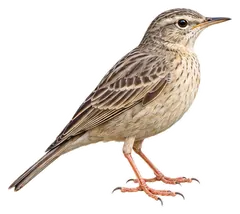 Long-billed PipitAnthus similis
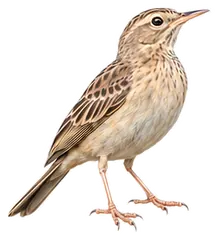 Nicholson's PipitAnthus nicholsoni
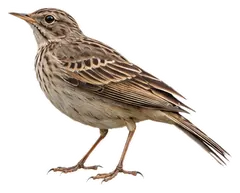 Wood PipitAnthus nyassae
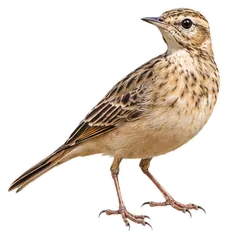 Buffy PipitAnthus vaalensis
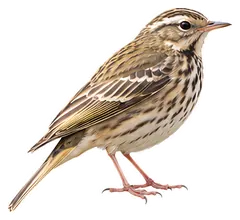
Download illustration
Free to use with credit: “Illustration: Bird Album (birdalbum.com)”. Drawn by AI from a reference photo by Charles J. Sharp. ↗

Heard it but can't see it? Mingji identifies birds by sound and photo, on your phone.