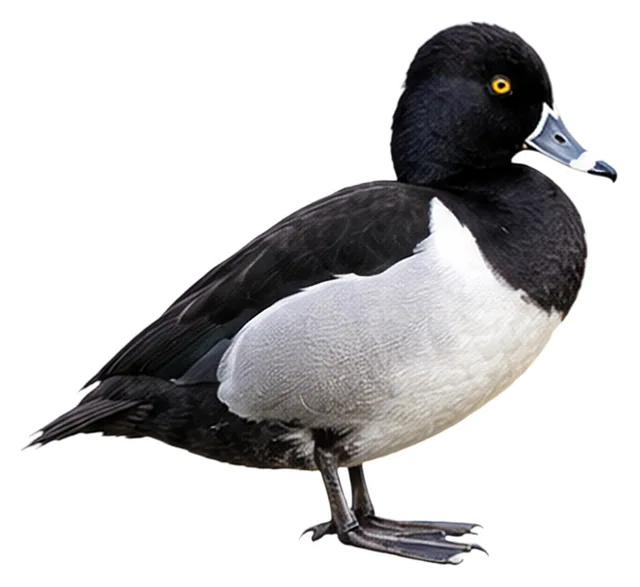
Ring-necked Duck
Aythya collaris (Donovan, 1809)
≈40 cmLength68 cmWingspan705 gWeight
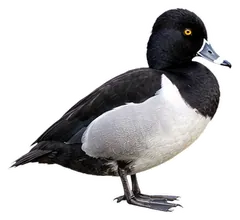
The adult male has a black head and gray bill with two white rings, while the collar that gives it its name is harder to see.
Busiest months: March–April · Most records: United States, Canada, Mexico
How to identify
Field marks
- Male has a gray bill with one white ring at the base and another near the tip
- Male has a black head, neck and breast
- Male has a conspicuous triangular white patch in front of the wing
- Male has yellow eyes
Male, female and young
Female has a gray-rufous head, smaller white bill rings than male, a white ring around the eye and a fine white stripe extending to the rear of the head.
Voice
Female gives a “trrr”-like call.
Where and when it's recorded
Busiest months: March–April · Most records: United States, Canada, Mexico

Ring-necked Duck has been recorded at 1,111 of the 8,276 birding hotspots we track, in 63 countries and regions.
Records by month Northern Hemisphere
Where it's recorded most
- Riparian Preserve at Gilbert Water RanchUnited States16,284 records
- Union Bay Natural Area/Montlake FillUnited States11,243 records
- Sweetwater WetlandsUnited States9,560 records
More places
- Billy Frank Jr. Nisqually NWRUnited States9,195 records
- Amado WTPUnited States8,706 records
- Reifel Bird SanctuaryCanada7,234 records
- Reid ParkUnited States7,230 records
- Ridgefield NWR – River 'S' UnitUnited States6,751 records
- Lake Apopka Wildlife DriveUnited States6,614 records
- Philomath Sewage PondsUnited States6,555 records
Countries and regions with the most records
eBird records via GBIF up to 2024-12-31. A record means someone listed it; more records partly mean more birders, not more birds.
About
The ring-necked duck (Aythya collaris) is a diving duck from North America commonly found in freshwater ponds and lakes. The scientific name is derived from Greek aithuia, an unidentified seabird mentioned by authors including Hesychius and Aristotle, and Latin collaris, "of the neck" from collum, "neck".
Excerpt from Wikipedia, CC BY-SA 4.0 · authors · Read more on Wikipedia
Questions
How big is the Ring-necked Duck?
The Ring-necked Duck is about ≈40 cm long, with a wingspan of 68 cm and weighs around 705 g.
Where does the Ring-necked Duck live?
Its breeding range: North America: widespread. It is most often recorded in United States, Canada and Mexico.
When is the best time to see the Ring-necked Duck?
At the hotspots we track, it is recorded most in March and April (Northern Hemisphere).
Is the Ring-necked Duck endangered?
The IUCN Red List classifies the Ring-necked Duck as Least Concern.
What does the Ring-necked Duck eat?
Main food: Aquatic plants.
What family is the Ring-necked Duck in?
It belongs to the family Ducks, Geese, Swans (Anatidae), order Anseriformes.
At a glance
- Length
- ≈40 cm
- Wingspan
- 68 cm
- Weight
- 705 g
- Habitat
- Wetland
- Diet
- Aquatic plants
- Lifestyle
- On the water surface
- Migration
- Migratory
- Conservation
- Least Concern
More measurements
- Wing
- 195 mm
- Tail
- 58 mm
- Bill
- 51 mm
- Tarsus
- 33 mm
Averages from the AVONET dataset; length from field guides where available.
Range
North America: widespread
Breeding range, IOC World Bird List 15.2
Classification
- Order
- Anseriformes
- Family
- Ducks, Geese, Swans Anatidae
- Genus
- Aythya
Other birds in the genus Aythya
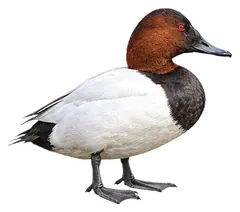 CanvasbackAythya valisineria
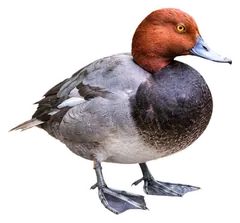 RedheadAythya americana
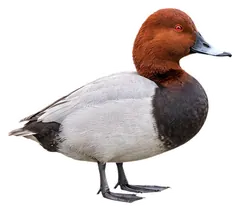 Common PochardAythya ferina
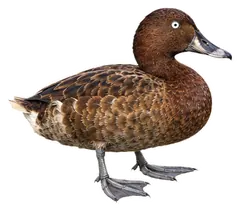 HardheadAythya australis
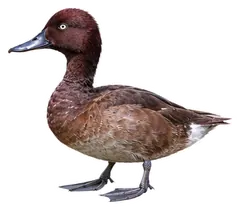 Madagascar PochardAythya innotata
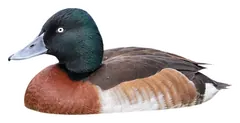 Baer's PochardAythya baeri
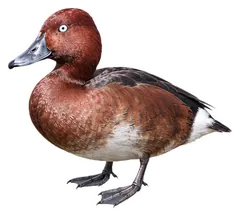 Ferruginous DuckAythya nyroca
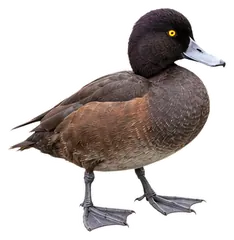 New Zealand ScaupAythya novaeseelandiae
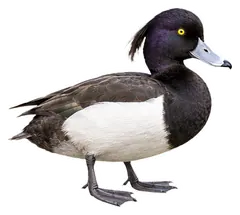 Tufted DuckAythya fuligula
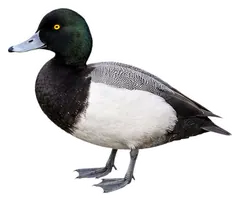 Greater ScaupAythya marila
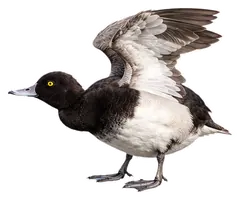 Lesser ScaupAythya affinis
Download illustration
Free to use with credit: “Illustration: Bird Album (birdalbum.com)”. Drawn by AI from reference photos. ↗
Heard it but can't see it? Mingji identifies birds by sound and photo, on your phone.