 Bird Album
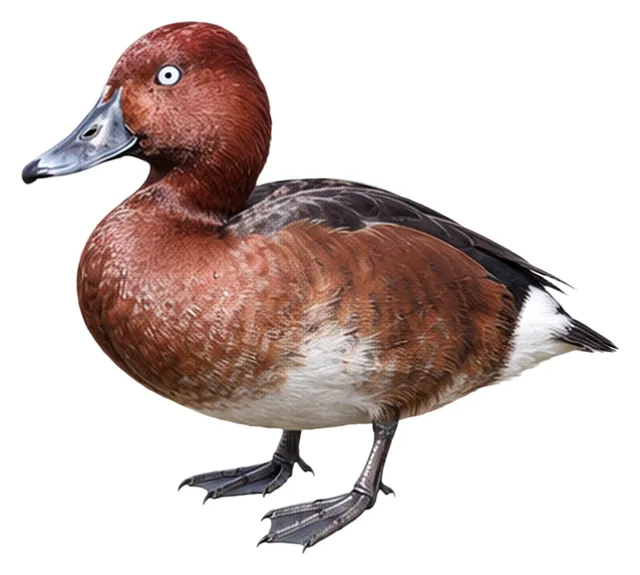
Ferruginous Duck
Aythya nyroca (Güldenstädt, 1770)
≈36 cmLength65 cmWingspan574 gWeight
In the breeding season, the male has a deep chestnut head and breast, a pure white patch below the tail and white eyes.
Busiest months: December–March · Most records: India, Spain, China
How to identify
Field marks
- Male has a deep chestnut head, breast and body sides
- Undertail-coverts pure white, strongly contrasting
- Male has a white iris, female dark eyes
- White belly and white underwing patch visible in flight
Male, female and young
Female duller and more rufous, with dark eyes.
Where and when it's recorded

Ferruginous Duck has been recorded at 1,131 of the 8,171 birding hotspots we track, in 82 countries and regions.
Records by month Northern Hemisphere
Where it's recorded most
- Gazelle ValleyIsrael2,383 records
- Al Jahra Reserve (Restricted access)Kuwait1,438 records
- Bharatpur – Keoladeo Ghana NPIndia1,422 records
More places
- Sultanpur National ParkIndia910 records
- Schinias National ParkGreece760 records
- Private estate near Green MubazzarahUnited Arab Emirates680 records
- Charca de Suárez—MotrilSpain673 records
- Gajoldoba Barrage JGIndia618 records
- Maguri BeelIndia616 records
- Eilat – KM19 Sewage Ponds 19Israel614 records
Countries and regions with the most records
eBird records via GBIF up to 2024-12-31. A record means someone listed it; more records partly mean more birders, not more birds.
About
The ferruginous duck (Aythya nyroca), also known as the ferruginous pochard, common white-eye or white-eyed pochard, is a medium-sized diving duck native to the Palearctic. The scientific name is derived from the Ancient Greek word, αἴθυιᾰ (aithuia), an unknown seabird mentioned by authors including Hesychius and Aristotle, and the Russian word, нырок (nyrok), the Russian word for pochard, which occurs in the bird's Russian common name.
Excerpt from Wikipedia, CC BY-SA 4.0 · authors · Read more on Wikipedia
Questions
How big is the Ferruginous Duck?
The Ferruginous Duck is about ≈36 cm long, with a wingspan of 65 cm and weighs around 574 g.
Where does the Ferruginous Duck live?
Its breeding range: Palearctic: western Europe and northwestern Africa to Central Asia. It is most often recorded in India, Spain and China.
When is the best time to see the Ferruginous Duck?
At the hotspots we track, it is recorded most in January, February, March and December (Northern Hemisphere).
Is the Ferruginous Duck endangered?
The IUCN Red List classifies the Ferruginous Duck as Near Threatened.
What does the Ferruginous Duck eat?
Main food: Aquatic plants.
What family is the Ferruginous Duck in?
It belongs to the family Ducks, Geese, Swans (Anatidae), order Anseriformes.
At a glance
- Length
- ≈36 cm
- Wingspan
- 65 cm
- Weight
- 574 g
- Habitat
- Wetland
- Diet
- Aquatic plants
- Lifestyle
- On the water surface
- Migration
- Migratory
- Conservation
- Near Threatened
More measurements
- Wing
- 182 mm
- Tail
- 53 mm
- Bill
- 41 mm
- Tarsus
- 29 mm
Averages from the AVONET dataset; length from field guides where available.
Range
Palearctic: western Europe and northwestern Africa to Central Asia
Breeding range, IOC World Bird List 15.2
Classification
- Order
- Anseriformes
- Family
- Ducks, Geese, Swans Anatidae
- Genus
- Aythya
Other birds in the genus Aythya
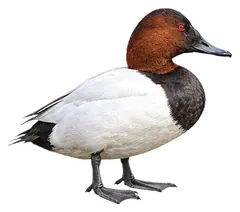 CanvasbackAythya valisineria
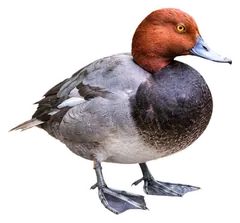 RedheadAythya americana
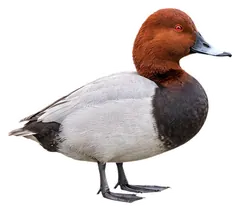 Common PochardAythya ferina
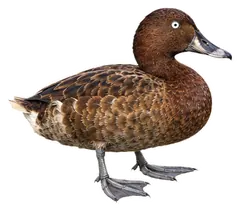 HardheadAythya australis
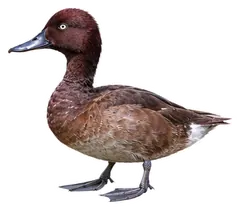 Madagascar PochardAythya innotata
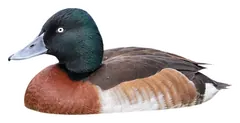 Baer's PochardAythya baeri
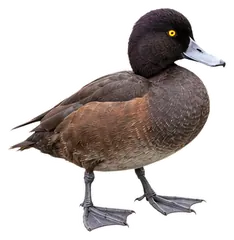 New Zealand ScaupAythya novaeseelandiae
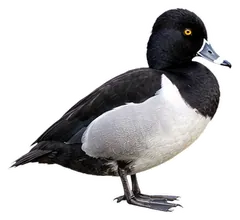 Ring-necked DuckAythya collaris
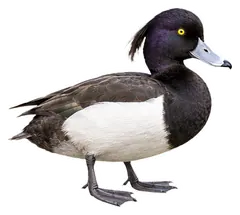 Tufted DuckAythya fuligula
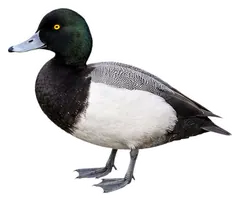 Greater ScaupAythya marila
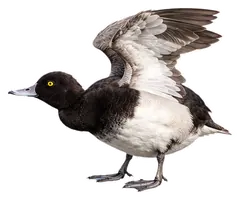 Lesser ScaupAythya affinis
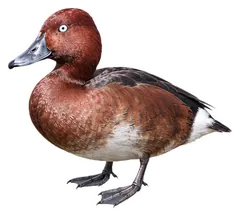
Download illustration
Free to use with credit: “Illustration: Bird Album (birdalbum.com)”. Drawn by AI from a reference photo by Francis C. Franklin. ↗

Heard it but can't see it? Mingji identifies birds by sound and photo, on your phone.