 Bird Album
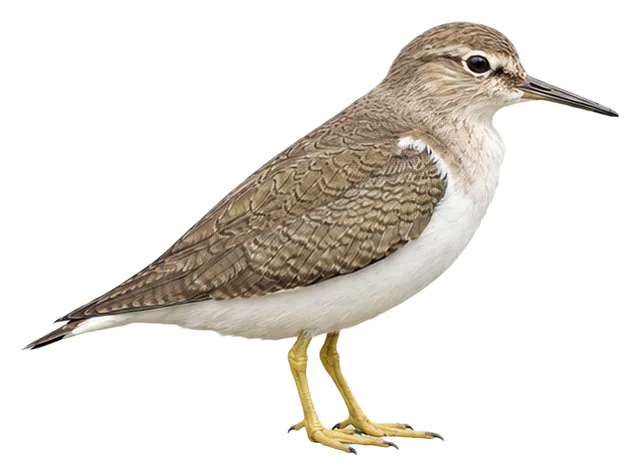
Common Sandpiper
Actitis hypoleucos (Linnaeus, 1758)
18–20 cmLength27 cmWingspan48 gWeight
It is a small sandpiper with a gray-brown back and white belly, flying low over the water on stiff wings.
Busiest months: April and August–September · Most records: China, Spain, India
How to identify
Field marks
- Upperparts gray-brown; underparts white
- Legs and feet short and dark yellow
- Base of the bill pale, tip dark
- Darker in winter plumage; barring on wings only obvious at close range
Male, female and young
Juvenile has more barring on upperparts and buff feather edges on the wings.
Voice
A thin, high-pitched piping “twee-wee-wee-wee”.
Where and when it's recorded

Common Sandpiper has been recorded at 3,827 of the 8,171 birding hotspots we track, in 161 countries and regions.
Records by month Northern Hemisphere
Where it's recorded most
- Desembocadura del Guadalhorce – ÁreaSpain4,377 records
- Huajiang IBA – Huajiang Wild Duck Nature Park (Huajiang to Zhongxing Bridge)Taiwan (China)4,215 records
- Taipei – Tianliaoyang WetlandTaiwan (China)3,798 records
More places
- Txingudi – PlaiaundiSpain3,528 records
- Mai Po Nature ReserveHong Kong (China)3,284 records
- Sungei Buloh Wetland ReserveSingapore3,057 records
- Lezíria Grande de Vila Franca de Xira – área geralPortugal2,858 records
- Changaram Wetlands – EzhupunnaIndia2,684 records
- Private estate near Green MubazzarahUnited Arab Emirates2,674 records
- Urdaibai RB – bird center y laguna de OruetaSpain2,666 records
Countries and regions with the most records
eBird records via GBIF up to 2024-12-31. A record means someone listed it; more records partly mean more birders, not more birds.
About
The common sandpiper (Actitis hypoleucos) is a small Palearctic wader. This bird and its American sister species, the spotted sandpiper (A. macularia), make up the genus Actitis. They are parapatric and replace each other geographically; stray birds of either species may settle down with breeders of the other and hybridize.
Excerpt from Wikipedia, CC BY-SA 4.0 · authors · Read more on Wikipedia
Questions
How big is the Common Sandpiper?
The Common Sandpiper is about 18–20 cm long, with a wingspan of 27 cm and weighs around 48 g.
Where does the Common Sandpiper live?
Its breeding range: Palearctic: widespread, subarctic to temperate inland waterbody margins of Palearctic: British Isles north to Scandinavia south to Iberian Peninsula, east through temperate Russia to east-central Chukotskiy Peninsula (northeastern Russia), south from Turkey, Caucasus, Iran, Central Asia to Kashmir (northwestern Himalayas), northern Mongolia, northeastern China and Japan. It is most often recorded in China, Spain and India.
When is the best time to see the Common Sandpiper?
At the hotspots we track, it is recorded most in April, August and September (Northern Hemisphere).
Is the Common Sandpiper endangered?
The IUCN Red List classifies the Common Sandpiper as Least Concern.
What does the Common Sandpiper eat?
Main food: Fish, shrimp & shellfish.
What family is the Common Sandpiper in?
It belongs to the family Sandpipers, Snipes (Scolopacidae), order Charadriiformes.
At a glance
- Length
- 18–20 cm
- Wingspan
- 27 cm
- Weight
- 48 g
- Habitat
- Wetland
- Diet
- Fish, shrimp & shellfish
- Lifestyle
- Active on the ground
- Migration
- Migratory
- Conservation
- Least Concern
More measurements
- Wing
- 110 mm
- Tail
- 57 mm
- Bill
- 30 mm
- Tarsus
- 22 mm
Averages from the AVONET dataset; length from field guides where available.
Range
Palearctic: widespread, subarctic to temperate inland waterbody margins of Palearctic: British Isles north to Scandinavia south to Iberian Peninsula, east through temperate Russia to east-central Chukotskiy Peninsula (northeastern Russia), south from Turkey, Caucasus, Iran, Central Asia to Kashmir (northwestern Himalayas), northern Mongolia, northeastern China and Japan
Breeding range, IOC World Bird List 15.2
Classification
- Order
- Charadriiformes
- Family
- Sandpipers, Snipes Scolopacidae
- Genus
- Actitis
Other birds in the genus Actitis
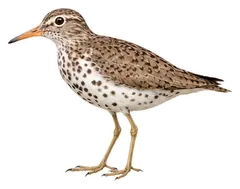 Spotted SandpiperActitis macularius
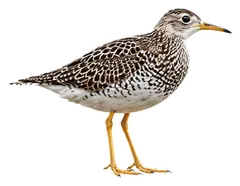 Upland SandpiperBartramia longicauda
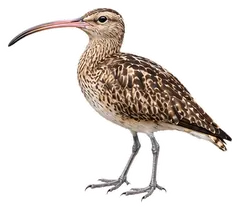 Bristle-thighed CurlewNumenius tahitiensis
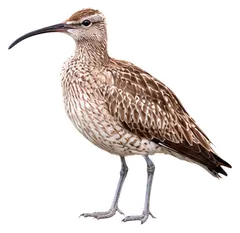 Eurasian WhimbrelNumenius phaeopus
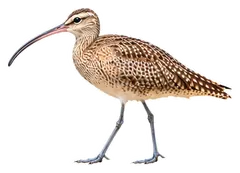 Hudsonian WhimbrelNumenius hudsonicus
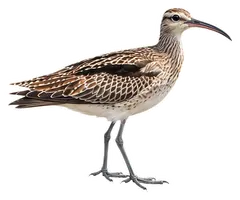 Little CurlewNumenius minutus
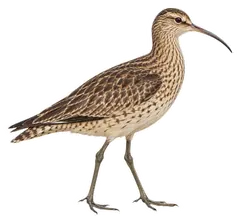 Eskimo CurlewNumenius borealis
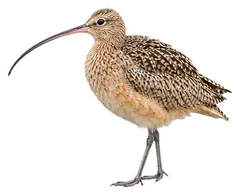 Long-billed CurlewNumenius americanus
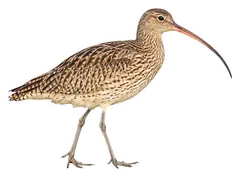 Far Eastern CurlewNumenius madagascariensis
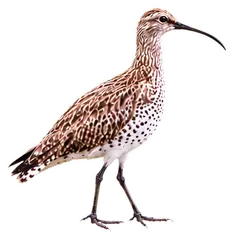 Slender-billed CurlewNumenius tenuirostris
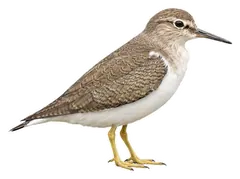
Download illustration
Free to use with credit: “Illustration: Bird Album (birdalbum.com)”. Drawn by AI from a reference photo by JJ Harrison (https://www.jjharrison.com.au/). ↗
Heard it but can't see it? Mingji identifies birds by sound and photo, on your phone.