 Bird Album
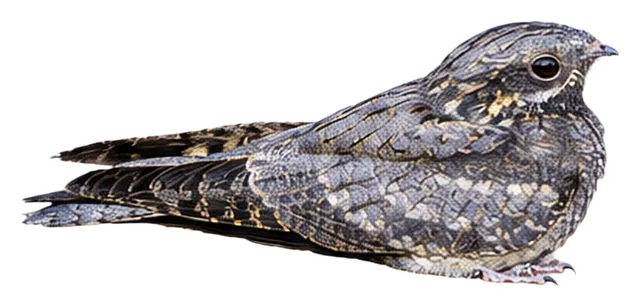
European Nightjar
Caprimulgus europaeus Linnaeus, 1758
27 cmLength60 cmWingspan67 gWeight
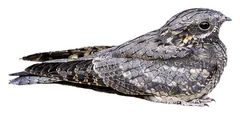
Its plumage is patterned in gray-brown, making it hard to spot when resting motionless by day.
Busiest months: May · Most records: Israel, Türkiye, United Arab Emirates
How to identify
Field marks
- Adults of the nominate subspecies have gray-brown upperparts with streaks
- Adults of the nominate subspecies have a pale yellowish-brown collar on the nape
- Adults of the nominate subspecies have a white moustachial stripe
- Long, pointed wings
Male, female and young
In flight, the male shows white on the upperwing and at the tips of the outer tail feathers; the female shows no white; fledged juveniles resemble the female.
Voice
The male gives a sustained trill, singing continuously for up to 10 minutes at a time.
Where and when it's recorded
Busiest months: May · Most records: Israel, Türkiye, United Arab Emirates

European Nightjar has been recorded at 628 of the 8,276 birding hotspots we track, in 87 countries and regions.
Records by month Northern Hemisphere
Where it's recorded most
- Jerusalem Bird ObservatoryIsrael659 records
- Aras Kuş Halkalama İstasyonuTürkiye457 records
- Private estate near Green MubazzarahUnited Arab Emirates375 records
More places
- International Birding and Research Center Eilat (IBRCE)Israel270 records
- Antikythira Bird ObservatoryGreece220 records
- RivaTürkiye190 records
- Sečoveljske soline – jug | Sečovlje Salina – southSlovenia150 records
- RN Estuário do Tejo – Monte de PancasPortugal146 records
- Thursley CommonUnited Kingdom144 records
- CHKO Jeseníky – Červenohorské sedloCzechia141 records
Countries and regions with the most records
eBird records via GBIF up to 2024-12-31. A record means someone listed it; more records partly mean more birders, not more birds.
About
The European nightjar (Caprimulgus europaeus), common goatsucker, Eurasian nightjar or just nightjar is a crepuscular and nocturnal bird in the nightjar family that breeds across most of Europe and the Palearctic to Mongolia and Northwestern China. The Latin generic name refers to the old myth that the nocturnal nightjar suckled from goats, causing them to cease to give milk. The six subspecies differ clinally, the birds becoming smaller and paler towards the east of the range.
Excerpt from Wikipedia, CC BY-SA 4.0 · authors · Read more on Wikipedia
Questions
How big is the European Nightjar?
The European Nightjar is about 27 cm long, with a wingspan of 60 cm and weighs around 67 g.
Where does the European Nightjar live?
Its breeding range: Palearctic: western, central. It is most often recorded in Israel, Türkiye and United Arab Emirates.
When is the best time to see the European Nightjar?
At the hotspots we track, it is recorded most in May (Northern Hemisphere).
Is the European Nightjar endangered?
The IUCN Red List classifies the European Nightjar as Least Concern.
What does the European Nightjar eat?
Main food: Insects & other invertebrates.
What family is the European Nightjar in?
It belongs to the family Nightjars (Caprimulgidae), order Caprimulgiformes.
At a glance
- Length
- 27 cm
- Wingspan
- 60 cm
- Weight
- 67 g
- Habitat
- Shrubland
- Diet
- Insects & other invertebrates
- Lifestyle
- Feeds in the air
- Migration
- Migratory
- Conservation
- Least Concern
More measurements
- Wing
- 180 mm
- Tail
- 128 mm
- Bill
- 19 mm
- Tarsus
- 17 mm
Averages from the AVONET dataset; length from field guides where available.
Range
Palearctic: western, central
Breeding range, IOC World Bird List 15.2
Subspecies · 1
- Caprimulgus europaeus plumipes nw China to w, s Mongolia
Classification
- Order
- Caprimulgiformes
- Family
- Nightjars Caprimulgidae
- Genus
- Caprimulgus
Other birds in the genus Caprimulgus
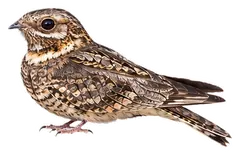 Red-necked NightjarCaprimulgus ruficollis
 Jungle NightjarCaprimulgus indicus
 Grey NightjarCaprimulgus jotaka
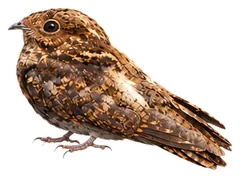 Palau NightjarCaprimulgus phalaena
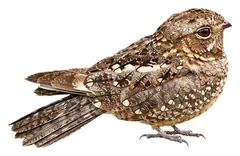 Sombre NightjarCaprimulgus fraenatus
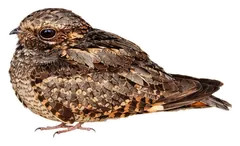 Rufous-cheeked NightjarCaprimulgus rufigena
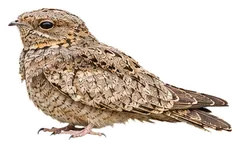 Egyptian NightjarCaprimulgus aegyptius
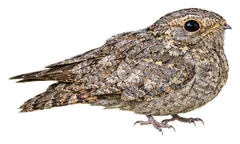 Sykes's NightjarCaprimulgus mahrattensis
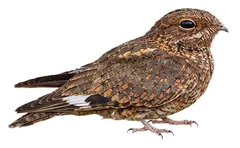 Nubian NightjarCaprimulgus nubicus
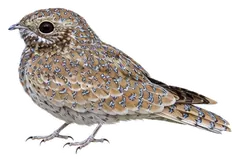 Golden NightjarCaprimulgus eximius
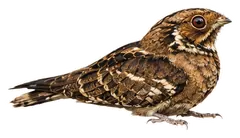 Jerdon's NightjarCaprimulgus atripennis
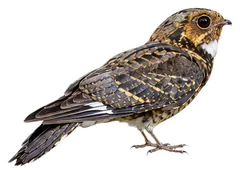 Large-tailed NightjarCaprimulgus macrurus
Download illustration
Free to use with credit: “Illustration: Bird Album (birdalbum.com)”. Drawn by AI from a reference photo by RenatKorotkov. ↗
Heard it but can't see it? Mingji identifies birds by sound and photo, on your phone.