 Bird Album
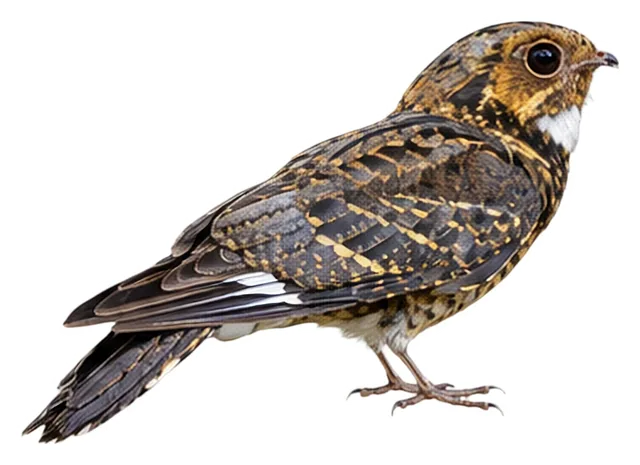
Large-tailed Nightjar
Caprimulgus macrurus Horsfield, 1821
≈27 cmLength66 gWeight
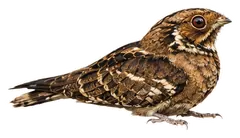
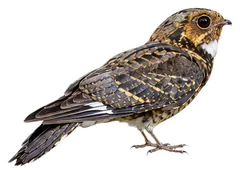
It has a long, broad tail and well-camouflaged plumage.
Busiest months: February–March · Most records: Singapore, Thailand, India
How to identify
Field marks
- Male has a pale crown with a dark central stripe
- Male has a white throat patch
- Male has a long rufous tail with dark barring
- Male shows white patches on the upperwing and outer tail feathers in flight
Male, female and young
The female is paler and grayer than the male, with smaller, yellowish-brown wing patches.
Voice
A monotonous territorial song, also a low “wroww”.
Where and when it's recorded
Busiest months: February–March · Most records: Singapore, Thailand, India

Large-tailed Nightjar has been recorded at 522 of the 8,276 birding hotspots we track, in 18 countries and regions.
Records by month Northern Hemisphere
Where it's recorded most
- Singapore Botanic GardensSingapore564 records
- Kaeng Krachan NP – Baan Maka Nature LodgeThailand508 records
- Kaeng Krachan NPThailand484 records
More places
- Bharatpur – Keoladeo Ghana NPIndia281 records
- MacRitchie Reservoir ParkSingapore273 records
- Jurong Lake GardensSingapore265 records
- Cat Tien NPVietnam229 records
- Khao Yai NPThailand218 records
- Mahidol University [Kanchanaburi Campus]Thailand207 records
- Kranji MarshSingapore185 records
Countries and regions with the most records
eBird records via GBIF up to 2024-12-31. A record means someone listed it; more records partly mean more birders, not more birds.
About
The large-tailed nightjar (Caprimulgus macrurus) is a species of nightjar known for its distinctive long, broad tail and cryptic plumage that allows it to blend into its surroundings. Found along the southern Himalayan foothills, eastern South Asia, Southeast Asia and northern Australia, its natural habitats are subtropical or tropical moist lowland forest, subtropical or tropical mangrove forest, and subtropical or tropical moist montane forest.
Excerpt from Wikipedia, CC BY-SA 4.0 · authors · Read more on Wikipedia
Questions
How big is the Large-tailed Nightjar?
The Large-tailed Nightjar is about ≈27 cm long and weighs around 66 g.
Where does the Large-tailed Nightjar live?
Its breeding range: Oriental, Australasia: eastern India to northern Australia, New Guinea region and Bismarck Archipelago. It is most often recorded in Singapore, Thailand and India.
When is the best time to see the Large-tailed Nightjar?
At the hotspots we track, it is recorded most in February and March (Northern Hemisphere).
Is the Large-tailed Nightjar endangered?
The IUCN Red List classifies the Large-tailed Nightjar as Least Concern.
What does the Large-tailed Nightjar eat?
Main food: Insects & other invertebrates.
What family is the Large-tailed Nightjar in?
It belongs to the family Nightjars (Caprimulgidae), order Caprimulgiformes.
At a glance
- Length
- ≈27 cm
- Weight
- 66 g
- Habitat
- Woodland
- Diet
- Insects & other invertebrates
- Lifestyle
- Varied
- Migration
- Resident (barely migrates)
- Conservation
- Least Concern
More measurements
- Wing
- 179 mm
- Tail
- 125 mm
- Bill
- 22 mm
- Tarsus
- 13 mm
Averages from the AVONET dataset; length from field guides where available.
Range
Oriental, Australasia: eastern India to northern Australia, New Guinea region and Bismarck Archipelago
Breeding range, IOC World Bird List 15.2
Subspecies · 1
- Caprimulgus macrurus bimaculatus ne India and s China through se Asia, Malay Pen., Sumatra and Riau Is. (e of c Sumatra)
Classification
- Order
- Caprimulgiformes
- Family
- Nightjars Caprimulgidae
- Genus
- Caprimulgus
Other birds in the genus Caprimulgus
 Red-necked NightjarCaprimulgus ruficollis
 Jungle NightjarCaprimulgus indicus
 Grey NightjarCaprimulgus jotaka
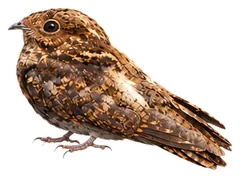 Palau NightjarCaprimulgus phalaena
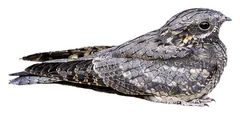 European NightjarCaprimulgus europaeus
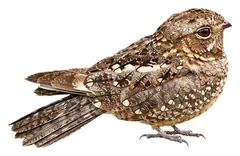 Sombre NightjarCaprimulgus fraenatus
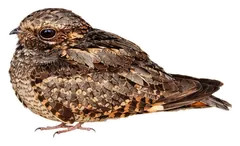 Rufous-cheeked NightjarCaprimulgus rufigena
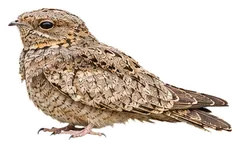 Egyptian NightjarCaprimulgus aegyptius
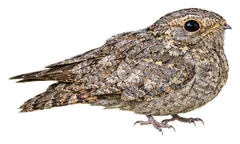 Sykes's NightjarCaprimulgus mahrattensis
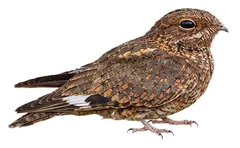 Nubian NightjarCaprimulgus nubicus
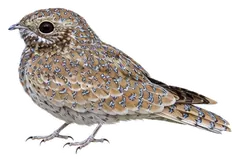 Golden NightjarCaprimulgus eximius
 Jerdon's NightjarCaprimulgus atripennis
Download illustration
Free to use with credit: “Illustration: Bird Album (birdalbum.com)”. Drawn by AI from a reference photo by Kai Weng Chan. ↗
Heard it but can't see it? Mingji identifies birds by sound and photo, on your phone.
In other languages
- EnglishLarge-tailed Nightjar
- 简体中文长尾夜鹰
- 繁體中文長尾夜鷹
- 日本語オビロヨタカ
- DeutschLangschwanz-Nachtschwalbe
- FrançaisEngoulevent de Horsfield
- EspañolChotacabras macruro
- Portuguêsnoitibó-de-cauda-larga
- ItalianoSucciacapre codalarga
- NederlandsHorsfields Nachtzwaluw
- РусскийДлиннохвостый козодой
- Svenskabredstjärtad nattskärra
- DanskOrientalsk Natravn
- Polskilelek paskogłowy