 Bird Album
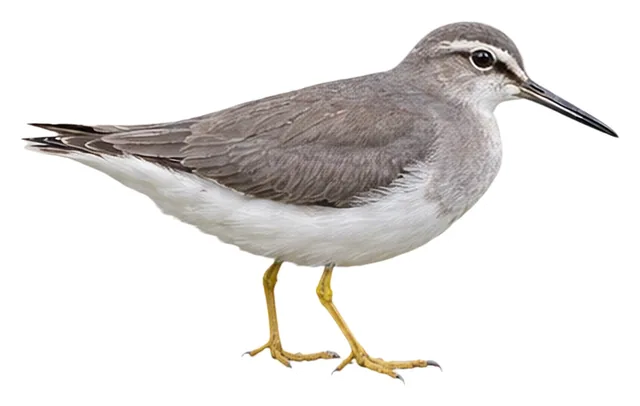
Grey-tailed Tattler
Tringa brevipes (Vieillot, 1816)
≈29 cmLength63 cmWingspan127 gWeight
This bird has gray upperparts, a white belly, short yellow legs and feet, and a two-syllable whistled call.
Most records: Australia, China, Japan
Looks like Wandering Tattler
How to identify
Field marks
- Upperparts, face and neck gray; belly white
- Legs and feet short and yellow
- Bill pale at the base and dark at the tip
- Wings and back gray and unmarked
Voice
A two-syllable whistle, rather noisy.
Similar species
Where and when it's recorded

Grey-tailed Tattler has been recorded at 516 of the 8,171 birding hotspots we track, in 37 countries and regions.
Records by month Northern Hemisphere
Where it's recorded most
- Cairns EsplanadeAustralia3,785 records
- St. Paul IslandUnited States1,484 records
- Cairns Esplanade – Southern EndAustralia924 records
More places
- Cairns Esplanade – Northern EndAustralia901 records
- Long Reef Aquatic ReserveAustralia857 records
- GambellUnited States706 records
- Dapingding and Xucuogang IBA – XucuogangTaiwan (China)703 records
- Hualien River Estuary IBATaiwan (China)620 records
- Toorbul High Tide RoostAustralia595 records
- Kinmen – Wujiang River EstuaryChina584 records
Countries and regions with the most records
eBird records via GBIF up to 2024-12-31. A record means someone listed it; more records partly mean more birders, not more birds.
About
The grey-tailed tattler (Tringa brevipes), also known as the Siberian tattler or Polynesian tattler, is a small shorebird in the genus Tringa. The English name for the tattlers refers to their noisy call. The specific brevipes is from Latin brevis, "short", and pes, "foot".
Excerpt from Wikipedia, CC BY-SA 4.0 · authors · Read more on Wikipedia
Questions
How big is the Grey-tailed Tattler?
The Grey-tailed Tattler is about ≈29 cm long, with a wingspan of 63 cm and weighs around 127 g.
Where does the Grey-tailed Tattler live?
Its breeding range: Palearctic: (mainly) subarctic tundra of north-central, northeastern Palearctic: montane Krasnoyarsk (west-central Siberia) and Yana River to Anadyr Peninsula and Kamchatka (east-central, eastern Siberia). It is most often recorded in Australia, China and Japan.
Is the Grey-tailed Tattler endangered?
The IUCN Red List classifies the Grey-tailed Tattler as Least Concern.
What does the Grey-tailed Tattler eat?
Main food: Fish, shrimp & shellfish.
What family is the Grey-tailed Tattler in?
It belongs to the family Sandpipers, Snipes (Scolopacidae), order Charadriiformes.
At a glance
- Length
- ≈29 cm
- Wingspan
- 63 cm
- Weight
- 127 g
- Habitat
- Wetland
- Diet
- Fish, shrimp & shellfish
- Lifestyle
- Active on the ground
- Migration
- Migratory
- Conservation
- Least Concern
More measurements
- Wing
- 158 mm
- Tail
- 68 mm
- Bill
- 42 mm
- Tarsus
- 33 mm
Averages from the AVONET dataset; length from field guides where available.
Range
Palearctic: (mainly) subarctic tundra of north-central, northeastern Palearctic: montane Krasnoyarsk (west-central Siberia) and Yana River to Anadyr Peninsula and Kamchatka (east-central, eastern Siberia)
Breeding range, IOC World Bird List 15.2
Classification
- Order
- Charadriiformes
- Family
- Sandpipers, Snipes Scolopacidae
- Genus
- Tringa
Other birds in the genus Tringa
 Green SandpiperTringa ochropus
 Solitary SandpiperTringa solitaria
 Wandering TattlerTringa incana
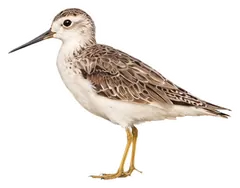 Marsh SandpiperTringa stagnatilis
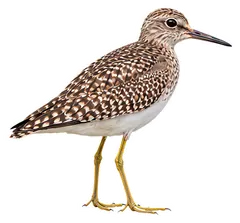 Wood SandpiperTringa glareola
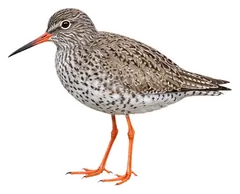 Common RedshankTringa totanus
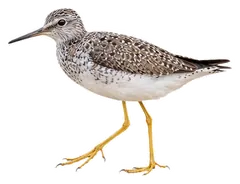 Lesser YellowlegsTringa flavipes
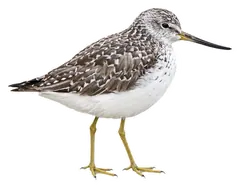 Nordmann's GreenshankTringa guttifer
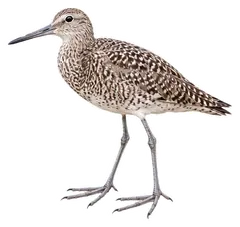 WilletTringa semipalmata
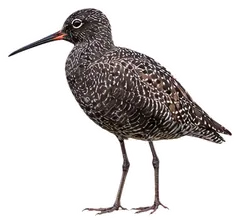 Spotted RedshankTringa erythropus
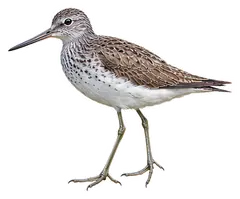 Common GreenshankTringa nebularia
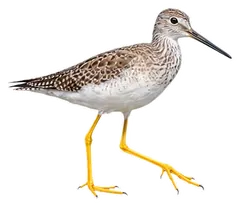 Greater YellowlegsTringa melanoleuca
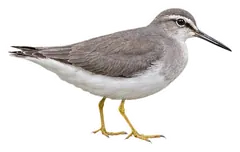
Download illustration
Free to use with credit: “Illustration: Bird Album (birdalbum.com)”. Drawn by AI from a reference photo by honan4108 on Flickr. ↗

Heard it but can't see it? Mingji identifies birds by sound and photo, on your phone.
In other languages
- EnglishGrey-tailed Tattler
- 简体中文灰尾漂鹬
- 繁體中文黃足鷸
- 日本語キアシシギ
- 한국어노랑발도요
- DeutschGrauschwanz-Wasserläufer
- FrançaisChevalier de Sibérie
- EspañolPlayero siberiano
- Portuguêsmaçarico-de-cauda-cinzenta
- ItalianoPiro piro siberiano
- NederlandsSiberische Grijze Ruiter
- РусскийСибирский пепельный улит
- Svenskasibirisk gråsnäppa
- DanskSibirisk Gråklire
- Polskibrodziec szary