 Bird Album
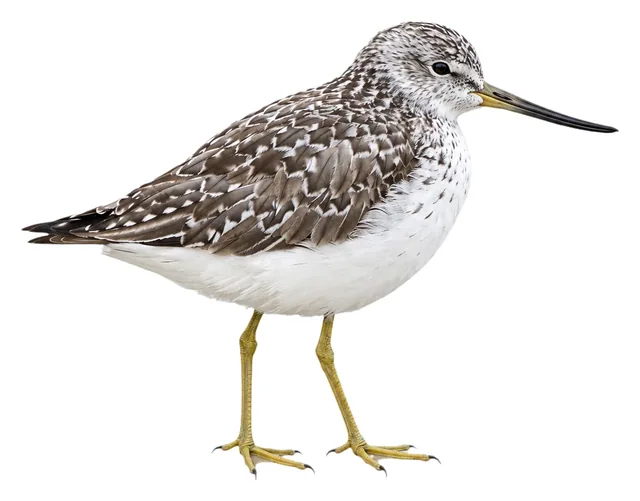
Nordmann's Greenshank
Tringa guttifer (Nordmann, 1835)
≈32 cmLength55 cmWingspan158 gWeight
This bird has a slightly upturned bill and relatively short yellow legs and feet.
Busiest months: April · Most records: China, Thailand, Australia
How to identify
Field marks
- Bill slightly upturned and two-colored
- Legs and feet yellow and relatively short
- Breeding adult has broad black crescent-shaped markings on the breast
- Breeding adult has dense streaks on the head and upper neck
Male, female and young
Chick is pale rufous, with interlacing black and dark brown stripes on the back and head.
Where and when it's recorded

Nordmann's Greenshank has been recorded at 128 of the 8,171 birding hotspots we track, in 11 countries and regions.
Records by month Northern Hemisphere
To protect this bird from disturbance, we don't list exact sites.
Countries and regions with the most records
eBird records via GBIF up to 2024-12-31. A record means someone listed it; more records partly mean more birders, not more birds.
About
Nordmann's greenshank (Tringa guttifer) or the spotted greenshank is a wader in the large family Scolopacidae, the typical waders. They are considered endangered by the International Union for Conservation of Nature (IUCN) Red List and are typically found within the East Asian-Australasian Flyway.
Excerpt from Wikipedia, CC BY-SA 4.0 · authors · Read more on Wikipedia
Questions
How big is the Nordmann's Greenshank?
The Nordmann's Greenshank is about ≈32 cm long, with a wingspan of 55 cm and weighs around 158 g.
Where does the Nordmann's Greenshank live?
Its breeding range: Palearctic: coastal larch forest of northeastern Palearctic: western, southern coastal Sea of Okhotsk, Tatar Strait (west of Sakhalin) and Sakhalin (eastern Siberia). It is most often recorded in China, Thailand and Australia.
When is the best time to see the Nordmann's Greenshank?
At the hotspots we track, it is recorded most in April (Northern Hemisphere).
Is the Nordmann's Greenshank endangered?
The IUCN Red List classifies the Nordmann's Greenshank as Endangered.
What does the Nordmann's Greenshank eat?
Main food: Fish, shrimp & shellfish.
What family is the Nordmann's Greenshank in?
It belongs to the family Sandpipers, Snipes (Scolopacidae), order Charadriiformes.
At a glance
- Length
- ≈32 cm
- Wingspan
- 55 cm
- Weight
- 158 g
- Habitat
- Coast & tidal flats
- Diet
- Fish, shrimp & shellfish
- Lifestyle
- Active on the ground
- Migration
- Migratory
- Conservation
- Endangered
More measurements
- Wing
- 171 mm
- Tail
- 61 mm
- Bill
- 57 mm
- Tarsus
- 43 mm
Averages from the AVONET dataset; length from field guides where available.
Range
Palearctic: coastal larch forest of northeastern Palearctic: western, southern coastal Sea of Okhotsk, Tatar Strait (west of Sakhalin) and Sakhalin (eastern Siberia)
Breeding range, IOC World Bird List 15.2
Classification
- Order
- Charadriiformes
- Family
- Sandpipers, Snipes Scolopacidae
- Genus
- Tringa
Other birds in the genus Tringa
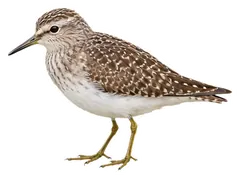 Green SandpiperTringa ochropus
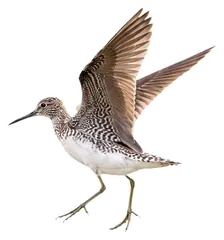 Solitary SandpiperTringa solitaria
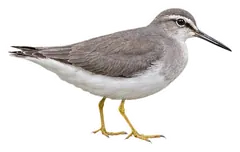 Grey-tailed TattlerTringa brevipes
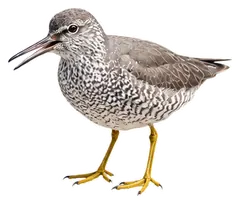 Wandering TattlerTringa incana
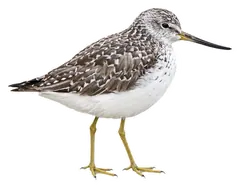
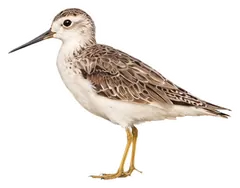 Marsh SandpiperTringa stagnatilis
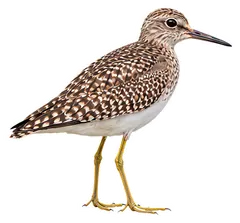 Wood SandpiperTringa glareola
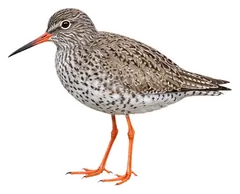 Common RedshankTringa totanus
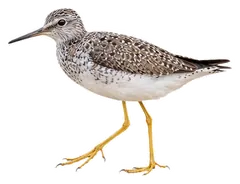 Lesser YellowlegsTringa flavipes
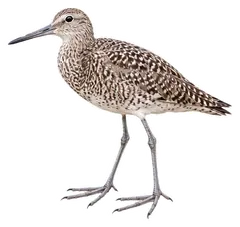 WilletTringa semipalmata
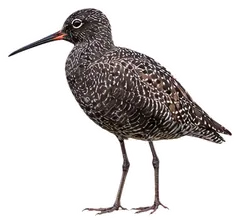 Spotted RedshankTringa erythropus
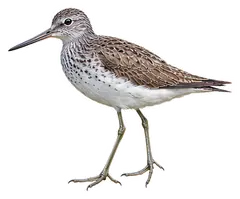 Common GreenshankTringa nebularia
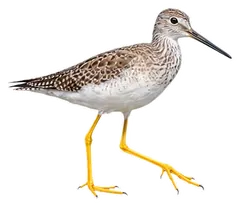 Greater YellowlegsTringa melanoleuca
Download illustration
Free to use with credit: “Illustration: Bird Album (birdalbum.com)”. Drawn by AI from a reference photo by 조흥상. ↗
Heard it but can't see it? Mingji identifies birds by sound and photo, on your phone.
In other languages
- EnglishNordmann's Greenshank
- 简体中文小青脚鹬
- 繁體中文諾氏鷸
- 日本語カラフトアオアシシギ
- 한국어청다리도요사촌
- DeutschTüpfelgrünschenkel
- FrançaisChevalier tacheté
- EspañolArchibebe moteado
- Portuguêsperna-verde-sarapintado
- ItalianoPantana di Nordmann
- NederlandsNordmanns Groenpootruiter
- РусскийОхотский улит
- Svenskaträdsnäppa
- DanskSakhalinklire
- Polskibrodziec nakrapiany