 Bird Album
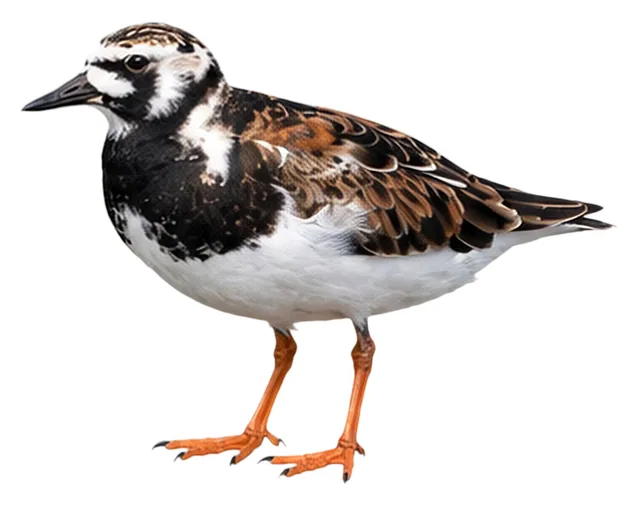
Ruddy Turnstone
Arenaria interpres (Linnaeus, 1758)
22–24 cmLength47 cmWingspan136 gWeight
It is a stocky shorebird with clown-like black-and-white markings and short orange legs, often turning stones to find food.
Busiest months: May · Most records: United States, United Kingdom, Canada
How to identify
Field marks
- Legs short and bright orange
- Head white with black facial pattern in the breeding season
- Breast black with white patches on either side in the breeding season
- Bill dark, wedge-shaped and slightly upturned
Male, female and young
Female slightly duller, with a browner, more heavily streaked head; juvenile has a pale brown head and pale feather edges on the back giving a scaly appearance.
Voice
Short, intermittent, quacking calls; chattering alarm calls are given mainly in the breeding season.
Where and when it's recorded

Ruddy Turnstone has been recorded at 2,444 of the 8,171 birding hotspots we track, in 193 countries and regions.
Records by month Northern Hemisphere
Where it's recorded most
- Fort De Soto ParkUnited States17,298 records
- Bolivar Flats Shorebird SanctuaryUnited States7,216 records
- Barnegat Lighthouse SPUnited States6,959 records
More places
- Ocean City InletUnited States6,457 records
- Titchwell Marsh RSPB ReserveUnited Kingdom5,552 records
- Huguenot Memorial City ParkUnited States5,163 records
- St. Paul IslandUnited States5,161 records
- Txingudi – PlaiaundiSpain4,643 records
- Rollover PassUnited States4,455 records
- San Carlos Bay/Bunche Beach PreserveUnited States4,429 records
Countries and regions with the most records
eBird records via GBIF up to 2024-12-31. A record means someone listed it; more records partly mean more birders, not more birds.
About
The ruddy turnstone (Arenaria interpres) is a small cosmopolitan wading bird, one of two species of turnstone in the genus Arenaria.
Excerpt from Wikipedia, CC BY-SA 4.0 · authors · Read more on Wikipedia
Questions
How big is the Ruddy Turnstone?
The Ruddy Turnstone is about 22–24 cm long, with a wingspan of 47 cm and weighs around 136 g.
Where does the Ruddy Turnstone live?
Its breeding range: North America, Palearctic: high and low Arctic tundra of coastal Holarctic. It is most often recorded in United States, United Kingdom and Canada.
When is the best time to see the Ruddy Turnstone?
At the hotspots we track, it is recorded most in May (Northern Hemisphere).
Is the Ruddy Turnstone endangered?
The IUCN Red List classifies the Ruddy Turnstone as Near Threatened.
What does the Ruddy Turnstone eat?
Main food: Fish, shrimp & shellfish.
What family is the Ruddy Turnstone in?
It belongs to the family Sandpipers, Snipes (Scolopacidae), order Charadriiformes.
At a glance
- Length
- 22–24 cm
- Wingspan
- 47 cm
- Weight
- 136 g
- Habitat
- Coast & tidal flats
- Diet
- Fish, shrimp & shellfish
- Lifestyle
- Active on the ground
- Migration
- Migratory
- Conservation
- Near Threatened
More measurements
- Wing
- 149 mm
- Tail
- 61 mm
- Bill
- 25 mm
- Tarsus
- 26 mm
Averages from the AVONET dataset; length from field guides where available.
Range
North America, Palearctic: high and low Arctic tundra of coastal Holarctic
Breeding range, IOC World Bird List 15.2
Classification
- Order
- Charadriiformes
- Family
- Sandpipers, Snipes Scolopacidae
- Genus
- Arenaria
Other birds in the genus Arenaria
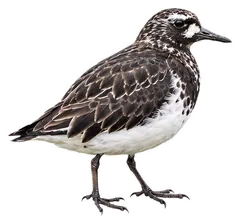 Black TurnstoneArenaria melanocephala
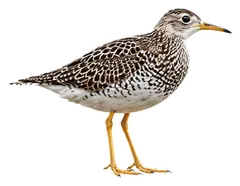 Upland SandpiperBartramia longicauda
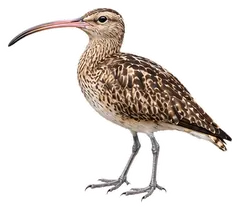 Bristle-thighed CurlewNumenius tahitiensis
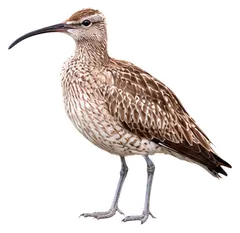 Eurasian WhimbrelNumenius phaeopus
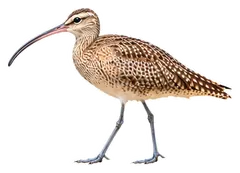 Hudsonian WhimbrelNumenius hudsonicus
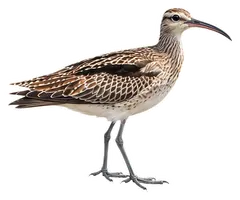 Little CurlewNumenius minutus
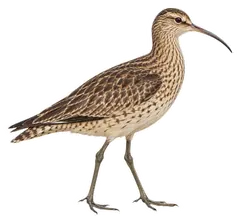 Eskimo CurlewNumenius borealis
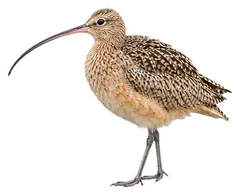 Long-billed CurlewNumenius americanus
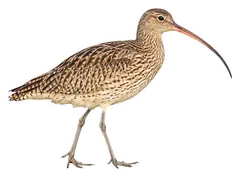 Far Eastern CurlewNumenius madagascariensis
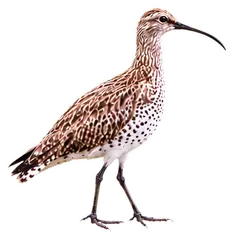 Slender-billed CurlewNumenius tenuirostris
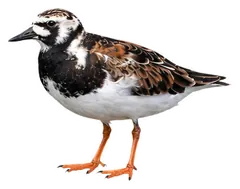
Download illustration
Free to use with credit: “Illustration: Bird Album (birdalbum.com)”. Drawn by AI from a reference photo by Chuck Homler d/b/a Focus On Wildlife. ↗

Heard it but can't see it? Mingji identifies birds by sound and photo, on your phone.