 Bird Album
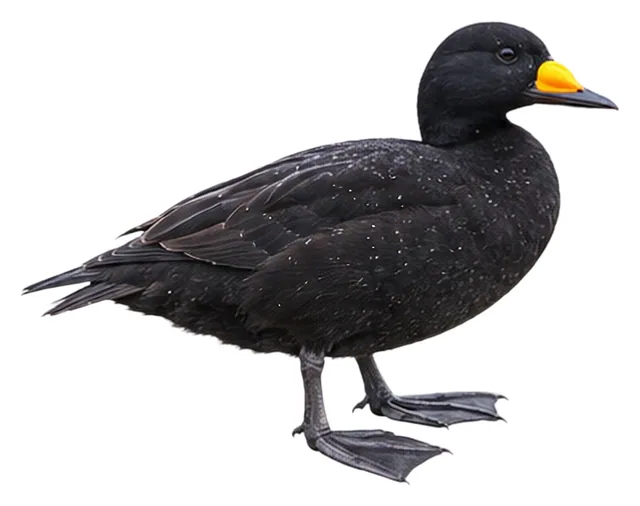
Black Scoter
Melanitta americana (Swainson, 1832)
43–49 cmLength1.1 kgWeight
The male is jet-black overall, with a large, swollen bill that is mostly yellow.
Busiest months: October–November · Most records: United States, Canada, Japan
How to identify
Field marks
- Male all black, without any white on the body
- Bill large and swollen, mostly yellow
- Compact and stocky
- Female brown with pale cheeks
Male, female and young
Male all black; female brown with pale cheeks.
Where and when it's recorded
Busiest months: October–November · Most records: United States, Canada, Japan

Black Scoter has been recorded at 410 of the 8,276 birding hotspots we track, in 16 countries and regions.
Records by month Northern Hemisphere
Where it's recorded most
- Parker River NWRUnited States7,666 records
- Cape Island – CMP – Coral Ave. dune crossingUnited States6,946 records
- Ocean City InletUnited States5,589 records
More places
- Barnegat Lighthouse SPUnited States5,362 records
- Sandy HookUnited States4,386 records
- Jones Beach SP – Coast Guard StationUnited States4,118 records
- Quai, Pointe-au-PèreCanada3,732 records
- Halibut Point SPUnited States3,594 records
- Cape Island – Cape May Point SPUnited States2,825 records
- Cape Island – South Cape May MeadowsUnited States2,732 records
Countries and regions with the most records
eBird records via GBIF up to 2024-12-31. A record means someone listed it; more records partly mean more birders, not more birds.
About
The black scoter or American scoter (Melanitta americana) is a large sea duck, 43 to 49 cm (17 to 19 in) in length. The genus name is derived from Ancient Greek melas "black" and netta "duck". The species name is from the Latin for "American".
Excerpt from Wikipedia, CC BY-SA 4.0 · authors · Read more on Wikipedia
Questions
How big is the Black Scoter?
The Black Scoter is about 43–49 cm long and weighs around 1.1 kg.
Where does the Black Scoter live?
Its breeding range: Palearctic, North America: Yana River to Kamchatka (eastern Siberia), Alaska east to northwestern Yukon; eastern Northwest Territories and southwestern Nunavut to Newfoundland (central to eastern Canada). It is most often recorded in United States, Canada and Japan.
When is the best time to see the Black Scoter?
At the hotspots we track, it is recorded most in October and November (Northern Hemisphere).
Is the Black Scoter endangered?
The IUCN Red List classifies the Black Scoter as Near Threatened.
What does the Black Scoter eat?
Main food: Fish, shrimp & shellfish.
What family is the Black Scoter in?
It belongs to the family Ducks, Geese, Swans (Anatidae), order Anseriformes.
At a glance
- Length
- 43–49 cm
- Weight
- 1.1 kg
- Habitat
- Wetland
- Diet
- Fish, shrimp & shellfish
- Lifestyle
- On the water surface
- Migration
- Migratory
- Conservation
- Near Threatened
More measurements
- Wing
- 220 mm
- Tail
- 75 mm
- Bill
- 45 mm
- Tarsus
- 40 mm
Averages from the AVONET dataset; length from field guides where available.
Range
Palearctic, North America: Yana River to Kamchatka (eastern Siberia), Alaska east to northwestern Yukon; eastern Northwest Territories and southwestern Nunavut to Newfoundland (central to eastern Canada)
Breeding range, IOC World Bird List 15.2
Classification
- Order
- Anseriformes
- Family
- Ducks, Geese, Swans Anatidae
- Genus
- Melanitta
Other birds in the genus Melanitta
 Surf ScoterMelanitta perspicillata
 Velvet ScoterMelanitta fusca
 White-winged ScoterMelanitta deglandi
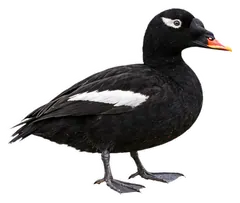 Stejneger's ScoterMelanitta stejnegeri
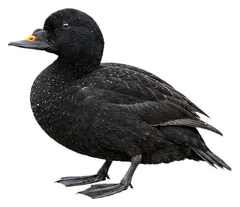 Common ScoterMelanitta nigra
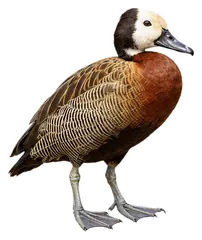 White-faced Whistling DuckDendrocygna viduata
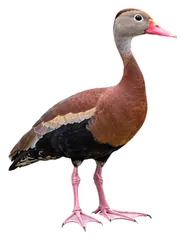 Black-bellied Whistling DuckDendrocygna autumnalis
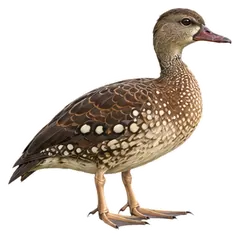 Spotted Whistling DuckDendrocygna guttata
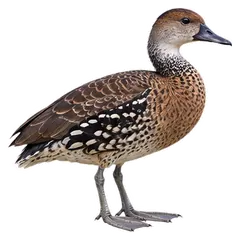 West Indian Whistling DuckDendrocygna arborea
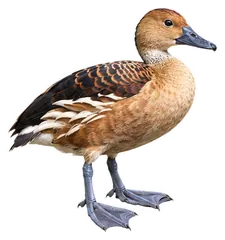 Fulvous Whistling DuckDendrocygna bicolor
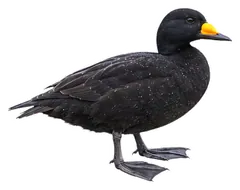
Download illustration
Free to use with credit: “Illustration: Bird Album (birdalbum.com)”. Drawn by AI from a reference photo by Radd Icenoggle. ↗
Heard it but can't see it? Mingji identifies birds by sound and photo, on your phone.
In other languages
- EnglishBlack Scoter
- 简体中文黑海番鸭
- 繁體中文美洲黑海番鴨
- 日本語クロガモ
- 한국어검둥오리
- DeutschPazifiktrauerente
- FrançaisMacreuse à bec jaune
- EspañolNegrón americano
- Portuguêsnegrola-americana
- ItalianoOrchetto marino americano
- NederlandsAmerikaanse Zee-eend
- РусскийАмериканская синьга
- Svenskaamerikansk sjöorre
- DanskAmerikansk Sortand
- Polskimarkaczka amerykańska