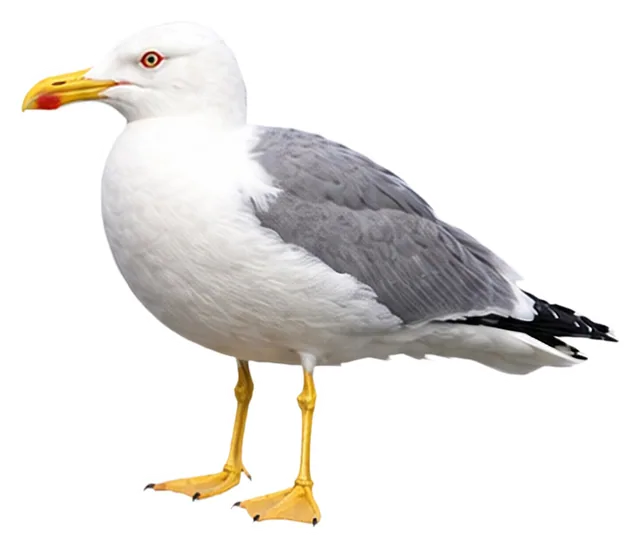
Yellow-legged Gull
Larus michahellis Naumann, JF, 1840
1.1 kgWeight
The yellow-legged gull or western yellow-legged gull (Larus michahellis) is a large gull found in Europe, the Middle East and North Africa, which has only recently achieved wide recognition as a distinct species.
Busiest months: April–May and September–October · Most records: Spain, Portugal, United Kingdom
Where and when it's recorded
Busiest months: April–May and September–October · Most records: Spain, Portugal, United Kingdom

Yellow-legged Gull has been recorded at 905 of the 8,276 birding hotspots we track, in 60 countries and regions.
Records by month Northern Hemisphere
Where it's recorded most
- Desembocadura del Guadalhorce – ÁreaSpain5,330 records
- Txingudi – PlaiaundiSpain5,248 records
- Urdaibai RB – bird center y laguna de OruetaSpain3,541 records
More places
- Balsa de Zolina/EzkorizSpain3,412 records
- PN Sintra-Cascais – Cabo RasoPortugal3,073 records
- Lagoa dos SalgadosPortugal2,816 records
- RNL Estuário do Douro – área geralPortugal2,658 records
- PN Sudoeste Alentejano e Costa Vicentina – Cabo de São VicentePortugal2,344 records
- Paul do Cabo da PraiaPortugal2,303 records
- El Estrecho PNat – Los LancesSpain2,065 records
Countries and regions with the most records
eBird records via GBIF up to 2024-12-31. A record means someone listed it; more records partly mean more birders, not more birds.
About
The yellow-legged gull or western yellow-legged gull (Larus michahellis) is a large gull found in Europe, the Middle East and North Africa, which has only recently achieved wide recognition as a distinct species. It was formerly treated as a subspecies of either the Caspian gull L. cachinnans, or more broadly as a subspecies of the herring gull L. argentatus.
Excerpt from Wikipedia, CC BY-SA 4.0 · authors · Read more on Wikipedia
Questions
How big is the Yellow-legged Gull?
The Yellow-legged Gull weighs around 1.1 kg.
Where does the Yellow-legged Gull live?
Its breeding range: Palearctic: coastal and inland southern, western, central Europe, Macaronesia, Mediterranean and northwestern Africa. It is most often recorded in Spain, Portugal and United Kingdom.
When is the best time to see the Yellow-legged Gull?
At the hotspots we track, it is recorded most in April, May, September and October (Northern Hemisphere).
Is the Yellow-legged Gull endangered?
The IUCN Red List classifies the Yellow-legged Gull as Least Concern.
What does the Yellow-legged Gull eat?
Main food: Fish, shrimp & shellfish.
What family is the Yellow-legged Gull in?
It belongs to the family Gulls, Terns, Skimmers (Laridae), order Charadriiformes.
At a glance
- Weight
- 1.1 kg
- Habitat
- Coast & tidal flats
- Diet
- Fish, shrimp & shellfish
- Lifestyle
- Varied
- Migration
- Partial migrant
- Conservation
- Least Concern
More measurements
- Wing
- 423 mm
- Tail
- 163 mm
- Bill
- 68 mm
- Tarsus
- 66 mm
Averages from the AVONET dataset; length from field guides where available.
Range
Palearctic: coastal and inland southern, western, central Europe, Macaronesia, Mediterranean and northwestern Africa
Breeding range, IOC World Bird List 15.2
Classification
- Order
- Charadriiformes
- Family
- Gulls, Terns, Skimmers Laridae
- Genus
- Larus
Other birds in the genus Larus
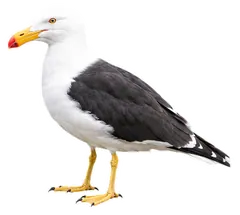 Pacific GullLarus pacificus
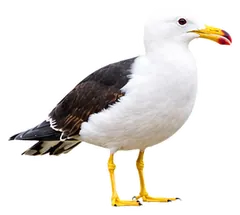 Belcher's GullLarus belcheri
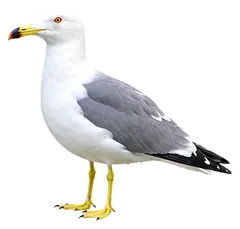 Black-tailed GullLarus crassirostris
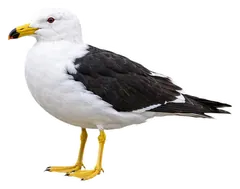 Olrog's GullLarus atlanticus
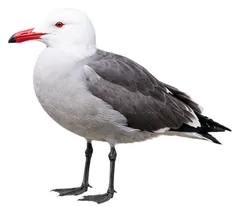 Heermann's GullLarus heermanni
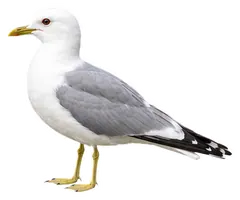 Common GullLarus canus
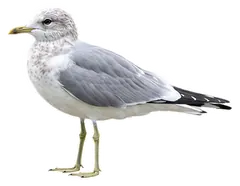 Short-billed GullLarus brachyrhynchus
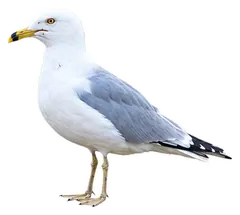 Ring-billed GullLarus delawarensis
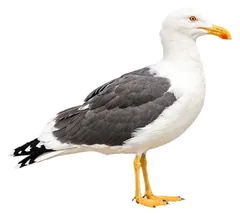 Yellow-footed GullLarus livens
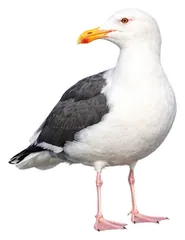 Western GullLarus occidentalis
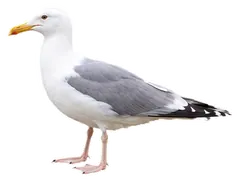 Caspian GullLarus cachinnans
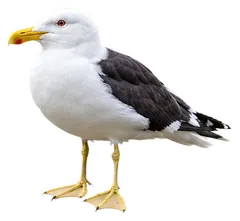 Kelp GullLarus dominicanus
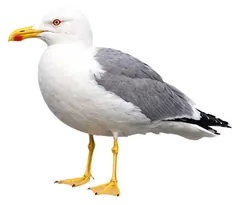
Download illustration
Free to use with credit: “Illustration: Bird Album (birdalbum.com)”. Drawn by AI from a reference photo by Jörg Hempel. ↗
Heard it but can't see it? Mingji identifies birds by sound and photo, on your phone.