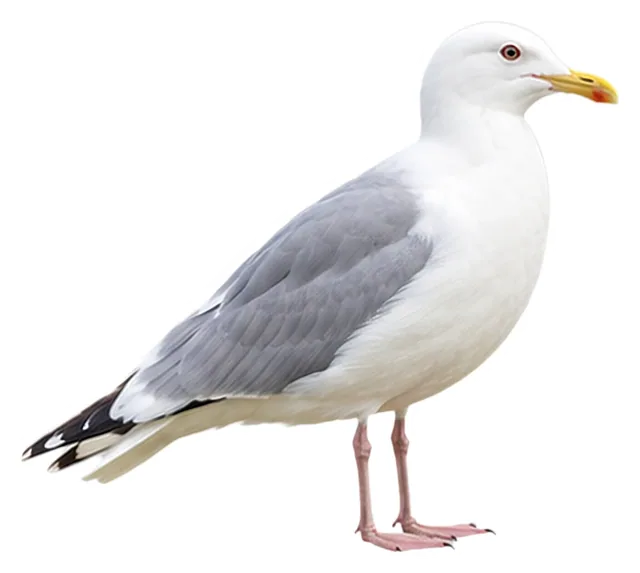
Vega Gull
Larus vegae Palmén, 1887
It is a large gull resembling European Herring Gull, with a slightly darker gray back and usually bright pink legs.
Busiest months: May–June and September · Most records: United States, South Korea, Japan
Looks like Mongolian Gull, Slaty-backed Gull
How to identify
Field marks
- Back slightly darker gray than in European Herring Gull
- Legs usually bright pink
- Adult bill yellow with a single red spot
- Head and neck densely marked with rufous stripes in winter, forming a collar
Male, female and young
First- and second-winter immatures have dark brown spots and stripes over almost the entire body. The bill may be almost entirely dark gray to black, with the gray gradually decreasing as they mature.
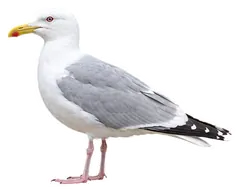
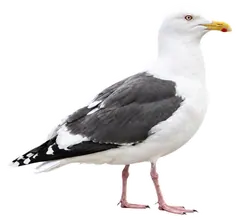
Similar species
Where and when it's recorded
Busiest months: May–June and September · Most records: United States, South Korea, Japan

Vega Gull has been recorded at 347 of the 8,276 birding hotspots we track, in 6 countries and regions.
Records by month Northern Hemisphere
Where it's recorded most
- GambellUnited States5,407 records
- St. Paul IslandUnited States1,117 records
- Edogawa Ward – Kasai Rinkai Park / Kasai Kaihin ParkJapan334 records
More places
- MeynypilgynoRussia248 records
- Funabashi – Funabashi Sanbanze Seaside ParkJapan170 records
- Choshi – Choshi PortJapan155 records
- Mai Po Nature ReserveHong Kong (China)131 records
- Aogu Wetland IBATaiwan (China)123 records
- Seoul – Gangseo Wetland Eco ParkSouth Korea94 records
- Nanhui DongtanChina88 records
Countries and regions with the most records
eBird records via GBIF up to 2024-12-31. A record means someone listed it; more records partly mean more birders, not more birds.
About
The Vega gull, East Siberian gull, or East Siberian herring gull (Larus vegae) is a large gull of the herring gull/lesser black-backed gull complex which breeds in Northeast Asia. Its classification is still controversial and uncertain. It is variously treated as a separate species, as a subspecies of the American herring gull (L. smithsonianus) or included with both the American herring gull and European herring gull in L. argentatus.
Excerpt from Wikipedia, CC BY-SA 4.0 · authors · Read more on Wikipedia
Questions
Where does the Vega Gull live?
Its breeding range: Palearctic: Arctic central, eastern Siberia from Taimyr to Chukotka, New Siberian Islands (far north-central Russia) and St. Lawrence Island (northern Bering Sea). It is most often recorded in United States, South Korea and Japan.
When is the best time to see the Vega Gull?
At the hotspots we track, it is recorded most in May, June and September (Northern Hemisphere).
What family is the Vega Gull in?
It belongs to the family Gulls, Terns, Skimmers (Laridae), order Charadriiformes.
Range
Palearctic: Arctic central, eastern Siberia from Taimyr to Chukotka, New Siberian Islands (far north-central Russia) and St. Lawrence Island (northern Bering Sea)
Breeding range, IOC World Bird List 15.2
Classification
- Order
- Charadriiformes
- Family
- Gulls, Terns, Skimmers Laridae
- Genus
- Larus
Other birds in the genus Larus
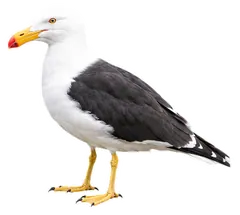 Pacific GullLarus pacificus
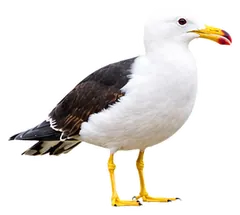 Belcher's GullLarus belcheri
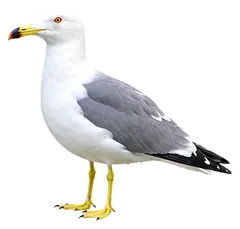 Black-tailed GullLarus crassirostris
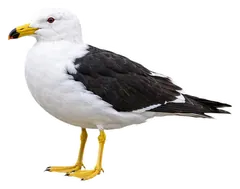 Olrog's GullLarus atlanticus
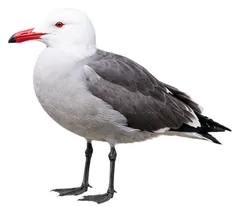 Heermann's GullLarus heermanni
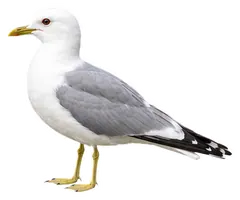 Common GullLarus canus
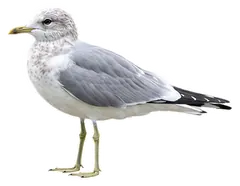 Short-billed GullLarus brachyrhynchus
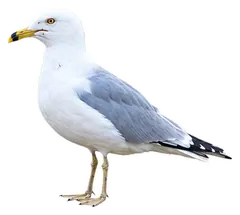 Ring-billed GullLarus delawarensis
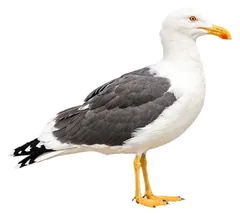 Yellow-footed GullLarus livens
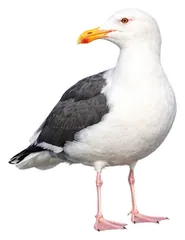 Western GullLarus occidentalis
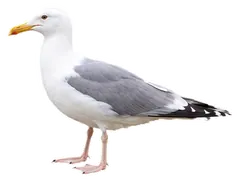 Caspian GullLarus cachinnans
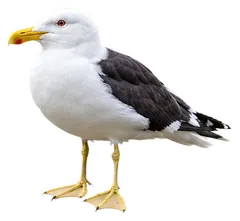 Kelp GullLarus dominicanus
Download illustration
Free to use with credit: “Illustration: Bird Album (birdalbum.com)”. Drawn by AI from a reference photo by Doctor Digger Shrew …. ↗

Heard it but can't see it? Mingji identifies birds by sound and photo, on your phone.